Manabu Yamanaka’s Gyahtei, published earlier this Fall, brings together Yamanaka’s six major series focusing on societal outcasts, including street children, homeless, the physically deformed, and the elderly. Working in a similar vein for over 25 years, each series might take up to four to five years to complete. Yamanaka doesn’t just bring his subjects into a studio but chooses to immerse himself in the milieu of his subjects and their living conditions before ever setting up his camera.
Yamanaka’s working methods, as well as the consistency of purpose and style he approaches his subjects with, clearly show that he doesn’t take his project lightly, nor is he interested in a quick hit of shock. In a 2005 interview, Yamanaka talked about his working process:
First of all, I decide on a subject for a project and then study and research the subject. And the next step is planning out picture composition [while] at the same time scouting, casting, and thinking about the other details. Finally, I start the new project if I convince myself that all of the above is in place. Usually it is not so easy, so I’m constantly making changes. I always find the appropriate way of shooting after I start. I believe that there is always a way through a difficult project.
The title Gyahtei as well as other series’ titles all originate from Buddhism. Even though Yamanaka has said he is not a practicing Buddhist, he does “always hope that I gain more understanding of Buddhism every time I finish a project. In other words, I show my work as a consequence of my understanding on the theme of the project.”
Manabu Yamanaka’s photographs are often referred to as disturbing, or unnerving, but perhaps that faint praise says more about the viewer than it comments on the actual work, the subjects of the photos, or the photographer’s intentions. In the way that some people peek through their fingers at horror films, labeling Yamanaka’s work as disturbing seems a defense mechanism, a way of distancing oneself from the visceral realization that what separates the viewers’ reality from that of Yamanaka’s subjects is what the Japanese call ç´™ä¸€é‡ (kami hitoe) — a fine line. That Yamanaka can bring us so uncomfortably close to confronting that which we take for granted, and our corporeality and mortality, in the reserved and respectful manner that he does, might be one reason why the photographer Kyoichi Tsuzuki called Yamanaka the most “hardcore” of all Japanese photographers working today.
Japan Exposures is honored to have the opportunity to present to our readers the following introduction to Manabu Yamanaka’s work. Please also see our current Cover Photo featuring Yamanaka.
Manabu Yamanaka: Wu Kong #19
Manabu Yamanaka: Wu-Kong-#01
Manabu Yamanaka: Jyoudo #03
Manabu Yamanaka: Jyoudo #13
Manabu Yamanaka: Dohshi #03
Manabu Yamanaka: Dohshi #09
Manabu Yamanaka: Gyahtei #14
Manabu Yamanaka: Gyahtei-#09
Manabu Yamanaka: Arakan #01
Manabu Yamanaka: Arakan #13
More of Yamanaka’s work can be seen at his website, including some brief writings about each series. A report on him in Japanese can be found here.
Earlier this year, a friend mentioned to me that he’d recently seen an award-winning show at the Konica Minolta gallery. It had apparently made a real impression on him, so when I next found myself in Shinjuku I decided to stop by. As it turned out, the show was “Asadake” by Masashi Asada, who won the 31st career-making Kimura Ihei Award. (Hiromix and Rinko Kawauchi are two recent winners whose names may be familiar to readers.)
Having only recalled a bit of my friend’s description — something about family — I didn’t really know what to expect. Walking in to the room I saw about 15 or 20 large color prints, with no clear visual order. I remember thinking to myself: “what am I looking at?” Even looking at the first print, I couldn’t process the image properly. Why was it so big? Who were those people? Why were they in a ramen shop? Who takes a large format camera to a ramen shop anyway? And why was the woman in the corner giving the camera such a strange, knowing smile?
“I couldn’t process the image properly. Who were those people? Why were they in a ramen shop? Who takes a large format camera to a ramen shop anyway?â€
Soon I remembered the concept behind the show: Asada takes portraits of his family (in Japanese, the “Asadake”) in highly staged situations, often engaged in activities that would have some resonance for a Japanese audience: working at a ramen shop, gathering at a school assembly, campaigning for votes in a white van, and so on. (It’s worth noting that others are less specifically Japanese, like playing in a rock band, reporting a news story on TV, or fixing up a car.)
It seems to me that the intent of using these activities is not to comment on contemporary Japanese culture, as they’re never scrutinized in any serious way. Rather, they are a medium through which Asada can heighten the feeling of his portraits. Using these artificial situations brings out the personalities of the members of his family, and also creates a relationship between the work and its audience.
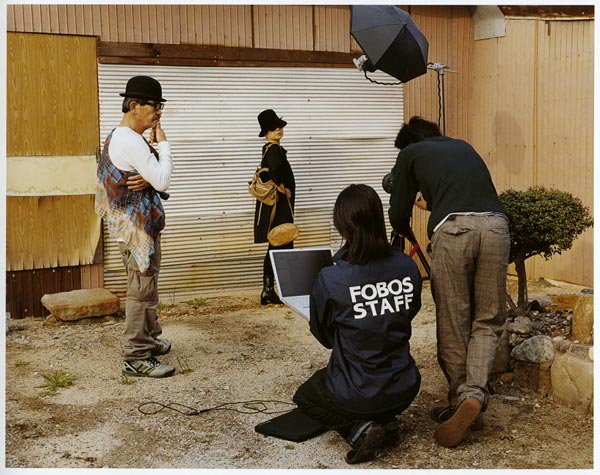
Masashi Asada, from Asadake (2008)To create these portraits, Asada had to put his family into some fairly strange situations. For example, how often do you pretend to be on the set of a fashion shoot with your family? The obvious relish with which Asada’s parents (an older couple) tear into their roles in this image is what makes it work. As a model being photographed, the mother wears a glamorous all black outfit, and two gaudy purses more likely to be found on a woman at least half her age. She affects an almost contemptous look, while the father, an art director, sports a bowler hat, a ludicrous shawl of some sort, and a posture that suggests, “I’m thinking very deeply about what’s going on here.†Throughout the work, the audience finds the family wearing silly outfits, or pretending to be something they’re obviously not. This reveals the person to the audience—the mother’s come-hither pose communicates something tangible about her ability to take herself seriously. Depending on the situation, there can be genuine feelings of humor, warmth, or seriousness in the way that the subject approaches their role. This feeling breaks through the artificial conceit of the scene.
Masashi Asada, from Asadake (2008)Asada’s work makes it easy for the audience to establish a relationship with his family. Although the scenes are obviously staged—and there can only be an initial, fleeting doubt about this—they play a small but useful trick on the audience. In an uncanny way, it’s as if the audience already knows them from the beginning: here are the farmers you see when you visit your grandma in the countryside, here are the drunk office workers you see around midnight, here is the staff at your local ramen shop. Taking an American audience, for example, scenes at a drive-through fast food restaurant, a high school football game, or the parking lot of a big box retailer could produce the same effect. Even if you don’t love those things, they would be immediately recognizable in the way that a white political campaign van will be recognizable to anyone who lives in Japan. Asada effectively removes a barrier to identification with his subjects by placing them in these situations.
Masashi Asada, from Asadake (2008)The charm of “Asadake” is that it seems as though everyone could be about to break into laughter. This is actually the case in the ramen shop photo, where the mother gives the camera a sly grin, but it’s even more pronounced in the political campaign van photo, where everyone is cracking up. Each person shows the role they are playing, but they show themselves as well. It’s not a surprise that this image got quite a lot of attention at the gallery, where people would come up to it and share in the absurdly joyous moment.
Masashi Asada, from Asadake (2008)The audience at the Konica Minolta exhibition was certainly in tune with the humor running through Asadake. Almost without fail, people walking into the gallery would stop for a few seconds, figure out what was going on, and then laugh all the way through the series. The feeling of walking through an exhibition where most people were laughing, gesturing at a photo, or calling a friend over to see something outrageous was certainly much different than most photography exhibits I’ve seen. In such an atmosphere, it was hard to not feel close to the subjects of the work. I haven’t ever heard of such a thing, but the exhibit felt like a getting-to-know-you party for the Asadas.
You can purchase a copy of Asadake (The Asadas) in the Japan Exposures Bookstore.
Dan Abbe lives in Tokyo and writes a blog about photography called Street Level Japan.
Never meet your heroes — or so they say. Those who do live on to tell the tale. About twenty years ago, I remember it being a cold winter’s day as I once more browsed the photography section of the public library in central Frankfurt, Germany. My interest in the medium was just firming, and like all of us I was trying to take in as much as I could, on technique and on the art. I knew little about the ‘masters’, much less about Japan and its contributions. Nonetheless, I found myself strongly attracted to a book by a photographer, whose name I was not even sure how to pronounce; it meant nothing to me at the time and yet for quite a while afterwards, when being asked, I would name him as my favourite photographic artist. The book was called Embrace by Eikoh Hosoe.
Last week Japan Exposures were invited to the launch of a new book by Hosoe titled Hana Dorobou (「花泥棒ã€, lit. Flower Thief). Of course, given my own first encounter of many years ago, I was delighted to finally meet him all this time later. And, as it turned out, it was not a connection of past and present only for me: even though the book has just been published, the photographs themselves date back over 40 years.
“She presented to Hosoe a series of her handmade dolls and told him, ‘Do with them what you want’.â€
In 1966, Eikoh Hosoe was introduced by his sister-in-law, the photographer Hisae Imai — who passed away earlier this year — to women’s undergarment designer Yoko Kamoi (1925-1991). By that time, Kamoi was well-known in artist and fashion circles for revolutionizing the undergarments Japanese women wore, and was once described as “someone who has advanced the cause of women’s liberation through her underwear designs”. But beyond this, Kamoi was an essayist, an exhibited painter, and — pertinent to this new book — a maker of handmade dolls.
She presented to Hosoe a series of her handmade dolls and told him, “Do with them what you want.” For Hosoe, they were more human than doll, and they seemed to take a life of their own, the scenes he eventually photographed them in seemingly situtations these dolls were getting themselves into — or so Hosoe felt, so strong was their human-like nature.
Hosoe photographed these situations around his studio in Yotsuya, Tokyo, and even took the dolls — more companions than props — on trips to Aomori and Nagano.
The photos were eventually used to illustrate a small book of Kamoi’s underwear designs called Miss Petan, but only 300 of these were printed. Hosoe would go on to make Kamaitachi (1968) and Embrace (1971), and promptly forgot about the project until earlier this decade when someone found a copy of this long out-of-print book and reminded Hosoe of the project. Digging up the negatives, he realized he had completely forgotten about this project. Thanks to the perseverance of publisher Tosei-Sha’s Kunihiro Takahashi, the negatives were reprinted and assembled in this book, which Hosoe considers, as he writes in the book’s afterword, a gift to both Imai and Kamoi who have reached heaven before him.
Hosoe and Tosei-sha’s TakahashiE. Hosoe and Dirk in conversation
Of course a good opening event should be more than having a few drinks and snacks in a gallery space with the artist present. Hosoe was keen to explain some of his philosophy to the audience, what he is occupied with right now and what is still to be done. As the director of Kiyosato Museum of Photographic Arts and his role in the Japan Professional Photographers Society, Hosoe was keen to emphasize the importance of nurturing young talent for the photographic arts. He lamented that unlike in other countries, in Japan photography is not part of art education in schools and went on to say that a country not involved in manufacturing photography equipment such as cameras appears to have greater creative potential than one which does. In Japan, the ultimate camera manufacturing super-power of today, there is simply too much emphasis on the technical aspects of photography and not enough attention paid to the creative side. Obviously the endless obsession with equipment is a challenge we are all only too familiar with. He called upon giving up the Kingdom of Cameras and move towards establishing an artistic Kingdom of Photography .
For this to occur, making the younger generation sensitive to the world and role of photography is absolutely key. However, how to go about it? One of the many possible ways to do so are photo books aimed at children, which there are only very few of. In fact, I could only think of a single one: Hosoe’s own Taka-chan and I: a Dog’s Journey to Japan, now long out of print. On the night I asked him whether he is aware of any other photo books aimed at children, and apart from the classic Show Me by Will McBride he also could not think of any and immediately added that he would love to create one.
Even though Hana Dorobou is not directly aimed at children, the images are magical and not quite of this world. Like in other Hosoe works, reality and the dream world appear to be merging, and in this case in an entirely benign and bright manner. While some of the images could be interpreted by adults as unsettling, I think this says more about the lost innocence of our own minds than the suitability of the photos for children. Or would a comparison to Grimm-style fairy tales be too far off? The dolls in odd spaces such as a broken television set or crammed into a travel bag, floating in the air or hanging in trees, or just the subtle signs of human nudity of the dolls make for good picture book quality that a child would enjoy and should easily be able to deal with, especially when viewed together with an adult. Make no mistake, the qualities of the photos are not naïve or too lighthearted by far. These images carry the typical Hosoe flair we know from so many of his works, but here we can also detect a playfulness that makes them accessible to not just an adult audience.
Hana Dorobou, created 40 years ago, and yet new today. An artist enjoyed by me 20 years ago and met in person last week. The creators of tomorrow being shown a fantasy world conceived by a spirit which has already passed. Photography and time, this eternally bonded pair, with moments that last a fraction of a second, and yet for all time.
It’s small, light, bears a quality name and there is a lot of plastic involved: welcome to the Yashica EZ Digital F521, a camera released in Japan yesterday with a price tag just around US$100 (click here to purchase).
Don’t let the big name “fool you” though, this is an inexpensive digital camera that has more in common with a cellular phone camera (with a different form factor of course) than state-of-the-art digital, just like toy cameras using 120 film don’t do so to achieve high quality medium format. For this reason, the F521 has already been dubbed “Digital Holga” even before its release.
Limitations and shortcomings in your equipment can be good for creativity and there are plenty of those present here. However, given the targeted audience and market segment it would be unfair to point them out as weaknesses on this quirky snapper. Shutter lag, dynamic range, limited configuration options and viewfinder accuracy (mainly parallax) to name just a few aspects. Nonetheless, there is enough potential to charm you anyway, if you like the idea of a toy camera. There does not seem an actual shutter rather than the exposures done by the sensor. Since the lens assembly is fixed onto the body from the front by several screws, there might be some hacking potential by replacing the lens with something else, if you are so inclined.
Please have a look at the brief video review containing further details and sample images with comments. More images can also be found on Flickr and a Flickr group dedicated to the F521 has also been set up.
An alternative, more detailed review can be found here.
The Yashica EZ Digital F521 is available to order in the Japan Exposures Web Shop, shipments are scheduled for next week.
Everyone I showed Slowly Down The River casually over drinks or at a dinner table, when there is no time to read the introduction, immediately assumed that these photos were taken in a war zone, after an earthquake or other catastrophic event. How better to arouse a viewer’s curiosity by taking expectations for a ride? Photographer Yasuhiro Ogawa scores for a comfortable lead before the match has even started — and it will get even better.
The premature conclusion is not without reason. Images of damaged buildings, people passing or standing on rubble, heavy construction equipment at work, steel enforcement rods in concrete sticking out, streets being cleared of debris, sometimes even smoke rising into the skies. The pictures often ressemble the photographs from Sarajevo or Beirut; is it because photojournalism from these types of events has become so formulaic and predictable making us easily jump at conclusions based on initial visual impressions? A very interesting question, but surely a topic for another discussion.
The scenes depicted in this superbly edited book are indeed of an event of catastrophic proportions, except that the cause is entirely man-made and intentional. What we see here is evidence of demolition of towns and resettlement of their populations during the process of construction of the Three Gorges Dam that spans the Yangtze River. To create this enormous hydro-electric power generating project of truly epic proportions, a vast area giving home to 1.24 million people and including archaeological and cultural sites was flooded and entire towns demolished and subsequently submerged in water. The controversy around this project was widely reported over the last ten years, but here someone has gone out to record what the effect is on the people affected by it.
“The tension rises slowly, very slowly, but its devastating impact will be inevitable.â€
Looking over the pictures repeatedly, one cannot escape an underlying quiet, deep and discomfortable tension emitting from the photos. This is exercabated by the fact that this not a sudden, big bang event. The tension rises slowly, very slowly, but its devastating impact will be inevitable, just as the continuously rising water levels. There is no battle to fight, no courage to show, no refuge or shelter to seek. It is the most despairing of confrontations, not unlike a cold war with the difference that its outcome is already decided when it starts — undoubtedly an unbearable fate. The consequence is to internalize the conflict, transforming it to a battle of the mind, and here within the mind only, and in this series Ogawa has totally succeeded in turning the invisible into something visual by means of his photographs. Yet one should not expect anything literal. Using a 35mm handheld camera the pictures show a ethereal quality, one could say a dream within a nightmare. These highly pregnant, often grainy and shadowy images flow by the viewer, like the passing of man-made history or of the river itself, continuously swelling. What at times may even appear as a romantic boat journey through China will slowly enter the reader’s mind and become clearer until full comprehension.
After a while I found myself searching for any signs of optimism in the photos. Some flowers perhaps, or children playing. There is nothing of this. The people depicted all seem to have the same the same leaden facial expression. The single laughing face in the book belongs to an old lady, and we don’t know whether it is laughter of joy or the sign of oncoming insanity.
The work effortlessly transcends the too common classification of photography. Is it art, is it documentary? It just does not seem to matter. Slowly Down The River, which was nominated for the 2006 Leica Oskar Barnack Award, is a very sensitive and personal account of the photographer’s encounter with the land, its people and the immense burden of a larger scale history weighing down on them. History that, we know, just continues to repeating itself.
A marvellous photo book.
Yasuhiro Ogawa was born in 1968 in Kanagawa prefecture, Japan. He started to take pictures at the age of 24, influenced by the work of Sebastiao Salgado. The first exhibition titled “Futashika-na-Chizu” was held at Ginza Kodak Photo-salon,Tokyo, in 1999. In 2000, won the 37th Taiyo award for that work. Since then, his work has appeared in many publications in Japan. In 2009, he won The Photographic Society of Japan Newcomer Award. In 2006 he was nominated for the Leica Oskar Barnack Award.
More images can be found on his website and on Flickr.
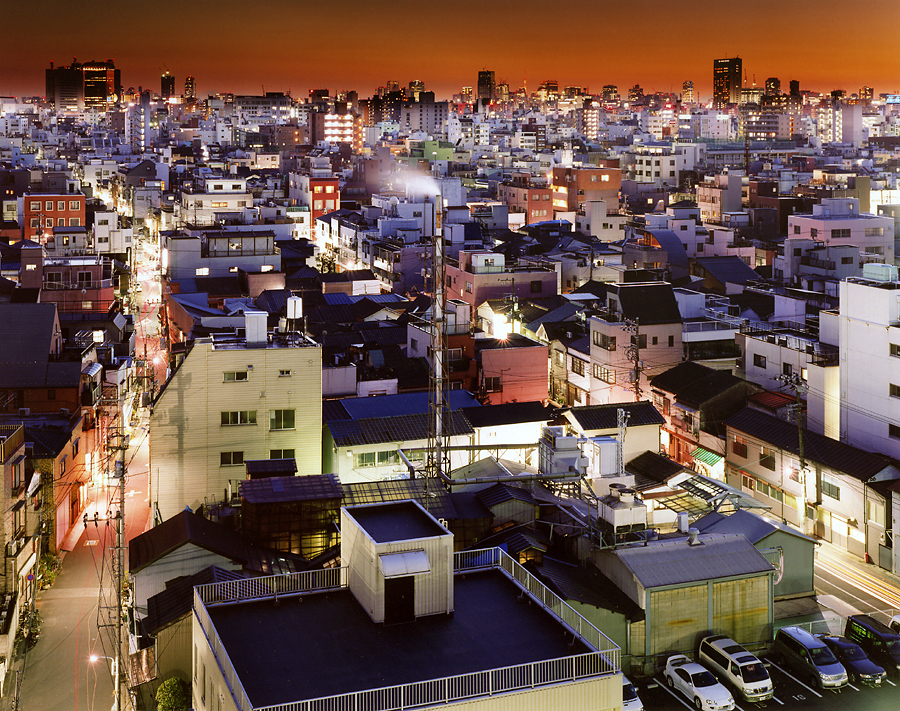
At first glance, the cityscape photos of Shintaro Sato seem to belong to that cliche of Tokyo as the hyperreal, super cool metropolis à la Blade Runner. Here is the great metropolis, tantalizingly beautiful in the twilight of the day, slowly succumbing to the neon-fueled incandescence of night. But to reduce Sato’s work to fulfilling this fantasy is a bit like not being able to see the city for the skyscrapers.
What is remarkable about Sato’s cityscapes is not merely that they escape cliche, but that they do so while also confounding our expectations about cityscapes themselves. Sure the skylines are there, teeming against the backdrop of the sun’s aftermath or the occasional fireworks burst, but what makes his photographs so rich and inviting of repeated viewings is that Sato has deftly managed, from the various 10th floor fire escapes that serve as his observation deck, to hitch the grandeur of these distant vistas to the here and now of a lived, real city of parking lots, public housing complexes, cellular antennas, rooftop air ventilators, apartment buildings and single-family homes, to say nothing of the palpable if unseen presence of the millions that call Tokyo home. To paraphrase the famous tagline, there are 12 million stories in the city of Sato’s birth, and in Sato’s Tokyo Twilight Zone, we get to see a few of them.
Japan Exposures is pleased to present the following extended interview with Sato, conducted earlier this year on the occasion of Sato being awarded the Newcomer’s Award from the Photographic Society of Japan. Sato talks to us about what it is that attracts him to photographing Tokyo, how he got started in photography, and the challenges of being a “house husband”, in addition to talking about his current work-in-progress revolving around the Tokyo Sky Tree broadcasting tower now being built.
Please also see our Cover Photo from Sato, taken from his “Tokyo Sky Tree” series.
Japan Exposures: Can you talk about when you first became interested in photography.
Shintaro Sato: In high school. I saw pictures by Keizo Kitajima in a magazine. At that time, I was not so fascinated with art, I was on the judo team, etc., but his photos were good. And after I graduated high school, I was fascinated with Shinya Fujiwara’s photos from India. Those two photographers fascinated me.
JE: And so then after high school you went to…..
SS: Of course I took some photos, but I only started shooting seriously after I entered school. I was there for three years. But my third year of photography school was also my first year at Waseda University. I wanted to study literature there.
JE: How was the photography school important to you?
SS: I got acquainted with many young photographers, many young students, which was inspiring for me. The way of looking at things was important, and I had some good teachers who taught me different ways to see things. It was at that time that I started to take pictures of the town.
JE: So quite early you were interested in the city and cityscapes.
SS: Yes, but before that I was taking very girly pictures, like flowers and wet roads. [laughs]
JE: After graduating from Waseda, you went to work at Kyodo News. You worked there for 7 years, correct?
SS: Yes. At first I worked with writers in the culture section, and so I would meet and shoot many artists, TV personalities, actresses, etc., that were being interviewed. It was good, but after four or five years, I got transferred to the news section. The job then became difficult. In the news section I took pictures of everything from baseball to accidents and murders.
JE: So you left?
SS: Yes. I didn’t like news photography. It was hard work, and it took most of my time. I didn’t have any time leftover to focus on my own personal work.
JE: Could you talk a little bit about your first book, Night Lights, which was published in 2000.
SS: This series is special, because each shot needs just 30 seconds, but I have to cover up my lens when people show up in the frame. So sometimes I have to cover up my lens and wait for several minutes until people dissapear from the frame. So to make a 30 seconds exposure, I have to be shooting in this place for about 30 minutes. It could be very frustrating, when someone shows up and starts using his cell phone. I want to say, “Get out of here!”
JE: Why did you not want any people in the shot?
SS: I wanted to show the thing itself. If people show up in the frame, the viewer sees people. Just the signs, just light, just colors, just the thing itself. And the rhythm these things were making.
JE: This project was shot at night, of course, and Tokyo Twilight Zone was shot as the day turned into night. What attracts you about this time of day?
SS: I’m fascinated with the colors and light at night. Also, I think in these pictures we can see everything, whereas in daytime maybe we cannot see like this. We can see dark and light at the same time. And color has more variety at night than in the daytime. For example, the sky appears red, dark places like the top of a building has a bluish color, the signboards are more vivid than in the daytime. And from the flow of light or the light coming from each of the windows, we can see signs of life more clearly than we can in the daytime, even though actual people cannot be seen in the photos.
JE: Did this project lead into Tokyo Twilight Zone, or do you see them as separate projects?
JE: All the photos in Tokyo Twilight Zone have a same kind of perspective, for example the horizon line is usually in the same position. Did you decide on the general look of each shot very early on in the project?
SS: Yes. I wanted to show density, but just density was not good enough for me. I needed to show space and color, like the blue sky, at the same time. As for the proportion of city and sky, I can’t remember why I chose it that way, but it just balanced best for me.
JE: The photos are not just cityscapes, but they also seem to be portraits of these different neighborhoods in Tokyo. Was that important?
“In World War II, this area east of Tokyo was burned to ashes, and after, people remade their houses and their lives by necessity. That kind of historical power which is born from necessity and not from a sense of beauty, fascinates me.â€
SS: Yes, very important. East Tokyo is important for me. I was born around this area — that’s one thing. Also, it’s not a very new place, like Shinjuku. In this area there are many old houses next to new high-rise buildings. That is chaos. But I feel a kind of power from this area, from this kind of disorder. This place has the unconscious power of chaos. In World War II, this area east of Tokyo was burned to ashes, and so after WWII, people remade their houses and their lives by necessity. That kind of historical power, that kind of unconscious power which is born from necessity and not from a sense of beauty, fascinates me.
JE: What was the “hit rate” for Tokyo Twilight Zone? You take, say, 10 pictures — how many of them are as good as the ones in the book?
SS: My success rate was not so low, because I am walking around during the daytime so many times, scouting locations, so when I take a picture, I know it’s a good location. I carry a map and notebook and mark down the place, the name of the building, the address.
JE: For many shots, you have to go to the same building twice?
SS: More than twice. Sometimes 10 times. This place [pointing to a photograph in Tokyo Twilight Zone], maybe I went to this place 20 times. Many many times, anyway. I like going to the same places. And sometimes I have to quit because of the strong wind.
JE: You also mentioned that you only shot in 2 different seasons for this project?
JE: Is this project finished, now that you have published the book?
SS: No, I will continue this project. Even if I take pictures of the same place, I can still take photos that are different because Tokyo itself is changing. Maybe I will go somewhere in the future and see a tall highrise building built there. I want to take photos of that changing Tokyo. I want to continue until I’m dead, 20 years or so. Life is short.
JE: But you’re still young?
SS: No, no. I’m 40, so maybe 30 years or so left. It’s not such a long time.
JE: The project is very multi-dimensional, isn’t it. It’s not just landscape. It’s almost like a portrait series, excepts it’s not a person, it’s the town. And the town, like a person, changes over time. So it’s like taking the same picture of a family, or the same people, over and over again, that makes it interesting.
“
I’m very interested in people. Many people gathering and making something. I think that’s interesting.â€
SS: It’s like Nicholas Nixon’s Brown Sisters. [laughs]
JE: You mentioned that in the Night Lights, you were not interested in people, just the signs. Here of course because of the distance there are no people per se. And your new project is also about building a new tower. Are you not interested in people?
SS: No, no. I’m very interested in people, like this. [Points to a picture from his ongoing current project] I think this is interesting — many, many people gathering and making something. I think that’s interesting. So I make this kind of large close-up shot of all these people doing something. I’m taking those kinds of pictures. That’s what is interesting for me.
JE: But generally, you’re not interested in portraits, or street photography. You’re more interested in shots from a tripod, or from a distant point. Why is that?
SS: I like the paintings of Breughel. In those paintings, many people are doing something, but doing different things in one picture. We can see many different scenes in one picture. To get many different things in one shot, I have to view a place at a distance. So shooting from a distance is good for me.
JE: You took the Tokyo Twilight Zone project with a 4×5 camera and on film. and the newer project on the Tokyo Sky Tree tower is mostly digital. Why did you shoot the Tokyo Twilight Zone project with film? Why not even then use a digital camera?
SS: Just a quality problem. Resolution, quality. I needed high resolution. If I could have used a digital camera equal to large format film, maybe I would have used that.
JE: Why is high resolution important?
SS: A desire for details. I want to see much more details in my picture. If possible, I want to be able to see the expressions on the faces of people who are standing in the distance, after enlarging the photo. You can sometimes see people in my picture, after enlarging. I want to show what kind of face, what kind of person is there. So high resolution is important. And if I make a very large picture, for example 1 meter wide on one side, you can see a man who is lying on his side in his room. I can see that in this picture. [points to a picture] With digital, I can get easier close up shot like enlarge, so I can get enlarge and enlarge, and I can see this person in large size. I like that.
SS: Yes. Not only is the camera quality good, but it is also better able to resist bad shooting conditions, so I don’t need to wait. If I wait until good shooting conditions come, like no wind, good weather, etc., the Tokyo Sky Tree tower continues to be built. So I need speed for this project. I need a camera I can use in bad conditions.
JE: Can you talk about this new project, how it got started?
SS: Yes. The advertising company Hakuhodo asked me to shoot the Tokyo Sky Tree for a big poster they wanted to do. At that time they were just doing foundation work, so I just shot the landscape of the building site. That was how it started. After that job was finished, I started to think that this new building was important, because it will change the landscape of East Tokyo. I was taking pictures of East Tokyo [for Twilight Zone], and this thing will change that landscape, so I thought that I have to take these pictures.
JE: The angle, the proportion of the sky to the ground, is of course quite different from Twilight Zone. These are only three pictures, but is this the general angle, the balance of the foreground to background, etc.?
SS: No, the tower will grow so high like this [gestures], so I have to change the proportion, according to the growth of the tower. I think that’s interesting, and that’s why I need a digital camera for this project, as it is very flexible.
JE: How would you like your pictures to be seen as? As a record of what things looked like or how people lived at the time. What’s the sort of value to the next generation?
JE: Do you have a specific audience in mind, or a particular purpose for your photos?
SS: Of course to make a record of the town where I was born is important for me. That’s one thing.
JE: Is there any critical judgment, either looking at the photo or looking at the location?
SS: No, just some impact, just whether or not I can feel the power of the town. That’s my judgment. The town was made by necessity, and not by beauty, but from the fire escape I can feel the beauty and power of human beings who made the town. Whether something is beautiful or not beautiful is not important. Beauty is very complicated notion. I feel some place is beautiful where many people don’t and I feel another place is ugly where people think it’s beautiful. Beautiful is ugly and ugly is beautiful. To me Tokyo is beautiful, not ugly. I don’t really understand “uglyâ€.
JE: When you say you don’t understand “uglyâ€, do you mean this scene, or in general?
SS: Things are not so simple. I think I take pictures of places where you cannot just say “beautiful” or “ugly”. Things are more complicated than that. I like those place which you can say beautiful and at the same time ugly.
JE: What do you think about people from overseas being interested in your work?
SS: I’m glad of course, but I don’t have much opportunity to have conversations with people from other countries. I would like to ask, why are people outside of Japan interested in my work. Maybe in my work of Tokyo, there are some elements that they don’t have in their countries. Part of the reason is the charm of Tokyo — I think Tokyo fascinates people because it is beautiful and at the same time ugly. It cannot be understood by dualism like human life cannot be. My pictures show that aspect of Tokyo clearly.
SS: Commercial work, and teaching school. Sometimes I do product photography, like taking pictures of clothes. And sometimes some magazines ask me to use my photos in their magazines, and they will give me some money. From that kind of thing. But mainly I’m a house husband.
JE: How do you balance your own personal photography work with your family and your obligations as a father and husband.
SS: I don’t do anything special. For example, I make my prints in my lab in my house. And during a break, I can cook, I can play with the kids, I can take my kids to the doctor. So I can balance my work with with my family.
JE: It’s not so common in Japan where the wife works full time and the husband stays home.
SS: Normally I feel nothing special about it, but when I go shopping in the daytime, I feel a little weird, self-conscious.
JE: Did your parents every say, “Why don’t you get a real job?â€
SS: No. I show my parents my photos, so I think they think I make money.
JE: Tell us more about your commercial work?
SS: Well, the other day I took a picture for the cover of a Panasonic lighting catalog. Panasonic wanted me to take a picture of Tokyo at night. They wanted to use something new, rather than something from Tokyo Twilight Zone, so they asked me to take a photo in Shinjuku, with a row of normal houses in the foreground, and highrise buildings in the background. So I searched for a spot and found an apartment in Nakano [the neighboring ward to Shinjuku — ed.].
JE: Did you ask for permission?
SS: Yes. The guard was a very nice person. [laughs]
“I’m feeling that life is very short, that I’m a little old, and that there’s no time. In the long history of Tokyo, I can take pictures for a very short period like 30 years or so.â€
JE: Your Tokyo Twilight Zone book has been very successful.
SS: Yes, now it’s running into a second printing, and I want maybe within a year for it to go into a third printing.
JE: This year you were awarded the Newcomer’s Award from the Photographic Society of Japan. Do you think you are a newcomer?
SS: Yes, in the photo world, anyone 40 or under is a newcomer. Of course I’m glad I received the award, because I thought I didn’t get it. I was just taking pictures because I thought I had to. That’s all. About getting a prize, I don’t have anything to do. It’s luck. Luck is important, so it’s hard to get.
JE: What about other “newcomers†that you think are doing interesting work?
SS: One photographer is Yuki Kanehira, who is taking photos of the Doujinkai apartments. He is kind of crazy, he is doing just that project. So until the last of Doujinkai apartments will be removed, he will continue shooting. He is a very weird person, but I want to introduce your readers to him. He is crazy.There is maybe just one more apartment left, and he lives there. He works very early in the morning distributing newspapers, to support himself. He is great, and I admire him.
JE: Anyone else?
SS: They are not newcomers, but Mistugu Onishi, Naoya Hatakeyama, Koji Onaka, Kanemura — I love their photographs. I think they are all great. Onishi-sensei was one of my teachers at the photography school. He’s great.
Shintaro Sato. Photo by Dirk Rösler.JE: Turning 40 this year, the “newcomer” — as a photographer, now is the big time ahead of you. Do you feel you are in a good position to go on to take photographs? Or do you feel too old?
SS: I’m feeling that life is very short, that I’m a little old, and that there’s no time. In the long history of Tokyo, I can take pictures for a very short period like 30 years or so. And besides taking photographs, I have many things to do. Studying English is one of them — I’m studying English everyday. And I have so many books to read. I wish I were still 20 years old.
We have signed copies ofTokyo Twilight Zoneavailable through the Japan Exposures bookstore.
Text and images by Tyler Ensrude for Japan Exposures
In Toshio Enomoto’s series Arlequin we can see a beautiful, present-day version of the classic circus right here in the heart of Japan. Arlequin is the French word for clown or jester; sometimes also written harlequin. At first glance, it’s hard to tell when these photographs were taken. It turns out that Arlequin, photographs of the Kigure Circus, consist of various images between 1998 and 2008, much later than I had originally assumed.
Shot with either a Hasselblad or Mamiya 6, these timeless square B&W prints could easily have been from the 1950s, 60s or 70s. The lasting characterization that kept me guessing on the date could possibly be from his subject’s signature uniform. The white face, the squirting flower, the giant shoes, as well as our image of the circus altogether, the appearance of the circus clown has gone virtually unchanged over the decades.
“The clown without the face paint or the clown behind the scenes has always been a subject begging to be photographed.â€
But, on the other hand, our depiction of and our fascination with the clown have taken on many forms over the past century. Our Hollywood horror provoked coulrophobia (abnormal or exaggerated fear of clowns — Ed.) and the humor we get out of the clown who has let their guard down, revealing the person he or she really is, has encompassed our overly entertained minds through out the 80s and 90s. The clown without the face paint or the clown behind the scenes has always been a subject begging to be photographed — back in the days of early photography and after seeing and listening to Enomoto’s take on the circus, that urge and attraction is obviously still alive today.
In the early and mid-twentieth century, with the popularity of photography as a way to document a life or a group of people over a period of time coming into play (i.e. Riis or Lange), we soon were able to take a subject, such as the clown, and expose it for what for what it really was from within.
Take Circus by Bruce Davidson, for example, from the late 1950s. We see portraits of clowns, unmasked, smoking, working hard and — for the first time — just being human. We see the lives of the performers and the “misfits” who loved and hated what they do. This concept of “exposure†is very similar to Enomoto’s portrayal of the circus as well.
Davidson’s images in Circus of Jimmy “Little Man†Armstrong make that book the classic that it is. He’s a small guy with the typical exaggerated clown emotions, but often, captured by Davidson, without the face paint. That was the real “Little Manâ€. You could even go as far to say it was one of the first times we looked at an abnormally small person as human.
Diane Arbus’s portrayal of Freaks from the 60s and early 70s did more of the same, if not more so. Her work of the short, tall, and tattooed showed us the life of the sideshow performers, who had been gawked at and treated as if they were animals for centuries. The human side of the circus had been exposed and it further fuelled our fascination and curiosity to find out who these people really are, pushing closer and closer toward the deeper, cinematic, yet all-human clown we think of today.
Much like Davidson or Arbus, Enomoto in Arlequin was able to exhume the circus for what it really is. You see the backbreaking life of the circus staff, the circus mothers and their children, the cramped quarters they’re living in, the rehearsals and performers of all kinds trying to make a living at what they do best.
But, Enomoto’s photographs seem to be slightly different. Those performers who seem to be struggling with life or seem to feel like an outcast, the ones trying to find a place in society or to remain sane in a somewhat insane setting, appear to be missing from Enomoto’s photographs. He very eloquently shows how today’s circus, behind the curtain, can be arduous, but at the same time fulfilling for the people who participate in it. They really seem to love what they are doing and, perhaps, the life in the circus, the clowns, and the “freaks†have changed more than it seems on the outside.
The circus has always been known as accepting to those not accepted in society, but nowadays, maybe, we, the audience, have changed and we have a better understanding of the truth and to who these people really are, thanks in part to the photographic exposure given to the people involved in it.
I was lucky enough to get invited to meet with Enomoto-san for a few minutes at his exhibition at the Nikon Salon Ginza. That morning, I had only sent him a quick mail in hopes he would answer a few questions the same morning and he said to come on down to Ginza again and we can talk in-person. I was taken aback a bit by his gesture of kindness to a complete stranger, but I rushed back to the Nikon Salon that afternoon to see if I couldn’t find out more about this intriguing ‘Arlequin’ photographer.
Toshio Enomoto at the Nikon Salon Ginza (Photo by Tyler Ensrude)It turns out that Enomoto has a very prominent history and was quite the traveller himself in the past. His most well known series of photographs and book is called Tooi Higashi or Far East (in the literal sense) and was originally displayed at the same Nikon Salon Ginza in 1974. The photographs, from that same year, cover his trip through most of Asia in a Toyota High Ace with his friend at the age of 24. Not only are the photographs and this book an amazing recollection of his road trip, but in a way, are visions of a young man changing and growing as a photographer. The journey in itself is something to be proud of as it covered countries including Turkey, via the Silk Road routes, through the Byzantine ruins, Iran, Afghanistan, Pakistan, India and Nepal.
His more recent works in Japan of Kyoto (Twilight Memories: Kyoto) and Sakura are mostly shots taken at dawn or dusk, with very little available light. Small things like the swaying of the cherry tree branches in the breeze, the stillness of the rain water after a big spring storm, the darkness of the temples in the early morning of winter and the evening quarters of the courtesan readying themselves for the night are very powerful and convey that moment he opened his cameras’ shutter so vividly. The images are usually sharp, but sometimes blurred, are all black and white and often convey strong depth, both compositionally and aesthetically. His book entitled Kagirohi or Lamp flame is an wonderful compilation of his view into Kyoto by the light of the Kagiro.
Finally, I asked him a little bit about his photographs in Arlequin. My initial impression and interpretation appeared to be right, as I had mentioned earlier, in that the circus has always been an accepting place. He said that that is one of the best things about being involved in the circus for the last ten years. He likes the sense of family the circus holds. Whether a performer is from Russia, China, Thailand or Japan, it’s all for one and one for all. He’s watched the children grow, learn from and admire their parent’s profession and even start to perform alongside them. In a way, you could say that he has been accepted into this group as well after photographing and documenting their lives for so long. He’s looking forward to seeing them grow and change even further as he continues to follow and photograph the Kigure circus today. Look for ‘Arlequin’ in print some time in the near future.




 The photos were eventually used to illustrate a small book of Kamoi’s underwear designs called Miss Petan, but only 300 of these were printed. Hosoe would go on to make Kamaitachi (1968) and Embrace (1971), and promptly forgot about the project until earlier this decade when someone found a copy of this long out-of-print book and reminded Hosoe of the project. Digging up the negatives, he realized he had completely forgotten about this project. Thanks to the perseverance of publisher Tosei-Sha’s Kunihiro Takahashi, the negatives were reprinted and assembled in this book, which Hosoe considers, as he writes in the book’s afterword, a gift to both Imai and Kamoi who have reached heaven before him.










 Tyler Ensrude is a contributing photographer and writer from the U.S. currently residing in Tokyo.