X-mas crossed: processing slide film with the Naniwa Colorkit N

Text and images by Christoph Hammann for Japan Exposures

Germany is full of Christmas fairs this time of the year. They are to be found in every larger town and even in some villages. Visually, they are an assault of colored lights, vivid vendor‘s stalls and people mingling and socializing while sipping Glühwein (mulled wine) and nibbling Lebkuchen (gingerbread).

C Hammann Naniwa Cross Process Review

What better to represent this mood photographically than cross-developed color slide film? So I found myself visiting the Nordhausen Christmas fair on the first Advent Sunday with my Nikon S3, Nikkor-P.C 1:2 f= 8.5 cm lens on it and Fujifilm Provia 400X in it.

Back home, I developed the film as if it were a C41 color negative film. I used the Naniwa Color Kit N with exactly the same procedure as in my previous article. Cross-development is always kind of an experiment, and you get surprising results.

As I said, Glühwein is an important part of the German Christmas fair experience, this vendor was happily counting his revenues.

C Hammann Naniwa Cross Process Review

These fellows seem to have consumed a fair amount of the spiced red wine.

C Hammann Naniwa Cross Process Review

The tonality lends a dystopic mood to the cosy scene, colors are rendered a bit off, gradation is steep and saturation is way up for some colors and rather subdued for others.

These are the results if you choose to scan the cross-developed slide film as a color negative film. It looks that way, too, minus the orange mask.

But sometimes you chance upon a „negative“ that makes sense as it is. So then you can of course scan it as the slide film that it was before you mistreated it in C41 chemistry. This is what that looks like after some levels and curves in Vuescan:

C Hammann Naniwa Cross Process Review

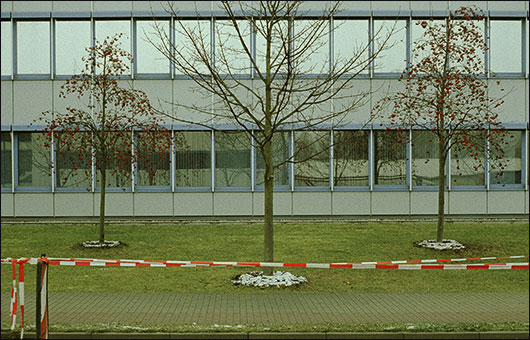
Here, of course, we‘re no longer at the Christmas fair, this is the facade of Jenoptic, one company that split off the east german branch of Zeiss.

After some straightening in Photoshop, you get the instant Warhologram that is the image at the top.

This is what this picture would have looked like had I scanned it as a negative:
C Hammann Naniwa Cross Process Review

I think I like both ways of treating cross-processed slide film in post-processing. Each one has it’s own creative possibilities.

So, if your lab would scoff at you for such an unreasonable demand, why not try it yourself? Dunk the wrong kind of film into the Naniwa Color Kit N and see what you get. It’s easy and fun!

Merry Cross-mas!


Christoph Hammann is a fine art photographer from Waltershausen, Germany. He works with traditional film and silver halide papers as well as digital post-processing and alternative printing techniques. His website is “Mostly Black & White”.

Up and hanging

JRP Matsudo Show

It’s been over ten years that I have had any of my photos displayed in public and I have to say that it felt great to bring a creative process of taking, selecting and printing an image to an end by publicly displaying it.

This morning we prepared the venue for the show by arranging and hanging the photos. The venue is a Citizen’s Culture Center, a common thing in Japan, but hardly glamourous and which has probably has seen better days. Nonetheless, seeing one’s work hanging on a wall and doors opening to the public is an uplifting event. Please feel free to stop by if you are in this part of the world if you are within reach, please come by and have a look (Google map).

On Saturday afternoon, Goro Nakamura, a well known Japanese documentary photographer and one of JRP’s top level photographers will visit and assess everyone’s work, providing comments, which should be another highlight.

Nobuyoshi Araki’s Koushoku Painting

Nobuyoshi Araki’s recent Koushoku Painting show at Rathole Gallery (October 17 – December 7, 2008) featured 10 very large silver gelatin black and white prints that Araki had then painted over with various colors. Most of the photos depicted different models in various states of bondage, or “kinbaku” as it is known in Japanese. This is of course very familiar territory for Araki, and on first thought it was hard to get excited about the prospect of seeing more of these, but the show was well worth seeing.

The majority of the painting has been applied in an abstract way, splotches of color here and there, brushstrokes here and there, all with bright, primary colors. While the paint obscures what we can see in the photos — sometimes frustratingly so — it is also quite appealing in its own right. There were also more literal uses of the color, such as in one photo where an eating fork looks to pierce the model’s breast, and here starts a brilliant red daub of paint that eventually runs down the remainder of the canvas. It’s obvious to be sure, but coupled with the artifice of the photo itself, it seemed in keeping for this “wound” to erupt in blood-red paint splotches.

On a purely visual level, the works were stunning. The size of each canvas (each over 130cm by 160cm), the sumptuousness of the black and white, and the vibrancy and texture of the color paint, created works which were gorgeous to look at, despite whatever reservations one might have about the subject matter.

Coming from crude triangular cut-outs hiding the genitalia, to be confronted with life-size, full-blown labia, was needless to say a rather breathtaking experience.”

Personally I found the works to be highly erotic, which was surprising to me. Frankly I have never cared for this side of Araki — nor of this side of Japanese sexuality and eroticism. Although I realize that I’m looking at it via Western eyes, it remains for me threatening, violent, and when you get right down to it, just not my cup of tea. Despite these prejudices, however, I found myself quickly warming to the idea that there might be more to this art form — and Araki’s treatment of it — than I previously was prepared to cede.

One thing that immediately jumps to mind when you look at the works is that it isn’t often you see such unabashed exposure of the female nude form, especially in Japan with its somewhat outdated restrictions against showing the pubic area. Araki’s own early books are a perfect example of this censorship, with their crude triangular cut-outs hiding the genitalia. Coming from this, to be confronted with life-size, full-blown labia, if you pardon the expression, was needless to say a rather breathtaking experience. More than erotic though, the pictures were very beautiful. And, as with a lot of Araki, they are also ugly and base.

One of the most arresting pieces in the show was one where the model has been suspended in mid-air by ropes. Because we don’t get to see the apparatus by which she is hanging — coupled with her calm, reposed expression — the ropes lose something of their menace. The model seems to be floating, like a diver in water, or an astronaut in gravity-less space. Unlike other kinbaku of this type, where an apparatus is used to suspend the woman in mid-air, and where the photos of models suspended like this are often shown hung upside down, or with their bodies contorted, Araki instead opts for a frontal approach. The model faces us, her legs suspended with ropes in a way that makes her look like she is sitting down for us. It could almost be a portrait. As such, she is presented as a more complete entity than the models in other photos.

The background in this photo helps to set it apart. It is clear that it was shot in a traditional Japanese house, and through open doors we can see outside beyond the model to what we imagine is a Japanese garden. Whereas the other works’ settings have a decidedly Western — or neutral, in the case of one photo with a studio backdrop — feel, spaces enclosed by walls with peeling patterned wallpaper and occupied by old Europe furniture, the airiness of this particular setting enhances the floating impression. On the floor lies an object which looks like one of Feininger’s seashells or some kind of elongated snail. Compared to a Godzilla figure or a rubber lizard that feature in other works, it is non-threatening, but earthy, helping to collapse interior and exterior space. The model’s kimono pushes the traditional aspect further, as does her fringe haircut. With its elaborate design, its excess of material and folds, the kimono makes this particular model the most-clothed of those on display. It is therefore with some irony that anatomically speaking, this is the most exposed of all the models, and Araki has resisted obscuring the woman’s sex with daubs of paint as he has done elsewhere.

There is another work by Araki done along the same lines, not shown at the Rathole exhibition but included in the accompanying catalog. It makes for an interesting contrast with the just-described photo. Here too a woman is hoisted in the air. Again, we cannot see from where she is hanging, only that she is suspended in air, giving us the same sensation that she is not hanging so much as floating. And here too, the model assumes a calm, almost bored expression. However, unlike the image in the show, the background is yet another interior, with a mock-Doric column nightstand with a black cat doll atop it. More importantly, here the model is completely nude. Because she is without clothes, there is no mistaking that her hands are bound behind her back. In fact, the hands can be seen dangling behind her, like a perverted extension of her vagina, or something — a fish, a butterfly — emanating from it. It’s a disconcerting appendage, if you will, but it also viscerally notches up the woman’s vulnerability. It’s a shame there wasn’t enough space to include this and a couple of other works that are shown in the catalog.

The lizard is a stand-in for a Warhol-like Araki that we know instinctively is just off-frame, turned on by the spectacle, and turned on by his control of the power cords.”

If it was possible to have a show-stopper in this exhibition of show-stoppers, it was one photo where a woman lies on a hardwood floor with her legs kicked up in the air, her hands reaching up to grab her heels in an ultimate “do me” pose. Her arms and legs are tied together as if to seal her available condition. Her head is completely obscured and the ropes give the impression of tied-up meat or a stitched together assemblage of Hans Bellmer body parts. A vibrator has been inserted into her vagina. We presume that it is “turned on” because we see it tethered to it’s battery-powered controller lying on the floor, and because the picture allows us no other realistic choice. As if to power the point home, on the floor lies another vibrator, still sheathed in a used condom, as if it had been castrated in flagrante delicto. The two vibrator cords are mildly tangled up with each other, and together with the slack power cord of a lamp in the background, they all seem to be mocking the taut ropes that bind the model. Near the vibrators is a rubber lizard, its mouth agape, poised between a lascivious grin and a heckling laugh. More threatening than a snail, yet much less self-consciously artificial than Godzilla, the lizard on the periphery of the action is a stand-in for a Warhol-like Araki that we know instinctively is just off-frame, turned on by the spectacle, and turned on by his control of the power cords.

Beyond the ropes and these props however, it is with his paint — the paint that is after all this show’s reason for being — that Araki gives us his final coup de grace. Unlike the majority of the works in the show and accompanying catalog, where the paint is applied relatively sparingly, here the entire canvas of the original print seems to have been stained with some sort of yellowish layer of paint. Since it shows up most clearly against the naked white body of the tied-up model, it gives one the further impression that this is no longer a woman on the floor but mere body parts, as if they were soaking in formaldehyde. But Araki doesn’t stop there. He has painted a circle around the model. This circle, even as it marks her as the haloed/hallowed focal point around which the tawdry props revolve, also demarcates the limits of her existence. Of course the shoot will end, and the model’s rope burns will fade with time, but as canvas she will, like Rauschenberg’s goat, be trapped in that circle, the paint mixing with silver gelatin to fix her twice.

The catalog accompanying this exhibition, Nobuyoshi Araki: KOUSHOKU PAINTING, is available for purchase from the Japan Exposures bookstore. Images from the book can also be seen there.

Naoki Ishikawa – Mt. Fuji

Naoki Ishikawa was born in 1977 in Tokyo, Japan, and earned his Bachelor of Fine Arts from Waseda University in 2002. Since the first book of his photography was published in 2003 (Pole to Pole, ChuoKoron Shinsha), he has published five additional books of his work, including Void (Knee High Media, 2005), New Dimension (AKAAKA, 2007) and Polar (Little More, 2007). This month sees the publication of two more bodies of work, Vernacular (AKAAKA) and Mt. Fuji (Little More), from which our Cover Photo is taken.

His work has been extensively exhibited since 2003, with solo exhibitions in Tokyo and Osaka, and participation in group exhibitions in Japan as well as in Shanghai, Vienna, and Seoul. He won a Jun Miki Award in 2006 from Nikon Salon for his exhibition “The Void”, and this year was awarded both the Newcomer’s Award from the Photographic Society of Japan, as well as Kodansha Publishers Culture Award for Photography. To top off a busy 2008, Ishikawa completed his Ph.D. from Tokyo University of the Arts. Currently, Ishikawa is a Special Research Fellow at the Institute for Art Anthropology at Tama Art University in Tokyo.

Making contacts

Contact printing with the ISE Contact Printer and Fuji Rembrant VAs I have written a short while ago I am busy preparing some prints for a small exhibition. After good results with the Fuji TONE Gaslight contact printing paper it was time now to produce some display quality fibre prints. I have not printed on fibre paper for at least ten years so was anxious to get things done on time.

I need not have worried. To create my prints I used Fuji Bromide Rembrant V variable grade fibre based paper. The paper comes in two weights, single weight (F) and double weight (G). I went for the double weight variant in 10×12 inch size. This lets me contact print the 8×10 negative while leaving a thick white border around the image area, which is visually pleasing and should come in handy for matting or mounting.

The other key tool for successful contact printing was the ISE Multiple Contact Printer. ISE makes these contact printers in 10×12 and 8×10 sizes. Most of them have markings for film strips in 120 or 35mm formats, but there is also a free size version with unmarked glass – ideal for sheet film contacts. The bottom is foam to ensure even pressure across the print and the glass lid locks into place with a latch. To achieve the white border, I cut a window in the thin black sheet of cover paper that comes with the paper to protect its surface. The window has the exact size of the 8×10 negative and also helps centering the negative on the paper. The unexposed edge of the film sheet is also included, which means you see a black border around the image area including the film coding.

The light source is my trusty Kaiser VC 35 enlarger from Germany, which as a drawer multi-grade contrast filters. I put the head on maximum height and de-focus it slightly as to not accidentally enlarge grains of dust sitting on the condensor, which will baffle you when trying to clean the contact printer’s glass and the negative itself over and over without improvement. When printing on TONE Gaslight paper the lens is wide open and results in base exposure times of around 90 seconds. The Rembrant paper is a lot more sensitive, so the lens needs be stopped down and the resulting times are under 10 seconds to allow ample time for dodging and burning. The key to efficient printing on fibre with its extended processing times is the prior work print on the TONE Gaslight paper. Once you understand the relationship between exposure times of the two papers you simply need to convert the time for base and burn exposures and you can achieve excellent prints using just a single or two sheets. Of course you can then also do split-grade exposures to add some punch. You can see the dry set up in the image above.

I am very pleased with the results of the Rembrant V papers. The tones are very pleasing and so is the air-dried surface. Curling is manageable with some pressure for a day or so.

Well, with the prints done well ahead of time all that is now left to do for me is matting and they are ready for display from the 16th this month!

2008 Nikon Salon Awards


In November, Nikon Salon announced that Kenshichi Heshiki* and Yasushi Nishimura were the 2008 winners of their annual Ina Nobuo and Miki Jun prizes, respectively.

The gallery, which since opening in 1968 has been instrumental in furthering the career of many a famous Japanese photographer, established the Ina Nobuo Award in 1976. The winner is chosen from amongst all the exhibitions held at the gallery in a given calendar year (October – September). The award is named for photography critic Nobuo Ina (1898-1978), the famed photography critic who headed Nikon Salon for its first 10 years of existence. Past winners have included Masahisa Fukase, Hiromi Tsuchida, and Hiroh Kikai (a full list of winners is at the bottom of this page). The winner receives a cash prize (this year, ¥1,000,000) as well as Nikon camera equipment.

This year’s 33rd annual Ina Nobuo Award winner Heshiki is a 60-year old photographer born in Nakijin, a village on Okinawa Island. His exhibition entitled 山羊の肺 沖縄1968-2005å¹´ (Lungs of a Goat — Okinawa 1968-2005) — which was held at the Nikon Salon in Ginza in May of this year — brought together roughly 90 images showcasing nearly 40 years of work focused on the everyday lives of Okinawa’s citizens.

The Miki Jun Award was established in 1998 in commemoration of the gallery’s 30th anniversary, and is given to a photographer under 35 years old and is chosen from among artists exhibited at Nikon Salon’s Juna21 gallery space. The prize is named after the photo journalist Jun Miki (1919-1992), one-time pupil of Ken Domon who worked for Life Magazine and other photo news magazines after the war, and was later president of the Nikkor Club. Renowned first and foremost for his photo reportage, Miki also played an accidental but important role in establishing the worldwide reputation of Nikkor lenses.

This year’s winner was Yasushi Nishimura for his exhibition entitled 彼女のタイトル (Her Title), a depiction of a young and troubled young woman’s life over a year and a half period. The 26 year old Nishimura is a member of the Photographer’s Gallery collective.

Since 2003, as part of the Miki Jun Award, Nikon Salon also gives out two “Inspiration Awards”. This year’s winners were 23-year old Hatsumi Matsushita for her series of amusing self-portraits, and Kaori Inbe, a 28-year old Tokyo-based photographer, for her ironically entitled exhibition “Moral Society”. You can view online galleries of the three Miki Jun winners at Nikon’s “Independents” site. (Click on the second “Enter” button on that page. The prize winners are galleries #28 (Nishimura), #31 (Matsushita), and #27 (Inbe). For some reason, the site only works with Internet Explorer for me).

Nikon Salon will re-mount each of the five winning exhibitions in December and January at their Shinjuku and Osaka salons. See this page for details.

* Please note that Heshiki’s surname is also romanized as Hirashiki on some Nikon Salon web pages.