Hiroshi Sugimoto Visions in my Mind

My first encounter with Hiroshi Sugimoto’s work was in a 1980s compilation of Japanese modern art featuring his movie theatre and seascape works. Not surprisingly, it took me quite a while to wrap my own mind around his visions.

What is fascinating about Sugimoto’s photographs is that even when looking at work from 20 or 30 years ago, it still seems very much contemporary and recent. The reasons for this are surely manifold, but not least because of the use of black and white, the often archetypal subject matter and ultimately the work’s examination of timelessness itself (which would make an interesting nested double conundrum). This short documentary is an attempt to get a better impression about the man behind the pictures.

I have hundreds of different ideas always in my mind, secretly.”

The film opens with Sugimoto experimenting with a Van de Graaff static electricity generator throwing sparks between the machine’s and the handheld spherical devices. The sparks are to be recorded on sheets of 8×10 film and later to be enlarged to prints resembling giant fireworks of lightnings, x-rays or even aerial reconnaissance images. He states that he had the idea to explore this when removing or inserting dark slides into the film holders during dry winters, which generated sparks, ruining the film in them.

His statement “I have hundreds of different ideas always in my mind, secretly” is the thread that appears to lead us from one project to another. Sugimoto is a quiet and persevering explorer of fascinating small details in the world which most of us would not care to look at for extended periods of time. While this may be valid for any noteworthy photographer, Sugimoto’s approach is unique in that it appears to completely isolate the subject matter, place it under the microscope (or rather the camera) and then records it in a quasi-scientific manner, often in a variety of subtle variations. While watching the film it occurs to me that a comparison to Edward Muybridge is not too far fetched.

The film continues to follow Sugimoto around during the preparations of his major retrospective. We join — presumably invited — visitors being shown around and explained selected works by the artist himself. Technically inclined viewers will certainly appreciate a glimpse at the working practices of a master, including his darkroom or the explanation of the “double-infinity” technique used in the Architecture series. Large format or film photographers in general will be assured that dust on film and prints will treat everyone equally, master or novice.

This documentary film by German art historian, curator and independent documentary filmmaker Maria Anna Tappeiner provides some valuable views on Sugimoto and his works. However, overall its approach appears rather detached, even restrained, showing little desire to dig its teeth into such rich subject material. Mostly for this reason I feel it ultimately falls short of giving the viewer the deeper thoughts behind the works, the influences, motivations and intentions. We see a lot of the well-known art works, results of brilliant craftsmanship, the Sugimoto studio with staff working on computers or work-in-progress images lined up against the walls – but even though these things catch the film viewers attention we are not enlightened about them, which is a shame. We are left with the impression of having scratched only the surface of a universe, about what makes the man tick. While this film is a must for all Sugimoto fans, to me at least it at no time seems to get near enough to reveal the title theme of visions in the mind.

The Visions in my Mind DVD is available in the Japan Exposures bookstore. We also have a couple of recent special magazine editions devoted to Sugimoto.


Ufer! Art Documentary, Germany, 2007, DIGIBETA, Colour, 43 min, English with Japanese subtitles

Film official site and trailer

Official Hiroshi Sugimoto home page

Hand-crafted cameras and calendars

Two photography calendars

This being the New Year’s holiday season in Japan, the bookstores seem to have been taken over by large displays of every manner of 2009 calendars. Although there are a few tastefully designed ones, as well the old Hokusai and Hiroshige standbys, there are also disturbingly large amounts of “Lighthouses of New England” types as well.

The current crop of photo magazines also have 2009 calendars bundled together with them, but sadly these are hardly an improvement. This month’s Asahi Camera comes with a 2009 calendar full of cat photos that stretches the bounds of decent taste, in this person’s humble opinion (and I’m a cat lover, so no flames please!). PHAT’s calendar features 12 picture postcard images from Bora Bora that does neither getaway islands nor calendars any favors.

Nippon Magazine: Camera Photos: Leica 1f
Fortunately, Nippon Camera comes to the rescue with a calendar any true photography lover would love to have on their walls. They call it “Cover Cameras” and it is the literal handiwork of Yasuhiko Ishikawa. Each month a different camera is featured, including a Leica If for January, a couple of Bosley B2’s for April, and a Hasselblad SWC for December. Digital cameras are represented too.

As I have alluded to and the pictures included here perhaps give away, these are not pictures of the cameras themselves, but rather pictures of cameras Ishikawa has made with a variety of cheap materials and modeled on their “real” counterparts. Each mock camera is accompanied by some text by Ishikawa, who divides his writing equally between venerating the real camera and discussing how he made the particular model on display, how much the materials cost (very cheap, in most instances). My favorite of the bunch, shown in the extended slide show, is a Casio Exilim Pro Ex-F1 that features a body made from a cross section of a law book Ishikawa picked up for a dollar and change at a used bookstore.

Ishikawa is a designer doing both graphic and product design — his flash-based website provides ample samples (though sadly none of these hand-made cameras). As if these cameras weren’t enough evidence, the way he writes about his “cameras” reveal a quirkiness that’s quite endearing.

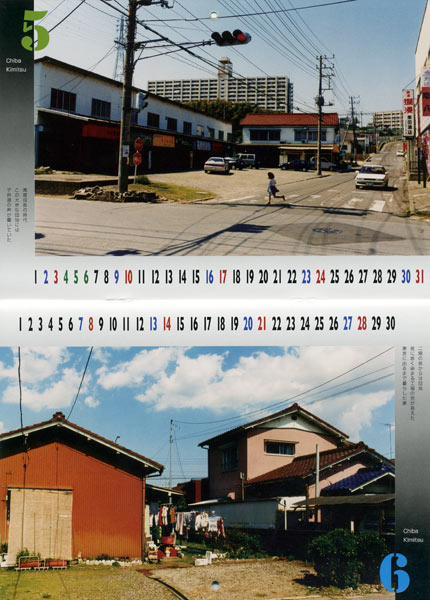
Koji Onaka 2009 CalendarAnother cool calendar choice for the photography lover is also from someone known for a certain quirkiness, not to mention a dry humor: photographer Koji Onaka. For this 2009 calendar, which is signed by Onaka and available in very limited quantities, Onaka has assembled a total of 14 landscapes/cityscapes done in his customary, high-contrast style.

Koji Onaka 2009 Calendar InteriorThe front and back covers feature photos from Mexico and Viet Nam, but the interior photos for each month are from different parts of Japan, including a couple from Kimitsu in Chiba where he grew up. (See photo to the right.) The pictures have some tangible connection to the months (a snowy scene for February, cherry blossom petals on the ground for April), as well as some much looser connections like his photo from the town of Obama in Fukui Prefecture for November (the town featured in a lot of silly news stories this year for obvious reasons).

Included is a 6-day excerpt from his travel diary, although this, like his typically understated captions for each photo, is only in Japanese.


Click the top image to bring up a gallery of larger images from these calendars. If you are interested in obtaining either of these, please get in touch with us using the form on the services page, but do it quick!

Season’s Greetings

We would like to wish all readers, friends, contributors and customers a happy year end season. Christmas is virtually over in Japan with decorations being removed from today preparing for the real holiday which is Japanese New Year. Like Christmas in the West, the country will come to a stand-still next week while we join with our families for some quiet and festive time together. If you place an order during this holiday period, please note that processing might be slightly slower than normal. The JE team wishes everyone happy holidays and all the best for 2009, photographic and otherwise.

Three delightful new books

Three New Books: Tamura, Tsuda, Shibata

I‘ve recently had the fortunate opportunity to acquire for myself, and for the bookstore, three lovely photo books by Akihide Tamura, Nao Tsuda, and Toshio Shibata. These are the kind of photo books you want to carry with you all the time, to show anyone with a smidgen of interest in photography or quality publishing, anyone who loves looking at photography by turning pages, feeling the texture of the page corner between their finger and thumb. The kind of books you imagine Martin Parr or John Gossage have by the shelf load in their abodes.

Akihide Tamura: Base (1992)
When I said “new” books in the title, I was fibbing a little. Base by Akihide Tamura is in fact not new at all, either in content or in publication. The content was shot by Tamura in the late 60’s. The book itself dates from 1992, and was published by Mole.

However, apparently from Tamura’s own stock, brand new copies of this 1992 book have recently been made available, and this is a very fortunate thing. “Base” in this case refers to the U.S. military bases that to this day continue their elephant-in-the-room existence throughout the Japanese Archipelago. In the 60s their presence raised considerably more overt opposition than they do now (though this by no means implies they are any more welcome by today’s majority), and not surprisingly they proved a fertile ground for many a Japanese photographer, with Shomei Tomatsu and Daido Moriyama leading a long list.

Unlike many, however, Tamura’s camera remains on the periphery, often employing on one hand extreme zoom lenses to capture the Air Force jets that feature in several images, or wide angle lenses that help to give the book a landscape feel. Whether this was of necessity, or of artistic choice, you feel the isolation of the bases from most Japanese, even as they could never escape their ubiquitous presence. I found Tamura’s close-ups of the jets particularly striking. Like Fukase’s ravens, we can instinctively hear their obnoxious, intrusive screeching emanating from the page.

These are the kind of books you imagine Martin Parr or John Gossage have by the shelf load in their abodes.”

The book itself is a thin volume, with just 16 black and white photographs plus two color photographs that illustrate the books front and back covers. The cover is an off-white textured card stock that feels lovely in the hand, with the title foil stamped in silver. The interior pages are printed on heavy weight, non-glossy paper, and suit the high-contrast and very grainy photos beautifully. The book is bound with two staples. A simple but elegant book.

Captions as well as technical details of the photographs are in English. Inserted unbound into the book is an eight-page booklet with essays by critic Koen Shigemori (who incidentally passed away the same year the book was published) and photographer Shinzo Shimao, but sadly these are in Japanese only.

Nao Tsuda: Smoke Line Exhibition Catalog (2008)

You might be surprised to know that Shiseido, the Japanese cosmetics giant, is the oldest cosmetics company in the world. But perhaps even more surprising, and more germane to the discussion here, is that the Shiseido Gallery in Tokyo’s Ginza area is the oldest existing art gallery in Japan. They do have a long-established reputation for supporting the arts, and young artists especially, and this was on evidence at the recently staged Nao Tsuda “Smoke Line – Tracing the Windstreams” exhibition I attended a couple of weeks ago. The exhibit featured work that Tsuda created during travels in China, Mongolia and Morocco, and was divided into two parts. The first, perhaps main part of the exhibit, featured large diptych-like landscapes. Off this space, in a darkened, curtained-off space, was “Smoke Face”, more spontaneous pieces accompanied by poems written by a Moroccan poet named Omar, with whom Tsuda spent some time traveling together.

But I’m here to write more about the catalog that accompanied this exhibition, for it is an exquisitely put together package that does justice not only to the work on exhibit, but to the exhibition itself. This is because the catalog is actually two books, each corresponding to the two different parts of the show. The larger book, which is bound, features the landscape diptychs. Inlaid behind this is a much smaller book featuring the “Smoke Face” work as well as the poems (in Japanese and French) that were on view in the smaller room. It is paperback size, bound by staples, and is secured by a ribbon rather than the rubber band as seems standard in Japan.

Sewn into the front fold-out cover is a 16-page booklet in Japanese and English, featuring a piece about Tsuda’s photography by world-renown Japanese novelist and poet Natsuki Ikezawa, in the form of a prose poem, as well as an essay by Shiseido Gallery’s curator Miho Morimoto.

In the back fold-out cover, which I didn’t even notice at first, are two separate fold-out pages, one for each part of the exhibit. One side of each details the pieces (media, sizes, etc.) in the exhibit, and the other features photographs of the exhibition itself. There is also a personal statement by Tsuda, again available in both Japanese and English.

The cover is basically a thin gray matte board that has been covered by fabric on the outer side, with the title and artist’s name embossed on the front. My description may make it sound cheap and inelegant but in actuality, the catalog feels anything but. The only thing “cheap” about this catalog is the price, which is extremely reasonable and makes me think the gallery produced these at a loss.

Often photo exhibition catalogs seems more like typical photo books, and while the works shown may be the same as the exhibit, there doesn’t seem to be any real correlation between the two. But here, you feel like you are getting what is, for lack of a better word, a true souvenir of the exhibition you attended.

Toshio Shibata: Still in the Night (2008)

Lastly we come to a very newly-published — two weeks ago in fact — small book featuring early Toshio Shibata photographs, published by the Soh Gallery to accompany his Still in the Night exhibition there. At the moment, Shibata is enjoying a major exhibition of his recent Landscape work at the Tokyo Metropolitan Museum of Photography, and there are a couple of smaller exhibitions going on in Tokyo to coincide with this show. Soh Gallery’s exhibition of some of Shibata’s early 4×5 work is one of them.

The work centers around various structures and scenes connected with the motor expressway, such as service areas, gas stations, and toll booths. Shibata shot these at night, and they date from 1982 to 1986. With the exception of one image, which was shot in Utah and is used to illustrate the book’s cover, the photos were all taken in Japan. Here we see the deceptively quiet, people-less places that are “off the road” or the gates to the road, yet full of their own life, their own motion.

Whether it is a row of empty but fully lit telephone booths, or a brightly lit but empty service area restroom, you get the sense that something is about to happen, that this is the scene of something. In the short essay about Shibata at the back of the book, by Yasuhide Shimbata, curator at Yokohama Museum of Art (translated into English), we learn that an early influence of Shibata’s were the films of Peter Bogdanovich, and indeed there is something of The Last Picture Show in these pictures.

This is a small, hardcover book about the size of a paperback (but in landscape orientation), featuring just 13 photographs (cover included). Although the prints on display were large-ish, here they measure just slightly larger than what an actual 4 x 5 negative would measure (a conscious choice, according to Soh Gallery’s owner).


Each of the three books are available in the Japan Exposures bookstore. You can also preview more of each book at the links below:

Base, by Akihide Tamura
Smoke Line Exhibition Catalog, by Nao Tsuda
Still in the Night, by Toshio Shibata

Shintaro Sato’s Tokyo Twilight Zone Back in Stock

We recently ran out of signed copies of Shintaro Sato’s Tokyo Twilight Zone, currently our best selling book. Fortunately, Sato-san was kind enough to sign some more copies for us, and these have now arrived in stock.

Sato-san told us recently that Seigensha, his publisher, is doing a second printing of his book (our in stock copies are first printings, however). He also tells us that his work will be featured in the January/February issue of European photography magazine Zoom, so if you’re a fan, please look for that.

10×2 Vol. 1 – Easterwood | Rösler

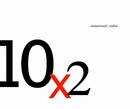
10x2 Cover

We are pleased to publish the first book of what we hope to be an ongoing series of books by photographers in a Japan context.

The series is called 10 x 2 and the idea is relatively simple — to present a series of 10 photos each by two different photographers. To kick off the series, the photographers in this case are myself and Dirk Rösler, the people behind the Japan Exposures web site.

The set of photographs by myself is entitled “Couple Suru” and contains work I have shot in Japan and Honolulu over the last few years. As the title perhaps hints at, the series looks at what it means to be a couple.

Dirk’s series titled “Between City and Nature” assesses the boundary between city and nature in the suburban and quasi rural Japanese landscape, reviewing what connects “civilised” human life and “wild” natural life.

Alright, you get 10 pictures together, I get 10 pictures together, and we’ll call it 10 x 2.”

There were several ideas originally behind the project. First, after several aborted attempts at something collaborative, both Dirk and I were looking for something that could be done without minimal fuss. I believe it was while we were standing at the ticket gates of Kita-Senju station that one of us just said, “Alright, you get 10 pictures together, I get 10 pictures together, and we’ll call it 10 x 2.”

One of the other ideas that we felt was important for pushing along the project quickly — and adding an element of chance or mystery — was that we would gather our respective series of images independently, and that we would not allow our choices to be then second-guessed by whatever the other submitted. I’m happy to say that both of us stuck to this idea.

Of course, once you get to a certain point and the book starts to take shape, it’s hard to just “throw it together” and we did take some time and back and forth in terms of how the book should look, whether there should be introductions to the series, and even little things like page numbers or extra blank pages can very quickly become big deals. The devil remains in the details.

And of course, there was the decision about where to have the book printed. I had had previous experience with Lulu and Dirk had had iPhoto and MyPublisher books done, but based on a variety of factors we decided that Blurb best suited our needs, or perhaps was the best compromise for a short-run book, and we are quite happy with that decision. Ideally we would like to have found a local Japanese company to self-publish the book, but rather distressingly, almost all books come in a square format which is perhaps nice for wedding photos but doesn’t really fit with our work.

Going forward, we would like to use this 10 x 2 structure we have created to publish books by other photographers working in Japan.

Kurt Easterwood | Dirk Rösler


The book can be purchased via Blurb. This book can be previewed here or by clicking the 10 x 2 image at the top of the page.

By easterwood | rösler