Text and images by Christoph Hammann for Japan Exposures
If you‘re using color negative film in a hybrid workflow, does it matter what film you use? Or is it true that you can do everything in post-processing? Essentially, in the digital age, what exactly does your choice of film itself bring to the table?
I had occasion to ponder these questions while testing the new Kodak Ektar 100 against DNP’sCenturia 100 film. While the former is lauded far and wide for it‘s fine grain and color reproduction, the latter is said to be a no-frills, mass-market oriented version of Konica‘s color negative film with high color saturation.
DNP Centuria 100
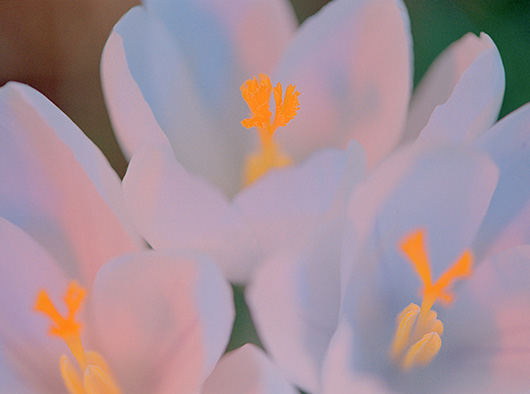
For the purpose of this comparison, I took photos of a field of crocuses in Düsseldorf‘s Nordpark at the beginning of February. In most shots, I used a Micro-Nikkor 105 VR and a R1C1 macro flash kit with colored gels.
DNP Centuria 100
I also used these two films in a studio lighting workshop held by Jens Brüggemann. This proved to be an excellent learning experience! The shot above shows a mixed light situation (daylight from above and the flashes modeling light out of a huge umbrella from front left) rendered by the Dai Nippon Printing film.
The lead image on top shows Kodak Ektar coping with light from two strip softboxes aimed at the model from 90 degrees left and right.
Apart from these single images, how did the test go?
Methodology first: I took care to develop the films the same way, putting one of each in a Jobo 1520 tank and developing them with the Naniwa Color Kit N.
The negatives were scanned with a Minolta Dimage Scan Elite 5400, using no anti-grain dithering and the same light grain reduction in both films.
DNP Centuria 100 at left, Kodak Ektar at right
Grain did indeed turn out to be a major difference between the two films. The 100% crops in the picture above had their levels adjusted, but were not sharpened or reduced in grain. Kodak‘s claims of extremely fine grain for the Ektar are fully justified.
DNP Centuria 100 on top, Kodak Ektar at the bottom
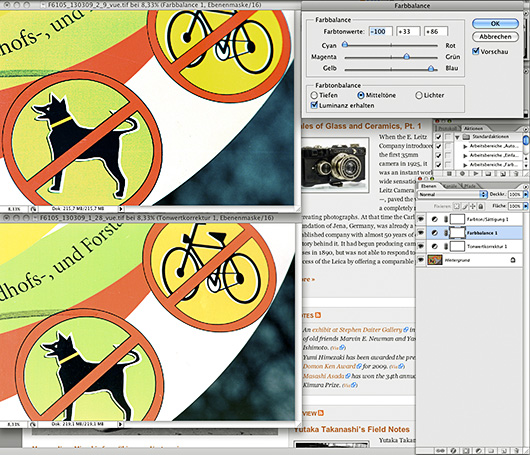
Color balance was markedly different, too. The prohibition sign in the picture above was photographed with the macro flash (without gel filter, of course!) and white-balanced with a levels layer on the white circle denoting the bike‘s crankset. The sign‘s colors weren‘t nearly as garish as the DNP film makes them look, more faded and muted as in the Ektar version. So, a high saturation color negative film the DNP Centuria 100 surely is!
DNP Centuria 100 on top being color corrected with a color balance and a saturation layer
When I tried cheating and to adapt the color correction of DNP Centuria to match the one of Kodak Ektar with layers in Photoshop, the green parts of the sign quickly fell apart along the film grain. I could neither get the same yellow nor do much about the saturation. They don‘t call it a color balance for nothing!
DNP Centuria 100 at left, Kodak Ektar at right
Skin tones suffer under the DNP film‘s color rendering, while I find Ektar‘s skin tones to be quite natural. Granted, these are two different models with different casts to their skin, but the left one wasn‘t that orange-y. And to be fair, the all-rounder DNP 100 has never claimed to be a portrait film.
If all that sounds like I‘m slamming the DNP Centuria 100 film, making an easy target out of it, I‘m not. In the crocus shots, I actually prefered it‘s saturation and color rendition. I also see a role for it photographing urban environments in their multicolored facets and a kind of grainy hastiness. Kodak‘s new Ektar is more true to life, though — mind you, it‘s colors are saturated enough. It has stunningly small and unobtrusive grain. If you are attracted by peculiar color and light combinations and want to capture them just the way you saw them, this is the film for you.
You have the choice, and that‘s the beauty of using film for color photography. Your results don‘t have to be predetermined by the sensor in your digital camera. Film matters, so take your pick and have fun.
Â
Christoph Hammann is a fine art photographer from Waltershausen, Germany. He works with traditional film and silver halide papers as well as digital post-processing and alternative printing techniques. His website is “Mostly Black & White”.
Â
Â
 We have DNP Centuria 100 film available at very attractive prices in our web shop. Why not treat yourself to an abundant 100 pack for summer?
gallery KAIDO utility pole sign -- photo by Tyler Ensrude
Text and images by Tyler Ensrude for Japan Exposures
Have you ever been to a gallery and felt as though the reception almost didn’t want you there or could care less that you entered the room? Even in Japan, a country known for it’s outstanding customer service, some places can still hold their noses in the air a bit when it comes to big art in a small space. Maybe it’s my foreign face that frightens the staff working in some galleries here to go back into the storeroom or look busy? I don’t know.
Actually, I take that back. I have had very friendly experiences in and out of Japan from helpful staff or artists who are very grateful to know their work is appreciated. Especially in parks, cafes, some more local/down-to-earth galleries and people doing joint exhibitions around Tokyo. I even remember a few free alcohol occasions! I think it must be the sterility of some of the bigger name galleries that gets to me sometimes and I think that sterility makes them come off as inhospitable or cold.
So despite my slight frustration at times I love many Tokyo galleries. Many of them are very impressive and open to new artists, but usually come at a hefty price. Young photographers and artists could always use more places to show their work at a price and a location that won’t make them think Ginza is actually made of silver, and fortunately some places have been popping up lately.
Ginza may be known for it’s pricy shops and exclusive, but very attractive, galleries. But if you want to get a good taste of what Tokyo really has to offer, you may be in for quite a hike. Galleries are rather spread out around Tokyo, especially photo galleries. You can wander for ages and it’s hard to hit too many in one day. If you’re a gallery savvy visitor to Tokyo, but you’re not sure where you’re going, this can easily turn a day of casual gallery hopping into a frustrating day of hitting up police boxes fumbling over a tiny map and talking to policemen who think you’re trying to find the nearest place to develop your film.
If you want to take a weekend afternoon to hit one of the best off-the-beaten-path photo spaces while you’re here, one that greets you with a smile, talks with you like you’re an old friend and maybe even stuffs a few extra post cards in your pocket as you’re leaving you should definitely try to find gallery KAIDO.
“
You keep expecting someone to come walking out of a room wearing a bathrobe and slippers!â€
I’ll try and give you a little help getting there, for while it’s not the easiest gallery to find, it’s definitely worth the trek. First, take the Tokyo Metro Marunouchi Line (subway) to Minami-Asagaya station. (You can also take the JR Chuo Line to the area, but the Marunouchi Line is more convenient). It’s only a few minutes from Shinjuku by train or subway. When you get there look for or ask how to find Ome Kaido (Ome Avenue). Gallery KAIDO is only a few minutes walk off the side streets near Ome Kaido. Ome is a busy road that starts from way-out-west Tokyo and ends around Shinjuku and is actually the inspiration behind the gallery’s name itself.
I was surprised I remembered how to get there without the use of a map the second time I visited. The map makes it look somewhat simple, but amongst the many turns, the never ending rows of houses and the narrow paths they call “streets” here, things can look quite similar. I took a few shots of some landmarks along the way to help you find the right corners, along with a scan of the gallery’s flyer map with some translated English.
gallery Kaido English map -- click for larger map and photos along route
Once you’re in the vicinity, the gate of gallery KAIDO is the next challenge. You’ll see a sign on a utility pole telling you to make a left. But then you’re stuck guessing where to go next, because you’ve turned into a dead end. If you live in Tokyo, it could very well be exactly what your apartment entrance looks like and there isn’t really much more than a small sign on the gate. It’s on the left side, about half why down the dead end. From this point, walk up the steep, steel steps, take off your shoes in the entryway and… it sounds like home already, doesn’t it?
As I mentioned before, you’ll probably be greeted with a smile and the curiosity of an old style Japanese inn owner welcoming a weary guest. If you’re not the shy type and you show enough interest and have some time, you may even be offered a cup of tea. It seems a bit like you’re walking through someone’s apartment and you keep expecting someone to come walking out of a room wearing a bathrobe and slippers! It feels old, but warm and real. It’s basically two bedrooms of photos with some closed rooms I only assumed were workshop space or possibly a darkroom. One of the rooms, which was apparently the old kitchen, is now the gallery gift shop.
If you come on the right day and happen to know your Japanese photographers, you maybe even get to meet gallery KAIDO’s creator, the renowned photographer Koji Onaka. Onaka-san’s most recent photo book, A Dog In France, is starting to gain Onaka attention overseas and is a great look into his life over 20 years ago. [The Japan Exposures online bookshop has signed copies available. — ed]
Fifteen years ago Onaka-san had a gallery in Nishi-Shinjuku, which he also called KAIDO near the same Ome Avenue. That has since closed. Several years ago, Onaka-san and his wife Yuko, who runs the gallery gift shop, started looking for a new space not so near the bustling Shinjuku area. After a thorough internet apartment search, they came across the current KAIDO in Asagaya which also happened to be near Ome Avenue.
His original intention for the Asagaya gallery KAIDO was unclear for him at first, but he mainly intended to show his work there, and use the extra rooms as darkroom work space and Yuko could even use the space for some of her own interests. But recently, he’s converted it into a full-fledged gallery, welcoming his students to show their own work there for several weeks at a time. His “students†are actually attendees of his weekly workshops he holds at Kaido and random places around Tokyo and Japan. [Japan Exposures Cover Artist Sachiko Kadoi is a past workshop participant. — ed] Each week Onaka offers advice to workshop participants and gives critiques of their work. (Workshop info and exhibition schedules, as well as pictures of past critique sessions, can be seen at the workshop’s blog — Japanese only).
gallery KAIDO exhibition postcards for recent shows
The most recent works on display (from March 20th-29th) in KAIDO’s tiny rooms when I visited were a small series of black and white images by the young Tatsuhiro Nakahara entitled Machi-Nagara (While Waiting), all of which were taken in his hometown of Hiroshima near his father’s farm. In the “PIN-UP Gallery†a playful color series called “empty, but†from Miki Iwaoka of Yokohama residents. Also a set of about 12 images from Onaka-san himself, all printed in Onaka-san’s wonderful signature mundane, smoky-grey style and taken between 1994-1999 in Hakodate, Hokkaido. Some past exhibitions included works by Tomomi Matsutani, Takeshi Dodo, and Shuhei Motoyama.
I found KAIDO a great place to see some straight-forward, down-to-earth images from some photographers who seem to love Japan and aren’t afraid to show it like it is. It’s kind of what I’d expect from a Japanese gallery in some ways after living in Japan for many years myself. It’s not exactly Ginza, but hey, Ginza’s just a dressed-up place made of silver and it’s too crowded anyway.
So, on top of the fact that gallery KAIDO provides that real, or even gritty Japanese art experience in a somewhat surreal Tokyo atmosphere, you also can rest assured that you’ll be welcomed back. KAIDO is open Friday, Saturday and Sunday from 1pm-7pm.
Tyler Ensrude grew up on the plains of rural Wisconsin in the United States and has lived in Tokyo since 2002. He has a degree in photography and graphic design from the University of Wisconsin and is a contributing writer and photographer for several publications in and outside Japan. His current projects include research on foreign photography within Japan as well as Japanese photography, photography books, culture and music. He can be found online at www.tylerensrude.com and www.tylerensrude29.blogspot.com.
When the E. Leitz Company introduced the first practical 35mm camera in 1925, it was an instant world-wide sensation. The Leitz Camera — Leica –, paved the way for a completely new way of creating photographs. At that time the Carl Zeiss Foundation of Jena, Germany, was already a well-established company with almost 50 years of optical history behind it. It had begun producing camera lenses in 1890, but was not able to respond to the success of the Leica by offering a comparable product. To do so, Zeiss acquired four small camera manufacturers and merged them into the Zeiss Ikon AG, based in Dresden and Stuttgart. Even so, it took several more years to develop and produce a match for the meanwhile dominant Leica camera. This was the Contax, Zeiss Ikon’s top of the line rangefinder camera, presented in 1932. Carl Zeiss in Jena around 1910
The first Contax did not manage to fully live up to its ambitions. It was a very sophisticated and also complex little device and soon became known to suffer from a lack of reliability, especially due to its complicated shutter. Hubert Nerwin, Zeiss Ikon’s camera designer par-extraordinaire, picked up the pieces from the first unreliable Contax designs, and re-designed it to one of most famous and desirable 35mm cameras ever to have been produced; the Contax II. In 1936 it was brought to market with many revolutionary improvements, such as a combined viewfinder and rangefinder. In terms of features, it beat the comparatively primitive Leica hands down. Not resting on its success, Zeiss immediately started working on the next generation, the Contax III. But another ambitious project was already lined up beyond it — the Contaflex twin-lens reflex camera (TLR).Zeiss Ikon Contax I, image courtesy of Tomei Collection
The second world war saw the cities of Jena and Dresden become the Soviet sector of occupied Germany. The production facilities were damaged and everything salvageable was relocated to Kiev in the Ukranian province, to provide the Soviet Arsenal conglomerate with the means to construct a world class camera called the Kiev, initially entirely from leftover parts from Germany. Prior to the handover to the Soviets, the withdrawing US Army had recognised the significance of Zeiss and facilitated the relocation of over 100 key personnel, management and engineers to West sectors. This chapter alone is a fascinating period of Contax history and many papers and books have been published trying to establish on what exactly happened under the Russians’ control and what cameras where built at what location.
Like Germany itself, Carl Zeiss was now divided into East and West. In the West, Zeiss continued working on improving the classic II and III series rangefinder cameras, whereas in the Soviet sector work concentrated on developing the single-lens reflex. In 1949, at the Leipzig Spring Fair, an industrial showcase, Zeiss Dresden (East) released the Contax S (for Spiegelreflex [reflex mirror]. Due to increasing disputes around the Zeiss trademarks, which occupied German courts for 15 years, Zeiss Dresden renamed their cameras to Pentacon, derived from the combined words PENTAprism CONtax). It was the one of first 35mm SLR film cameras featuring a pentaprism allowing direct viewing from behind without a reversed image.
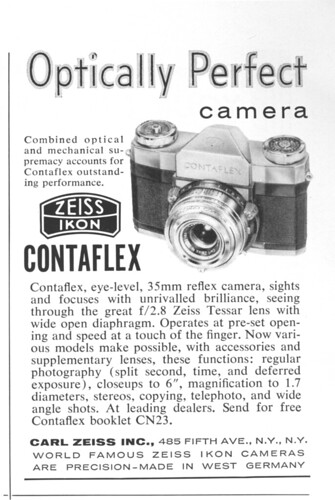
Contaflex ad in National Geographic, January 1958
The era of the rangefinder camera started drawing to a close and the SLR’s rise began. Carl Zeiss (West) released their first SLR in 1953, the Contaflex. Unlike its pre-war TLR namesake, it was a single-lens reflex camera (SLR) it featured a leaf shutter and but unlike the TLR only at a later stage was it equipped with a built-in (selenium) exposure meter. The follow-on model was called the Contarex and showed German engineering at its best: the world’s first exposure meter-coupled, focal plane shutter camera; it even sported interchangeable film backs. Despite its sophistication, the Contarex and its follow-on models were not commercially successful. While it was superbly crafted and packed with innovation, it was an engineer’s camera, which is to say ugly and heavy. Its selenium metering cell in front of the pentaprism gave it the name Cyclops or Bullseye. Production of the renowned Contax rangefinders IIa and IIIa (the a distinguishing them from the pre-war models) was ceased in 1961.
Meanwhile Japan had risen from its own ashes and started the onslaught that would leave the German camera industry practically wiped out (except for, ironically, the more and more archaic seeming Leica M). The Japanese practical design and not least pricing of cameras like the Nikon F simply could not be matched. Nonetheless, Zeiss continued to deliver in its cameras many world firsts that are taken for granted in today’s cameras: electronic auto-exposure, attachable motor drive and the technical feat of an electronically driven and vertically travelling shutter (a shorter travel distance means that shorter shutter speeds became possible). Undoubtedly SLR cameras would not be the same today if it wasn’t for the continuous innovation by Zeiss in their Contax cameras. The economic perspective was different, however. Zeiss simply could not continue to produce cameras in Germany alone, facing the fierce Japanese competition.
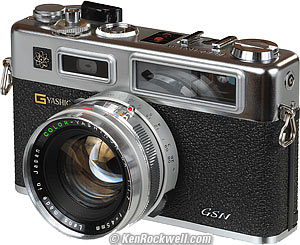
Yashica Electro 35 GSN, image courtesy kenrockwell.comThe key strategy was to find a strategic partner in Japan. Initially talks were held with Pentax, but efforts abandoned. The Pentax K is one remaining legacy of this attempted co-operation. In 1973 the alliance between Zeiss and Yashica commenced, a partnership that would hold for over 30 years. Yashica was founded in 1949 in Nagano prefecture and made a name for itself by producing high-quality 35mm and TLR cameras. The Yashica Electro 35 was a very popular rangefinder, said to have sold over 5 million units, and the Yashicamat a very reputable TLR. Yashica’s expertise in building electronic cameras paired with Zeiss’ excellence in producing optics seemed a promising formula for success.
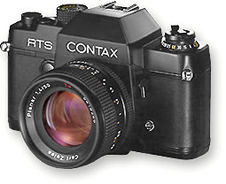
Perhaps it was the experience of the cyclops that prompted the addition of another ally: the F. Alexander Porsche Group. Industrial design was still in its infancy as a concept or product development consideration, yet Zeiss and Yashica must have recognised its importance and potential. Porsche Design were a pioneer in ergonomics and consulted on appearance and human interface design. The fruits of this collaboration were introduced at Photokina 1974 — the Contax RTS SLR. Contax RTSThe RTS (Real Time System) once more introduced a fireworks of innovation: a wholly electronic camera with aperture priority and manual exposure modes, optional five frame per second motor drive with intervolometer (selectable frame per second rate), 5-flash-per-second electronic flash capability and two frame per second winder. The totally stepless electronic shutter had a maximum speed of 1/2000s. Exposure compensation was found for the first time on any camera. The traditional maze of mechanical levers, rods, cams and gears, common to most shutter release systems had now completely given way to electronics and electro-magnetics. All timings in the body were now governed electronically; the follow-on RTS II had adopted quartz to ensure precision timing. A slew of other models targeted at different types of photographers followed and Yashica also continued to manufacture cameras under their own brand, which shared the Contax mount (C/Y mount) so that lenses were interchangeable between them. Zeiss concentrated on producing their fine SLR lenses.
Read inPart 2about how ceramic kitches knives from Kyoto helped Contax to remain on the cutting edge, tackling the challenges of auto-focus and the looming age of digital…
Yutaka Takanashi’s current retrospective at The National Museum of Modern Art in Tokyo, — it runs until March 8 — is a great opportunity not only to view the trajectory of a career that has spanned close to 50 years, but also to trace the city of Tokyo from its pre-1964 Olympics days up to the present day. Over 11 different series, we can follow Takanashi’s varied takes on the loose theme of “The City”.
“Figures of commuters solitarily ensconced in the bubbles of private space on a packed train.â€
Early on we have Takanashi as “economic miracle” chronicler in the mold of Shomei Tomatsu with the series “Tokyoites”, a series of 15 photos all taken in the year 1965. The photos are not all about boom and prosperity, to be sure, but the mood is generally upbeat. The images for the most part are intimate, a single figure captured in his or her world — a boy peering into a doll house, a woman nursing a baby in a speeding Mazda, or the figures of commuters solitarily ensconced in the bubbles of private space on a packed train.
Yutaka Takanashi: from “Towards the City” series
But on the other side of the wall, literally and figuratively, we have the series “Towards the City” of photos from the 60’s and 70’s. It is one of the few series where the capture details — when the photos were taken, the locales, etc. — are not provided, an aberration for the inveterate note taker Takanashi (the exhibition does after all bear the subtitle, “Field Notes of Light”). Takanashi was one of the founding members of the short-lived avant-garde group Provoke, known for their grainy, blurry black and white aesthetic, and these pictures, like that of the other “Provoke” artists of the time, are grainy in the extreme, poised between carefree and careless, and without any focus (both types). In contrast to the “Tokyoites” photos, the images here are generally long distant scenes, landscapes in a way. The angles are skewed, sharpness definitely a bourgeois concept. You get the feeling these were taken out in the country, from speeding cars, no doubt traveling “towards the city”.
Takanashi settled down after that heady time, and we don’t see again the same level of angst in his later work — but the restlessness is there in the ways Takanashi has taken on various projects and adapted various modes of working to accomplish them. Some more successful than others, it has to be said, in part I think because some of this work was driven by series published in the camera monthlies of the time, and carries with it vestiges of Takanashi’s commercial photographic work.
Along a long wall of the exhibit is the series “Hastukuni: pre-landscape” shot from the mid-80s to the early-90s, across the whole of Japan from Okinawa to Hokkaido, often taking as its focus various shrines and temples, as well as festivals. It’s a difficult series to grasp, in part because many of the photos for me are not compelling in their own right. You get the feeling it is a project that comes better across in book form, though personally I’m not familiar with Takanashi’s 1993 book of the same name.
“Empty, people-less spaces, yet stolid, girded for the coming decades.â€
Yutaka Takanashi: From the series “Visages of the Metropolis”
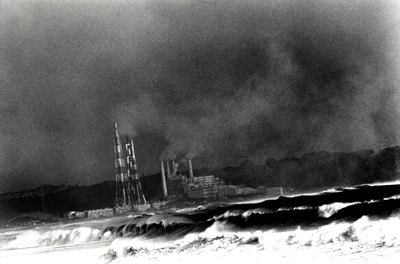
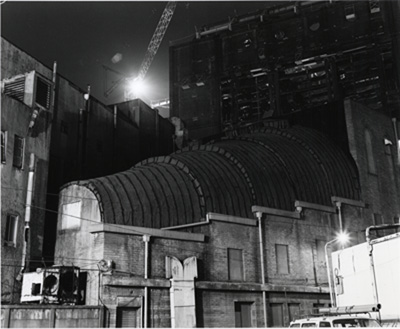
The series Visages of a Metropolis, from the late 80’s (published in book form in 1989), are photos Takanashi shot at night with a 6×7 camera, focusing on Tokyo buildings and structures that date from the 20s and 30s. They have a film noir feel to them — empty, people-less spaces, yet stolid, girded for the coming decades we know in retrospect they have survived. Though in earlier series on view — Machi (Town, 1977) and Text of the City: Shinjuku (1982-83) — Takanashi explored space as a type of city-dweller in and of itself, both series (one of storefronts and store interiors, the other of bar interiors) seem a bit cold and inaccessible, the various tightly framed, claustrophobic spaces more typological than individual. In the “Metropolis” photos, we get something in between the ephemeral gobs of grain of Towards the City and the specificity of these two series.
In the current decade, Takanashi has continued to explore the spaces of the city, alternating between a static, formal mode of exposition, and a decidedly more fluid one. In Nostalghia (2004) and Kakoi-machi (2007), he uses color film to explore the modern urban landscape of Tokyo and its environs. These two series are presented together, and unlike any of the series on view at the exhibition, here the photos are printed large and hung mosaic-like along three walls, so that walking through this semi-enclosed space indeed does feel like walking through a city where city planning has been thrown out the window, a city moving forward by accumulation rather than regeneration.
Yutaka Takanashi: From the series “Kakoi-machi”
In both series, but in Kakoi-machi in particular, many photos use as a visual motif those blue billowing tarps that are used to enclose buildings as they are being constructed, or the solid fences that enclose — and cut off — construction sites from the rest of the city. (We can translate the title as “enclosed city”). Takanashi uses these veils, as it were, to explore the fact that while the intention is to keep these places from view until their unveiling, we as dwellers of this place can’t avoid what is in effect the proverbial elephant in the room.
Takanashi has taken the idea of enclosed space in a completely different direction in the two other series that close this retrospective, WINDSCAPE (2004) and silver passin’ (2008), both a return to black and white and a more hand-held aesthetic. In the former series, which was included in book form as a supplement to Nostalghia, Takanashi shoots the landscape, both urban and rural, from local trains throughout Japan. (The series was shot between 2001-2003). There is no attempt to hide the fact that Takanashi is behind the glass of a train car, often incorporating the reflections and glare into the photographs.
Yutaka Takanashi: From the series “silver passin'”
Likewise, Takanashi’s most recent work has been a series of photographs taken while riding Tokyo’s city bus system. Taking advantage of his age to qualify for a “silver pass” — a reduced-fee bus pass for senior citizens — Takanashi haunts the city in an entirely different way. Unlike the train journeys, here he is in the midst of the city, only a meter or two from the sidewalk, and while there are one or two photos that give away he’s on a bus, the overall effect is a disconcerting one where Takanashi is both on the street and above it.
We have the catalog for this exhibition in the bookstore. While not outstanding by any means, it does reproduce every photograph in the exhibition and therefore serves as a good overview of Takanashi’s career. We also carry Takanashi’s 2007 book Kakoi-machi.
Takanashi’s early books like Towards the City (1974, self-published) and Tokyoites, 1978-1983 (1983, Shoshi-Yamada) are works of art in their own right that would cost you dearly if you can find them (expect to pay upwards of $2000 for the former, Takanashi’s first book). If you ever have the opportunity to see these books in person — the library at the Tokyo Metropolitan Museum of Photography is one such place — I recommend you seize it.
At most train stations in Tokyo, there are still film stores that can develop a roll of film in 45 minutes or less, so you can stop back and pick up your pictures on the way through, and enjoy looking at them on your train ride home. In the Japanese photography magazines, many articles are still devoted to film cameras each issue, although digital camera coverage is starting to pull way ahead. (There are even some dedicated magazines catering only to digital shooters.) Nonetheless most of the camera store ads in the front or back pages still list a huge selection of used film cameras and lenses for sale. These are now referred to as “classic” cameras.
Used camera shops like Sankyo Camera Co. [ map ], in the heart of the Ginza, Tokyo’s prestigious shopping district, located just off the famed 4-chome intersection, still offer shelves of Canon and Nikon rangefinder cameras and lenses for sale to film camera junkies like myself. In a store that is a throwback 20 years into the past, there aren’t any digital cameras for sale here.
At lunchtime, I have just enough time to walk up to Sankyo to see what’s new on their shelves since my last visit. Since I’m there, I can’t pass up the chance to stop by three other adjacent camera stores in this four-corner area of the Ginza that is a landmark for film camera buffs. My weekly “fix”.
There are actually two Sankyo camera stores within a half block, one specializing in Nikon and Canon rangefinders as well as other Japanese camera models, and another shop specializing in Leica cameras, although the window has a nice eye candy collection of Rollei 35mm, Rolleiflexes and Rolleicords for sale.
Across the busy street, there’s a Miyama Shokai Nikon branch store [ map ] that sells new and used cameras, mostly Nikon, but also enough used medium-format, rangefinder and other gear to take a look at. And just a few doors down is Katsumido [ map ], the ultimate store for Leica collectors who want everything in mint condition — and have the credit line to pay for it. This store also has a changing collection of highly priced and highly desirable cameras and lenses of all types in the window, with everything in near-mint condition.
“I’m also not going to be able to afford any of those line of Leica M3s or M2s on display. They know it, and I know it.â€
But the stop I enjoy the most is at the Sankyo Camera store with all the Nikon and Canon rangefinder gear, managed by Hiroatsu “Hero” Akizawa (call him Hero-san). At most Tokyo camera stores, the language barrier is difficult. There’s also the snobbery factor, as in stores like Katsumido, where the staff is aloof, and I’m too self-conscious to even ask a question, knowing that they are going to have to find somebody to talk to me in English, if there is anyone.
I’m also not going to be able to afford any of those line of Leica M3s or M2s on display, starting from 200,000 yen (about $2,200) and up. They know it, and I know it. So, I nonchalantly make my way over to the display case where cheap Nikon, Canon and Sigma auto-focus lenses are for sale, kept apart from the Leicas.
When I stop by Sankyo Camera, however, I’m greeted by Hero-san with a smile and in English. It’s the same relationship I first had with the now-closed Ohba Camera, which was located about a 10-minute walk from the Ginza near Shimbashi Station [Now a standing sushi bar — Ed.].
The rangefinder section at Sankyo Camera
The store manager at Ohba was friendly, spoke English, and since I was a good customer, always gave me a discount. If I brought back something I had bought there, he would always give me at least 80 percent in trade. That kind of service instills customer loyalty, since in most of the Tokyo used camera shops I’ve visited, I’ve been offered pennies on the dollar on my trade-in gear.
When Ohba was closing last April, one of the clerks asked me, “What are you going to do now?†They would see me stop by at lunch and sometimes after work, on my way to the station, to see what they had got in. When they closed, I went through withdrawal pains. Sankyo has stepped in to help ease the pain. The store has treated me well, offering me good trade-in prices, and usually knocking a little off the price of anything I’m interested in buying as well.
My first time there, I brought in some Nikon binoculars I wasn’t using, an old Nikon P camera and some Canon lenses to trade, Hero-san looked, and then grabbed a calculator to show me what he was offering. The price was very, very fair. Since that time, I’ve been a regular customer, wandering in off the street each week to see what’s in the display cases.
Prices are not cheap, and bargain hunters in the States still can get better buys on eBay or through their local Craigslist site, although the condition can be a craps shoot. But at Sankyo, there are good buys to be had on cameras and lenses that are impossible to find in the States, and usually in excellent condition.
One glorious day, there was an Olympus XA4 macro model, no strap, but I turned it over, and there was the extremely rare quartz date back on it. The price? 8,000 yen, or about $70. “I’ll take it,” I said. Hero-san smiled and nodded. I also traded in a Canon rangefinder cameras and some lenses one time for a Canon 7SZ with a 50mm 0.95mm lens, in fair condition, but a steal at under 90,000 yen (about $800).
“Happiness is finding a mint black Canon lens case for your 35mm F2 for a 100-yen coin.â€
Other days, there have been cameras like a rare, heavily used black Canon P (gone the next day, when I couldn’t get it out of my mind and went back for a second look), and lenses like the Avenon 21mm and 28mm models don’t stay on the shelves very long. Sometimes, in front of the store, there are boxes filled with old lens cases and camera cases, selling for 100 yen (about a buck). Although I feel like a homeless person foraging through a garbage can, I still can’t resist jumping in.
“Most Japanese like the Nikonâ€
Happiness is finding a mint black Canon lens case for your 35mm F2 for a 100-yen coin, which I embarrassingly hand over to Hero-san, my “purchase” for the day. But these days, business is slow at Sankyo, Hero-san says. On this Saturday, there’s a steady stream of customers looking, but few are buying. “Now, it is very slow, slow, slow,” Hero-san says. The reason? Of course, it’s digital cameras. Hero-san says it’s understandable, with how easy it is to use a digital camera. In the future, is there hope for stores like Sankyo to survive? A resurgence in film cameras?
“Sometimes, the person wants to do the shutter timing, aperture… maybe, I hope,” he laughs. Looking around at all the shelves of Canon and Nikon rangefinder cameras, I marvel at the selection, and ask Hero-san where they are from. Surprisingly, Hero-san has attended many camera shows in the United States, buying cameras and returning them to the country where they were made, to sell to collectors. He said the Pasadena show in particular, is a good place for them to buy rangefinder cameras and lenses in great condition.
“The weather is good, dry, the condition is better than in Japan,” Hero-san says. “In Japan the weather is very wet – sometimes the lens gets mold, the shutter time gets very long – not so good.” So, Japanese collectors are drawn to stores like Sankyo Camera, to buy the cameras that were exported to the U.S. back when the exchange rate was at 360 yen to a dollar.
Hero-san said Nikon cameras and lenses, particularly Nikon Tokyo Olympic models, are his store’s best sellers. Although the store has a display case full of Canon rangefinder cameras and lenses, the Nikons outsell the Canons. “Canon (prices) are going a little down,†he says.
Hero-san points to all the Nikon collectible books, and says this interest has helped fuel the collector market. “Most Japanese like the Nikon, I think,” he says. “Then, also, the Nikon mechanical system is better than the Canon – Canon changes their mount, very quickly – and the old ones are very hard to use.†Himself, he still likes the Nikon F camera. He was born in 1946, (“after the Second World War,” he laughs) so he always wanted the Nikon F when he was in high school, but it was too expensive. So, he started off with a Pentax camera, then later got his Nikon F. I compliment Hero-san on his store’s friendly customer service, and generous trade-in offers. “Ah, so,” Hero-san laughs. “If it is quick to sell, I buy.”
In this digital world, leave it to the nostalgic Japanese to keep a flickering candle lit for the world of film cameras.
Barry Kawa was born in Atlanta, Georgia, and grew up in Clearfield, Utah. He has worked as a reporter, bureau chief and editor at the Ogden Standard-Examiner, Times of Gainesville (Ga.), Charlotte Observer, Cleveland Plain Dealer and Dallas Morning News before moving to Japan in 2001 with his wife, Yumiko. He now works at a Japanese newspaper, and has become an avid camera enthusiast and collector.   Â
Tokihiro Sato’s work may well be that which I am most drawn towards that I have never seen in person. Usually a devoted advocate of the book form especially in regards to photography, Sato is one of those rare photographers whose execution and installation are all part of a piece; he has a thorough and encompassing conception of his own work, and I get the increasing sense that what I might glean from a page is a vastly different experience than standing in front of an actual photograph.
That said, what I have seen on paper and screen remains strangely compelling.
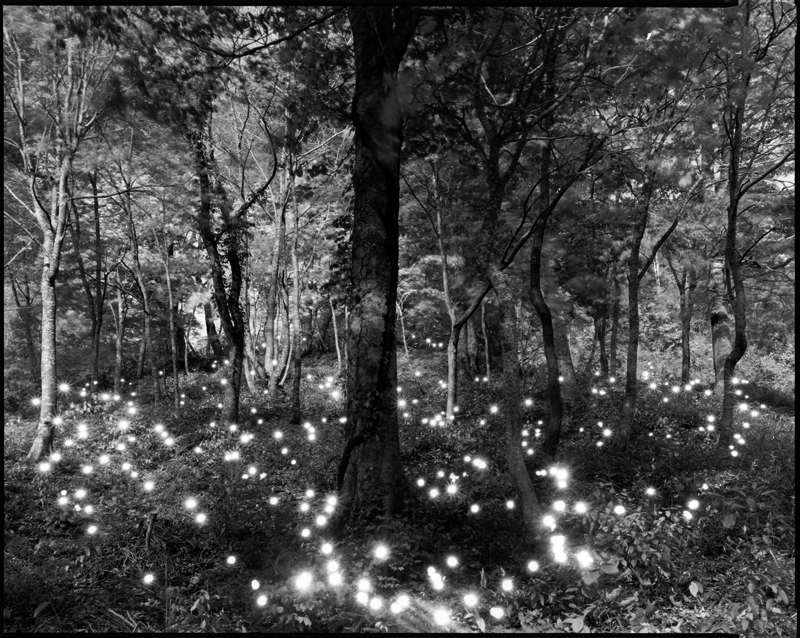
The images seem at once that they are like a kind of landscape, but with a palatable difference. Shot with an 8×10 large format view camera, the detail and tonal range of each are total and exquisite, but what lulls a viewer into lingering in the scene are the evidential traces that Sato leaves with us that tell us he was there, even though we do not see anyone in these still and quiet frames. Sometimes these traces take the form of little orbs of light hovering above water, snow or land; sometimes they are endlessly repeated long, thin and snake-like lines drawing our gaze down — these “landscapes†are full of something that was both always there and also intentionally carefully placed for us to consider. In a photograph by Tokihiro Sato, we are asked to see not just what is there, but what else might be there as well.
Sato’s initial artistic training was in sculpture. His first brushes with photography were with the rote act of documenting his sculptural output. He began experimenting with his first large format long-exposures and light drawing in order to grant his sculptural pieces qualities that he felt were inherently lacking in the medium: a sense of life and the ability to remark on the element of time. Sato has frequently commented on his enthusiasm for process over finished form, and the results of these early experiments are what gave birth to his “Photo-Respiration†works that he has become known for.
The term “photo respiration†derives from the actual human physical labor that is required to produce each finished image. Sato makes his photos in all kinds of spaces both rural and urban, and in the one to three hour exposure times he can be found to be walking, running, hiking, swimming, climbing, sweating (and definitely taking many breaths) between each interval required to record the impression of light on the film base. His process has been widely described in articles and online, and involves a combination of using mirrors to reflect sunlight back to the camera during daylight, and a flashlight hooked up to a battery pack or a penlight used for the nightshots. For the long exposures recorded during the day, Sato applies a darkening filter on his camera lens to prevent overexposure and to further allow himself a longer exposure time in which to navigate the terrain in whatever means necessary to fulfill the desired requirements of the photo. With exposure times of well over an hour any traces of the human element, or even the natural world in motion, become stillness and emptiness. People in a crowded intersection don’t become blurs, they simply Un-become, and waves in a seascape turn into a vague and hovering mist. In the snowy expanse of an image like Nikko 1 (2001, reproduced above), Sato ensured that the footsteps required to place the pinpoints of light would not become part of the exposure by placing himself in the back of the scene and working his way forward through the frame, so what we are left with is a snowy wood scene, a fallen tree and a seductive circlet of light with no hint of the footwork required to put them there.
“With exposure times over an hour any traces of the human element the natural world in motion become stillness and emptiness. People don’t become blurs, they simply Un-become.â€
The result is an image that is about process, traces and visible contradictions. Elizabeth Siegel, photo curator at the Art Institute of Chicago, said it well in the forward to their exhibition catalog of Sato’s work that, “…these pictures reveal a relationship between matter and energy, stillness and movement, and actual forms and potential ones.†Drawn to places that he self-describes as “sculptural space,†Sato’s choice of location is wholly intuitive. He has said that he is drawn in particular to locations that “seem to emit tiny sparks… that give off the air of an age.†Thus we have volcanic seascapes, woods, industrial waterfronts and commercial warehouse spaces — places from which images are made that are both landscapes and strange kinds of invisible portraits.
While claims have been made that in his images everything from fairies to references to Nude Descending a Staircase can be seen, and keen efforts by Western curators to place Sato in the wider and more accessible arena of a Buddhist or generally East Asian inflected aesthetic, Sato himself resists categorizing himself as purely a photographer, sculptor, land, performance or conceptual artist. In an interview he has said, “I only photograph landscapes, certain objects, and light. The light becomes corporeal, while the traces of light that I create as I move embody passing time, creating a sculpture in time.†His exhibition installations are much more than photos in frames on a wall, and belie his sculptural training. Stephen Longmire, writing in Afterimage of the Art Institute show in 2005, describes the work:
His large black and white images, nearly 40 x 50 inches each, are printed on a translucent material that is stretched with springs over grids of round fluorescent tubes, which mimic his own bursts of light. The results are sculptural, hearkening back to the artist’s beginnings in that three-dimensional medium. They remind viewers that photographs are, after all, objects, just as their making is an experience-one usually left outside the picture.
It is this extra emphasis placed on intended viewing that gives me pause for regret that I have yet to see Sato’s work in person. In the United States he is represented both by the Todd Haines gallery in San Francisco (their website has a very nice tour of an installation of his show where one can see the suspended transparencies in situ), and by the Leslie Tonkonow Gallery in New York.
While I love the surreal and seductive serenity of the Photo-Respiration work, I find myself increasingly interested in the newer color work that Sato has been producing within the last several years. Tantalizing bits are shown in the representative gallery webpages, but very little has been written or reviewed about them to date. Apparently Sato has created what he calls a Wandering Camera Project (House) — a mobile camera obscura, and has been making these Very Different images with it. Viewing them in relation to the earlier black-and-white work is almost like watching a pendulum swing; the newer color work is every bit as chaotic and jarring as the Photo-Respiration work is still and approachable. Both projects are, to my estimation, imminently engaging.
Tokihiro Sato was born in 1957 in Yamagata Prefecture. He graduated in 1983 with a MFA in sculpture from Tokyo National University of the Arts. He is well known in Japan and in the rest of the world for his exploration of making photographs of landscapes or common spaces using very long exposures. He proceeded to the construction of various kinds of cameras, including a multiple pinhole camera, and their installation in public or generally “vacant” spaces.
Since 1999 he has been an associate professor in the Department of Inter Media Art at the Tokyo National University of the Arts (known also as “Geidai”).
Tokihiro Sato’s work has been exhibited extensively internationally, for example as part of the 1997 6th Havanna Art Biennale and the 9th Asian Art Biennale, Bangladesh (2-person show) in 1999. He is represented by Gallery GAN (Tokyo), Leslie Tonkonow (New York) and Haines Gallery (San Francisco). Solo exhibitions of his work have been held in various locations in Japan and abroad, such as the Sakata City Museum of Art and the Art Institute of Chicago.
Most recently he has been working on a project on the theme of relationships with others as well as since 2000 the Sightseeing Bus Camera Project, where lenses are mounted onto the side of a public sightseeing bus to project the passing scenery onto a screen mounted in the middle of the bus.
In 2005 a book entitled Photo-Respiration was published in English by the Art Institute of Chicago. However, a book with the same title containing a very similar spectrum of work was already published in Japan in 1997 by the Nikkor Club*.
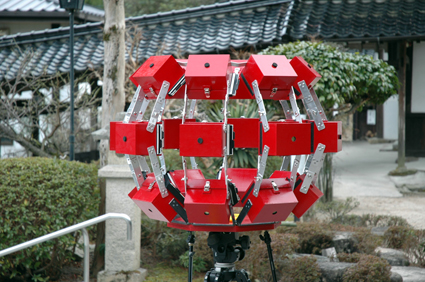
The Photo-Respiration series is Sato’s most well known work. When we approached him with our request for a cover photo, we were delighted to learn that he has been continuing to work on the series up until now, as the above 2008 image Shirakami #1 illustrates. Photo-respiration consists of two sub-streams, Breathing Light and Breathing Shadows. To make these photographs, Sato opens up the lens on his 8 x 10 camera for an extended exposure, sometimes up to three hours, and subsequently physically enters the scene in front of the frame. In Breathing Shadows a flashlight is pointed at the camera at nighttime or in a darkened space. In Breathing Light he uses a mirror to reflect light back toward the lens by day. In both cases he then moves around in the scene adding streaks or spots of light to the image. Ironically a long exposure of a person becomes a photo without anyone in it, but the viewer infers the person’s presence from the resulting image.
The title Photo-Respiration was chosen, according to Sato, because in the photographs he makes “a direct connection between my breath and the act of tracing out the light.” In his view this has the same significance as in monotonous activities such as long distance running or swimming, when one’s focus is only on breathing. The fact that Sato accommodates the three-dimensional real world by tracing it through his person into the image is often attributed to his training as a sculptor, although naturally the concept of dimensional collapse is part of the medium and a consideration for every photographer.
The resulting photographs have a very timeless and lyrical feel about them and this impression persists even after learning about the technique that was used to create them. In fact, knowing the method of creation adds to the enjoyment of the work. As always, it is the viewer who makes the image once more when facing it and doing so is a delightful moment. Interpretation is tempting, but one should be careful not to jump to quick associations. In an Q&A session, Sato was once asked what the reflections of light “represented” to him: perhaps fireflies, or marching pieces of string? His response was that representation is not his intention. All they represent is where he stood shining the light into the camera.
Even though we refer to Tokihiro Sato here as a photographer, it might be more accurate to speak of a visual artist who is appropriating the medium of photography. The Wandering Camera, for example, demonstrates a strong resemblance to an art installation or a performance which even includes an immediate feedback loop to the audience. Lastly, his award-winning contribution to the 20th Exhibition of Contemporary Japanese Sculpture 2003 is a camera-esque steel sculpture that reflects the outside world on the inside, showing that this artist is more than comfortable to move between the media he chooses to work in.






 Christoph Hammann is a fine art photographer from Waltershausen, Germany. He works with traditional film and silver halide papers as well as digital post-processing and alternative printing techniques. His website is “Mostly Black & White”.


 Tyler Ensrude grew up on the plains of rural Wisconsin in the United States and has lived in Tokyo since 2002. He has a degree in photography and graphic design from the University of Wisconsin and is a contributing writer and photographer for several publications in and outside Japan. His current projects include research on foreign photography within Japan as well as Japanese photography, photography books, culture and music. He can be found online at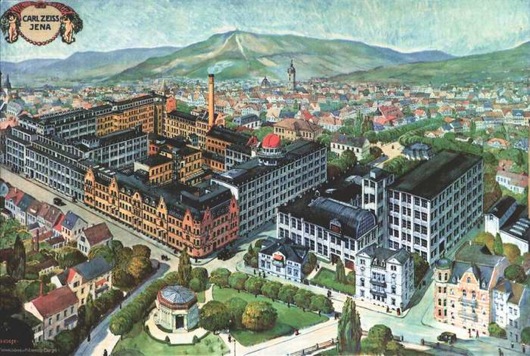




 Barry Kawa was born in Atlanta, Georgia, and grew up in Clearfield, Utah. He has worked as a reporter, bureau chief and editor at the Ogden Standard-Examiner, Times of Gainesville (Ga.), Charlotte Observer, Cleveland Plain Dealer and Dallas Morning News before moving to Japan in 2001 with his wife, Yumiko. He now works at a Japanese newspaper, and has become an avid camera enthusiast and collector.   Â
Barry Kawa was born in Atlanta, Georgia, and grew up in Clearfield, Utah. He has worked as a reporter, bureau chief and editor at the Ogden Standard-Examiner, Times of Gainesville (Ga.), Charlotte Observer, Cleveland Plain Dealer and Dallas Morning News before moving to Japan in 2001 with his wife, Yumiko. He now works at a Japanese newspaper, and has become an avid camera enthusiast and collector.    
 Stacy Oborn is an American writer and photographer living in Berlin. Raised a military brat, she grew up all over the southeastern United States, and did her graduate work in photography in Chicago at both the Institute of Design and Columbia College. Stacy now works remotely as a web editor in Berlin, Germany, while her fiancée completes research work for his dissertation. She is the author of the website