Travelling with Clowns — Toshio Enomoto

Text and images by Tyler Ensrude for Japan Exposures

In Toshio Enomoto’s series Arlequin we can see a beautiful, present-day version of the classic circus right here in the heart of Japan. Arlequin is the French word for clown or jester; sometimes also written harlequin. At first glance, it’s hard to tell when these photographs were taken. It turns out that Arlequin, photographs of the Kigure Circus, consist of various images between 1998 and 2008, much later than I had originally assumed.

Shot with either a Hasselblad or Mamiya 6, these timeless square B&W prints could easily have been from the 1950s, 60s or 70s. The lasting characterization that kept me guessing on the date could possibly be from his subject’s signature uniform. The white face, the squirting flower, the giant shoes, as well as our image of the circus altogether, the appearance of the circus clown has gone virtually unchanged over the decades.

The clown without the face paint or the clown behind the scenes has always been a subject begging to be photographed.”

But, on the other hand, our depiction of and our fascination with the clown have taken on many forms over the past century. Our Hollywood horror provoked coulrophobia (abnormal or exaggerated fear of clowns — Ed.) and the humor we get out of the clown who has let their guard down, revealing the person he or she really is, has encompassed our overly entertained minds through out the 80s and 90s. The clown without the face paint or the clown behind the scenes has always been a subject begging to be photographed — back in the days of early photography and after seeing and listening to Enomoto’s take on the circus, that urge and attraction is obviously still alive today.

In the early and mid-twentieth century, with the popularity of photography as a way to document a life or a group of people over a period of time coming into play (i.e. Riis or Lange), we soon were able to take a subject, such as the clown, and expose it for what for what it really was from within.

Travelling with clowns - Toshio Enomoto

Take Circus by Bruce Davidson, for example, from the late 1950s. We see portraits of clowns, unmasked, smoking, working hard and — for the first time — just being human. We see the lives of the performers and the “misfits” who loved and hated what they do. This concept of “exposure” is very similar to Enomoto’s portrayal of the circus as well.

Davidson’s images in Circus of Jimmy “Little Man” Armstrong make that book the classic that it is. He’s a small guy with the typical exaggerated clown emotions, but often, captured by Davidson, without the face paint. That was the real “Little Man”. You could even go as far to say it was one of the first times we looked at an abnormally small person as human.

Diane Arbus’s portrayal of Freaks from the 60s and early 70s did more of the same, if not more so. Her work of the short, tall, and tattooed showed us the life of the sideshow performers, who had been gawked at and treated as if they were animals for centuries. The human side of the circus had been exposed and it further fuelled our fascination and curiosity to find out who these people really are, pushing closer and closer toward the deeper, cinematic, yet all-human clown we think of today.

Travelling with clowns - Toshio EnomotoTravelling with clowns - Toshio Enomoto

Much like Davidson or Arbus, Enomoto in Arlequin was able to exhume the circus for what it really is. You see the backbreaking life of the circus staff, the circus mothers and their children, the cramped quarters they’re living in, the rehearsals and performers of all kinds trying to make a living at what they do best.

But, Enomoto’s photographs seem to be slightly different. Those performers who seem to be struggling with life or seem to feel like an outcast, the ones trying to find a place in society or to remain sane in a somewhat insane setting, appear to be missing from Enomoto’s photographs. He very eloquently shows how today’s circus, behind the curtain, can be arduous, but at the same time fulfilling for the people who participate in it. They really seem to love what they are doing and, perhaps, the life in the circus, the clowns, and the “freaks” have changed more than it seems on the outside.

The circus has always been known as accepting to those not accepted in society, but nowadays, maybe, we, the audience, have changed and we have a better understanding of the truth and to who these people really are, thanks in part to the photographic exposure given to the people involved in it.

I was lucky enough to get invited to meet with Enomoto-san for a few minutes at his exhibition at the Nikon Salon Ginza. That morning, I had only sent him a quick mail in hopes he would answer a few questions the same morning and he said to come on down to Ginza again and we can talk in-person. I was taken aback a bit by his gesture of kindness to a complete stranger, but I rushed back to the Nikon Salon that afternoon to see if I couldn’t find out more about this intriguing ‘Arlequin’ photographer.

Toshio Enomoto at the Nikon Salon Ginza (Photo by Tyler Ensrude)
It turns out that Enomoto has a very prominent history and was quite the traveller himself in the past. His most well known series of photographs and book is called Tooi Higashi or Far East (in the literal sense) and was originally displayed at the same Nikon Salon Ginza in 1974. The photographs, from that same year, cover his trip through most of Asia in a Toyota High Ace with his friend at the age of 24. Not only are the photographs and this book an amazing recollection of his road trip, but in a way, are visions of a young man changing and growing as a photographer. The journey in itself is something to be proud of as it covered countries including Turkey, via the Silk Road routes, through the Byzantine ruins, Iran, Afghanistan, Pakistan, India and Nepal.

His more recent works in Japan of Kyoto (Twilight Memories: Kyoto) and Sakura are mostly shots taken at dawn or dusk, with very little available light. Small things like the swaying of the cherry tree branches in the breeze, the stillness of the rain water after a big spring storm, the darkness of the temples in the early morning of winter and the evening quarters of the courtesan readying themselves for the night are very powerful and convey that moment he opened his cameras’ shutter so vividly. The images are usually sharp, but sometimes blurred, are all black and white and often convey strong depth, both compositionally and aesthetically. His book entitled Kagirohi or Lamp flame is an wonderful compilation of his view into Kyoto by the light of the Kagiro.

Finally, I asked him a little bit about his photographs in Arlequin. My initial impression and interpretation appeared to be right, as I had mentioned earlier, in that the circus has always been an accepting place. He said that that is one of the best things about being involved in the circus for the last ten years. He likes the sense of family the circus holds. Whether a performer is from Russia, China, Thailand or Japan, it’s all for one and one for all. He’s watched the children grow, learn from and admire their parent’s profession and even start to perform alongside them. In a way, you could say that he has been accepted into this group as well after photographing and documenting their lives for so long. He’s looking forward to seeing them grow and change even further as he continues to follow and photograph the Kigure circus today. Look for ‘Arlequin’ in print some time in the near future.

More images can be seen at Toshio Enomoto’s website.

Tyler EnsrudeTyler Ensrude is a contributing photographer and writer from the U.S. currently residing in Tokyo.

His work can be seen at www.tylerensrude.com and www.tylerensrude.blogspot.com.


MS-MAG x1.15 Leica M viewfinder magnifier back in stock

As we announced previously the popular MS-MAG 1.15x magnifier (announced as discontinued and sold out) is back in stock. This magnifier is of great value as on cameras with 0.85 magnification (e.g. Leica M3, Leica M6) it will result in natural view allowing shooting with both eyes open.

Thank you for your patience and those who have placed pre-orders, which will be fulfilled today.

Sho Niiro – from Dystopia Nippon series

Sho Niiro was born in Yokohama in 1982. He studied physics at Waseda University,

but left university and became an independent photographer in 2005. He is photographing in the streets of Tokyo, with particular emphasis on how the town is being redeveloped, documenting its rapid change quickly departing from its citizens’ own memories. He also photographs in the Sanya district in Tokyo.

He has held several solo exhibitions, most recently his series Dystopia Nippon, from which this photo is taken in February this year at Gallery Niepce in Yotsuya/Tokyo, who also represents Niiro and will host a solo exhibition of his work from 8th to 16th of August 2009.

Nobuyoshi Araki: Tokyo Aruki (Tokyo Walks)

Text and images by John Sypal for Japan Exposures

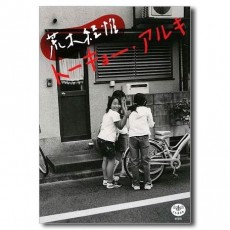
Nobuyoshi Araki: Tokyo Aruki (Tokyo Walks)The other night I picked up Araki’s latest book, Tokyo Aruki. It comes in at a modest 160 pages printed at the extremely portable A5 size. Initially I was taken in by the reasonable asking price, but after a couple go-throughs it is plain to see that portability was a major factor in this book’s construction.

Each section is divided between various locations throughout Tokyo, taken over a full year between July 2007 to July 2008. Similar to Aget’s Paris, Tokyo is Araki’s town.

It is worth stepping back for a moment to reiterate that “Tokyo” as you might think is not technically a city in the way that Omaha is considered to be. That said, he kept to a handful of the 23 wards for the photographs which ended up in this book. To be more casually precise (!), the photographic sections have been separated into areas often determined by the name of the local train station.

Nobuyoshi Araki: Tokyo Aruki (Tokyo Walks)

Interspersed through the pages are brief essays on thoughts of his personal meanings for each area. Some of the sections feature the appearance of young women who have flocked (his words) to him to be photographed. I say that jokingly, but I have with my own eyes seen a young woman break down into tears simply upon seeing the man step out of a room. So “flock” it is.

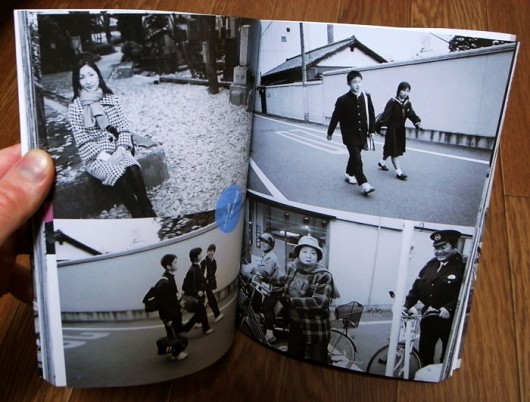
Often his writing goes further into technique and thoughts on the human condition in Tokyo which in Japanese can sound sweet, but putting it into English they are a little corny. For good measure it seems that the editor felt it best to highlight some of the cornier statements in blue or pink and slap them down on top of a perfectly fine photograph. There are unexpected visual treats here, but one has to look a little harder than usual to find them.

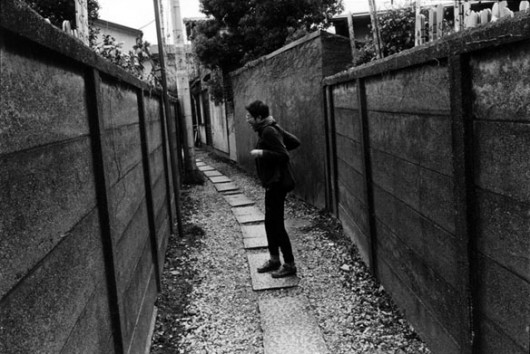
For those who only know the more internationally marketable and nude/bondage side of Araki’s work, the fact that he is a street photographer on par with — and often surpassing — the “greats” might come as a surprise. Due to limitations in printing quality and text placement this book isn’t the greatest vehicle to find this out, but at the price it is a good beginning chance to explore this recent softer side of his work.

Nobuyoshi Araki: Tokyo Aruki (Tokyo Walks)

If you are at all ever out with a camera in Tokyo you’ll no doubt recognize the locations of a good half of the pictures, or in some cases, have already photographed there yourself.

Nobuyoshi Araki: Tokyo Aruki (Tokyo Walks)

Earlier I mentioned that portability is an essential aspect to this book’s creation. It wasn’t until looking at the last three pages when the realization that Tokyo Aruki is in part, a Tokyo walk-a-bout type travel companion. It’s “Araki does Tokyo” in a way that is different from his other previous (and often more literal) experiences.

Nobuyoshi Araki: Tokyo Aruki (Tokyo Walks)

Since it is indeed a travel guide, each section of the book has it’s very own precise map, complete with Araki’s very route highlighted for those who might want to hit up the same spots. If the recent press is of any indication, Tokyo Camera Walks seemed to have exploded in popularity over the past few years and I’m assuming that due to it’s extremely approachable content matter, this book has several print runs ahead of it.

And for those who might be interested in the cameras which he used, a few pages before the maps are devoted to an informative essay about his camera choice (two Mamiya 7II) and (naturally) pictures of Araki on the street working.

Nobuyoshi Araki: Tokyo Aruki (Tokyo Walks)


John Sypal
John Sypal

John Sypal, born and raised in Nebraska, USA, currently living in Matsudo city (Chiba Pref.).

John has been exhibiting his photographs widely in the US and in Japan. His photographs are frequently featured in Japanese photo magazines.

He is currently a member of Machikata Sampo Shashin Doumei (Walking Photographers Alliance).

John also enjoys meeting people and photographs their cameras for tokyo camera style.


Tokyo Aruki can be purchased in the Japan Exposures Book Store.

Hiroyo Kaneko – Sentimental Education

Originally from Aomori, Japan, Hiroyo Kaneko has been living for the past seven years in San Francisco. She received her MFA in Photography from the San Francisco Art Institute in 2005. She has been exhibiting her photography since 1999 at such as places as the Photographers’s Gallery and the National Museum of Modern Art in Tokyo, the San Francisco Art Commission Gallery, and the Headlands Center for the Arts in Sausalito, CA.

In 2009 she was awarded the prestigious Santa Fe Prize for Photography. In the accompanying Juror’s statement, Charlotte Cotton, Curator and Head of the Wallis Annenberg Department of Photography at the Los Angeles County Museum of Art, wrote: “[…] I needed a little bit of time to become comfortable with the better than formulaic way that Hiroyo Kaneko works and to trust that the ambiguous and unexpected threads that her practice weaves are both interesting and enduring. I appreciate the subtle layers of thought and observation that underpin her practice and I really look forward to seeing how the amazing support that the Santa Fe Prize for Photography offers will impact on her photography.”


Please also see our interview with Hiroyo Kaneko.

Interview with Hiroyo Kaneko

I first came across the work of Hiroyo Kaneko earlier this year when I received my copy of Lay Flat, the new photography magazine started by Shane Lavalette. Included with the journal were 20 or so photographs by various artists, each printed individually on card stock. When I came to Kaneko’s image from her Picnic series (reproduced here), I was given a little start — here was a scene that was unmistakably of Japan, and yet somehow not of it at the same time. I was intrigued.

It was only a couple of weeks later that I read a blog post somewhere noting that Kaneko had won the prestigious Santa Fe Prize for Photography for her series Sentimental Education. It seemed almost too much of a coincidence. (So too did learning the fact that Kaneko had attended the school I had spent four years of my own educational life at — San Francisco Art Institute.) I wanted to know more about this person who was exploring such threads of the Japanese cultural and societal fabric as hot spring baths and cherry blossom viewing parties while removed in part from the day to day-ness of life in Japan.

This interview was conducted over email in May. Please also see our Cover Photo featuring Kaneko.

Japan Exposures: I would like to know how you first became interested in photography. You majored in French Literature at Meiji Gakuin University. How did you go from that to attending San Francisco Art Institute and earning an Masters of Fine Arts in Photography there?

Hiroyo Kaneko: When I was in Meiji Gakuin, I took some classes about the visual arts and film. That was because the period that I was studying within French Literature was early to mid 20th century, a time when all the cultural movements interacted each other. I was interested in the relationship between writers, visual artists and filmmakers, such as Andre Breton, Man Ray, Marcel Duchamp and Luis Bunuel.

I was also into French New Wave films, especially Jean-Luc Godard and François Truffaut as well as Japanese film makers, like Yasujiro Ozu, Mikio Naruse and Seijun Suzuki. All those visual experiences got me involved in a filmmaking circle and I made a few 8mm films with my classmates. However, after we graduated it became difficult to get together to continue the activity, and then I gradually shifted to photography which I could do on my own.

After working in an advertising office for a couple of years, I went to London to study English and photography. I attended a small art college and got a diploma in photography, then went back to Tokyo and started working as an assistant photographer, and eventually as a freelance photographer and writer for some culture and photography magazines.  At the same time, I kept working on my own photo projects. This was from mid-1990s to the turn of the 21st century.

The more I had chance to have exhibitions, the more I became interested in focusing on art photography for myself. Then I decided to go to the United States to pursue photography further. San Francisco Art Institute was one of the schools that I applied to, I was interested in it because a few interesting photographers had gone there, such as Lewis Baltz, Annie Leibovitz, Jim Goldberg, Catherine Opie, etc.

I got interested in seeing how our ordinary daily experiences nurture the ways we communicate with each other.”

JE: You still live in San Francisco. How long have you now lived in the U.S.?

HK: I have lived here since 2002. San Francisco is a comfortable place to live. Compared to Tokyo, New York, or other bigger cities, it’s slow and relaxed. But at the same time, the art scene is quite active. Although there are not many commercial galleries — actually I guess it’s almost the same size as Tokyo where the contemporary art market is really small – there are some alternative and community art galleries and organizations over the city which offer various events all the time. If you go over to the East Bay, you can see a different type of art scene as well. I should also mention that the Pacific Film Archive in the UC Berkeley and a few other independent movie theaters let me stay here as they always show a variety of film programs.

Hiroyo Kaneko - from "fountains" series
Hiroyo Kaneko – from “fountains” series
JE: How often — and for how long each time — do you return to Japan?

HK: I go back to Japan about twice a year since graduating, and stay for a couple of weeks to a month each time.

JE: Although based in the U.S., your projects themselves seem to be based very much around Japan and subjects close to Japan, such as cherry blossoms or hot springs. Do you think living outside of Japan lets you look at these familiar aspects of Japan in a different way?

HK: Although I said before that San Francisco is a comfortable place to live, for the first couple of years after I moved here, I experienced severe difficulty communicating with others. This doesn’t mean that the people in the US are more severe than people in Japan. I guess that any community in contemporary society should be same more or less, even within families. But for me, it was more obvious here because I was a stranger, had a language barrier, and faced cultural differences, etc.

However I also became more grateful and found it precious when I saw mutual respect or understanding. For those reasons, I got interested in seeing how our ordinary daily experiences (rituals) nurture the ways we communicate with each other and how we interact emotionally with each other. Rather than showing the tough side, I wanted to show something more neutral, basic or more positive and warmer aspects of it.

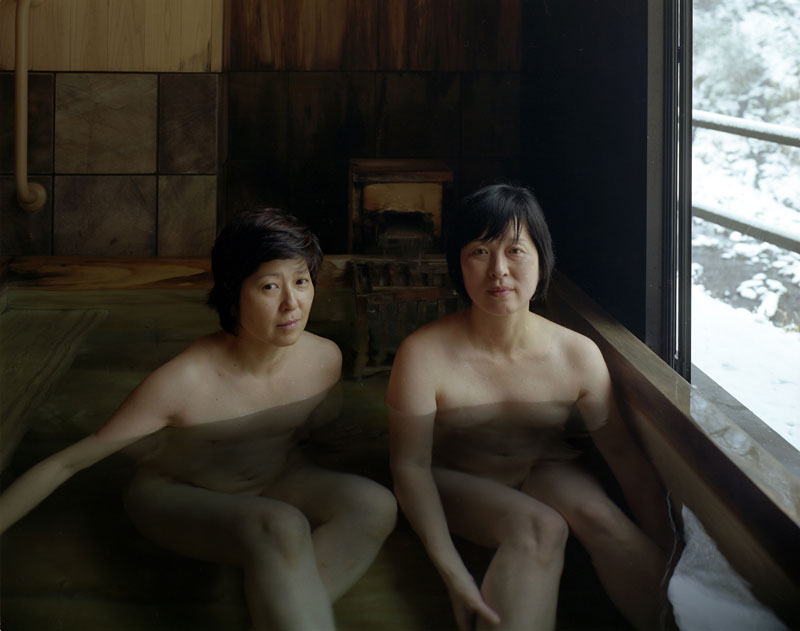
Then I came up with the idea of photographing people in bathhouses in Japan which seemed to me an ideal setting for my purpose. The cherry blossom pictures stem from a similar idea. I photographed them in Hirosaki in Aomori Prefecture, where I was born and spent my childhood. I was interested in reviewing and recreating my early experience which, I guess, helped to create my emotional makeup.

JE: In one of your artist statements [The Three Cornered World, 2006 — Ed.] you talk about moving around a lot due to your father’s work, and seeing yourself as a stranger. Can you talk more about how this idea of being a stranger manifests itself in your photography?

HK: As I wrote on that statement, the idea came from a novel by Natsume Soseki, who I like a lot. In his novel “The Three Cornered World”, he wrote:

Objectively you may feel that the love of a man for his wife or his parents is beautiful, and that loyalty and patriotism are fine things. When, however, you yourself are actually involved with them, the violent flurry of pros and cons, advantages and disadvantages, will blind you to all beauty and splendor, and the poetry will be completely lost to you.

In order to appreciate the poetry, you must put yourself in the position of an onlooker, who being able to stand well back, can really see what is happening. It is only from this position that a play or novel can be enjoyed, for here you are free from personal interests. You are only a poet while you are watching or reading, and are not actually involved.

(From a translation by Alan Turney; original Japanese text below.)

He talked about how important it was to see things as an onlooker for dealing with “love”, “faith”, “pain”, etc., being free from your own interest. In this novel, he repeated the phrase “standing as the third person” as well as “being detached” (he distinguished the meaning of these words from “inhuman”), telling how to sublimate emotional issues into art. And I totally agreed with his idea.

As people know, many of his novels actually deal with the emotional relationship between friends, couples, lovers and families. Sometimes, they are very touching and painful but at the same time they always keep some kind of dryness or a objective point of view, I think that this ambivalence or two sidedness is what I care about his work and I would like to apply for my work as well.

Hiroyo Kaneko - from "Sentimental Education" series
Hiroyo Kaneko – from “Sentimental Education” series
JE: I’m sure many people ask you this question, but how hard was it to get your family to agree to be photographed for the bath house series. You could of course have photographed other people at hot springs, but you chose your family. Why?

HK: At first, it wasn’t so hard. I just explained to them how I wanted to photograph in the bath house and they just agreed. I guess it was because they liked going out to hot springs to begin with and they wouldn’t have taken this photo session so seriously. But later, especially my mother became more hesitant to be a naked subject. So I had to make more of an effort to convince her. But they are basically pretty open minded and very helpful in general. I really appreciate their collaboration. Besides, the fact that I live abroad and show the work only in the US makes them less shy.

Initially, I didn’t particularly intend to make the portraits of my family but only to use them as models because I didn’t think that strangers would allow me to photograph them naked. Besides, I needed to demand of them some kind of posing as 1) I used a 4×5 camera and 2) I didn’t want this work to look like a documentary. So asking my family seemed to me the only choice for the situation. However, since then, I started to include their images in my other series also. I think that the more I photograph them, the more I am able to gain an objective and artistic view of them. So it has become less of an obstacle to deal with my family in my work.

JE: Could you tell us about some of the people (photographers or otherwise) that have been important to you, that inspire you?

HK: I am much more influenced by painting than by photography, I suppose. Especially the paintings by French impressionists like Manet and Cezanne (also Renoir and Bonnard too) teach me how I should deal with the natural light and color that are reflected from the subjects. For the way of seeing the relationship between people and family, I also learn a lot from movies by directors such as Mikiko Naruse, Yasujiro Ozu, Howard Hawks, Ingmar Bergman, Manoel de Oliveira, as well as others.

As for photographers, I admire these people: Eugene Atget, Lee Friedlander, Diane Arbus, Stephen Shore, Joel Meyerowitz, Jean-Marc Bustamante, Thomas Struth, Kineo Kuwahara, and Ihei Kimura.


Original Japanese of Soseki quote:

『恋はうつくしかろ、孝もうつくしかろ、忠君愛国も結構だろう。然し自身がその局に当たれば利害の旋風に巻き込まれて、うつくしき事にも、結構な事にも、目が眩んでしまう。従ってどこに詩があるか自身には解しかねる。

これがわかる為には、わかるだけの余裕のある第三者の地位に立たねばならぬ。三者の地位に立てばこそ芝居は観て面白い。小説も見て面白い。芝居を見て面白い人も、小説を読んで面白い人も、自己の利害は棚へ上げている。
見たり読んだりする間だけは詩人である。』