All posts by Kurt

Miyuki Okuyama Gallery

Miyuki Okuyama, in her series Safe Playground that she has been working on, off and on, for the past six years, constructs pseudo-landscape scenes using miniature props. Shooting these with toy and pinhole cameras, these dark and moody scapes may bear little relation to the staid spaces of The Netherlands where she now makes her home, but they are perhaps a closer reflection of how Okuyama is negotiating her island of existence between her homeland of Japan and her current domicile, and that no man’s land between the mystery and wonder of childhood and the stifling practicality of adulthood.

Perhaps we do a disservice to the work even mentioning the low-fi, constructed nature of it — after all, what photography isn’t constructed? There is no “real thing” when it comes to photography, or for that matter, memory, and longing. They are all constructions, and all very low-fi — muddy, blurry, and fragile.

Miyuki Okuyama – From Safe Playground

Miyuki Okuyama was born in Higashine, Yamagata Prefecture, in 1973. She received both a BA and MA in Studio Art from the University of Alabama in the US, and has been based in The Netherlands for the last few years. Her work has been exhibited in the US, Europe and at home, and was recently part of a three-person exhibition at The Empty Quarter in Dubai. In 2006, she was a finalist for the Hitotsubo-Ten prize (previous winners include Rinko Kawauchi, Mika Ninagawa, and Shin Suzuki).

See also our extended gallery with work by Miyuki Okuyama.

Moriyama’s Kabukicho lounge singer girlfriend love story — Nagisa Review

Daido Moriyama's Nagisa

Review by John Sypal for Japan Exposures

The thing about Daido Moriyama books is that as nice as they are, by now they certainly won’t surprise anyone. You know what you’re going to get the moment you see the cover. Ginza? Buenos Aries? Hawaii? You know exactly how the pictures are going to look. As a native Nebraskan I can tell you that if Moriyama were to spend a week shooting in the Cornhusker State the inevitable collection is going to look just like Moriyama does Nebraska. And it probably wouldn’t look all that different than his pictures of anywhere else he has photographed. Until the other day the only book by Moriyama that I had in my collection was the cheaper of his two Hokkaido books.

Daido Moriyama's Nagisa To me Moriyama had always been one of those photographers whose work was never all that interesting and it wasn’t until his Hokkaido show at Rathole gallery in early 2009 when it clicked. I found his exhibited work extremely moving, the gravity of which was revealed in a gallery setting with prints metaphorically layering upon one another to create a dizzying experience. I went five times to that show. In print (as opposed to prints) the books felt flat. Literally his pictures are layered on one another in book form but nearly all of his books were too constricting, too much about the book than the images to be of much personal interest.

So the other day at Sokyusha, the preeminent photo book publisher in Tokyo, I surprised myself by purchasing a copy of Moriyama’s recent book Nagisa. As I flipped through it, from behind the counter Ota-san, the shop owner, mentioned that this collection is simply of Moriyama’s current love interest, a kabukicho & kayokoku singer named Yoko Nagisa. While my photography book collection might be lean on Daido Moriyama, books featuring lovers or wives of Japanese photographers are well represented. Looking at it in the context of such a book it was doubly interesting.
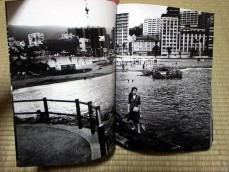
Daido Moriyama's Nagisa Yoko. What else could her name be but Yoko?

On one hand Nagisa follows that grand tradition of Japanese photo books centering on a singer or musical act. On the other hand it follows the other even grander tradition of Japanese photo books in that it are collections of photos of a lover. Since both of those hands belong to Moriyama it is very much the book you might imagine when hearing “Daido Moriyama’s Kabukicho lounge singer girlfriend love story”. If you know much about any of the words in the previous sentence you probably have a good idea as to how this book looks.

The book is handsome. It’s thick, visually dense, and features exquisite printing. Laid out flat it pulls the viewer in. Plus she is gorgeous. But for as hefty as the book is and for as distantly beautiful as Ms. Nagisa is there isn’t much development of her or her relationship with the photographer throughout all 200+ pages. She makes a good picture, hell, Moriyama makes a great picture and that’s what this comes down to. It’s two people good at what they do – one skilled with a camera, the other one looking great with eyeshadow in vintage outfits, moody bars, back streets of Shinuku, singing at Moriyama exhibitions, on desolate beaches, in the last train car, or among cherry trees in bloom. Sometimes it is several of these things at once.

Daido Moriyama's NagisaBut for every moody monochromatic sunset or languid look off into the distance one might feel that what’s not captured is true personal development. We don’t know any more about Yoko Nagisa by the last few pages than we could gather from the first ones. Moriyama’s Yoko is certainly not Araki’s Yoko. That said, maybe we don’t need to expect intense character development or a Deep Story when looking at collections like this. A beautiful book can be just that. In this way this collaboration between these two performers has resulted in something well worth a look.


You can see more images from the book, as well as an interview with Moriyama and Nagisa, in this video (Japanese only).


Nagisa is available in the Japan Exposures bookstore.

Aya Okabe Gallery

Profile by John Sypal for Japan Exposures

The Japan which Aya Okabe presents in her work is perhaps too familiar to those who live there and not nearly Japanese enough for those who don’t. Visually she would fit in the Street Photographer pool although her work is most likely maddeningly dull to that genre’s most righteous practitioners. Owing nothing in influence to the gritty contrasty black and white photography to which so many others with a camera in Tokyo follow, she plainly and clearly photographs events and places with a New Color sort of palette. All of those trite, tired, and worn Traditional & Modern, Old & New, East & West dichotomies are of little interest to Okabe. Her pictures refreshingly lack attempts at employing visual documentary drama but that contemporary photographic buzzword “deadpan” would be inaccurate in describing her work. These photographs are more complex and deftly framed than a first glance might determine. With the proper amount of consideration their charm shines through.

Okabe’s Japan is clearly lit, steadily focused, and often amusing. Cultural and visual elements come together within the frame often at the same physical distance from picture to picture but her skill at keeping everything just out of reach adds to their perplexity. The entire frame is the subject, not any one easily recognizable person or thing. Even when the Japanese national flag is prominently featured in stark red and white within the frame, it isn’t ever enough to make the image “about” Japan’s particular type of nationalism. Kimonos do not simply denote “tradition” any more than power-lines express a fondness of “electricity”. Faded signs of post-war local shops aren’t explicitly about the past or a desire to return to it. It would be easier to be fed meanings and stories but Okabe rightly avoids stooping to this sort of image making to provide the viewer with something more interesting.

The key to my own personal understanding of these photographs is the enjoyment of their ambiguity.

Aya Okabe — from 「天晴つばめ」

Aya Okabe was born and raised in Tokyo. A student of Mitsugu Onishi, Koji Onaka, and Masato Seto, she continues to hold solo shows of her work in Tokyo. Since the creation of the 2008 series 天晴つばめ (very loosely translated as “Swallows in Clear Skies”), from which the above photo comes, she has set down her DSLR to upgrade to a 35mm rangefinder and the joys of cheap consumer grade color negative film.

Michio Yamauchi — from “Tokyo 2009.12”

Michio Yamauchi was born in 1950 in Nishimikawa, Aichi Prefecture. After graduating from Waseda University, he attended Tokyo College of Photography. He has been exhibiting his works in independent galleries since 1980. A winner in 1997 of Nikon’s Ina Nobuo Award, Yamauchi has in the last 20 years published over 10 books of his work.

The above photo comes from Yamauchi’s new exhibition entitled “Tokyo 2009.12” which begins this Friday May 14 at Tokyo’s Third District Gallery (running until May 25). Approximately 50 works will be on view. On May 22 at 7p.m. at the gallery, Yamauchi will have a “teach-in” with photographer Seiji Kurata (Flash Up, 80’s Family: Street Photo Random Japan). If you’re interested in attending (Â¥1,000, one drink included), space is limited to 30 people (send an email to the gallery at info@3rddg.com).

Hideo Takiura Gallery

Hideo Takiura began his adult life not as a photographer but as a landscape designer. I don’t know much about this somewhat esoteric profession but it’s hard not to wonder how shaping the earth has ended up shaping Takiura the photographer. At the very least, these two vocations share the need to take a wild, amorphous nature and confine it within a defined, artificial frame. And if we are talking about frames, it strikes me that of all the various film formats, Takiura’s chosen format for his “Tokyo Bodies” series, the 6cm x 6cm square, represents the most artificial, self-conscious type of confinement a photographer can choose.

We have been conditioned for so long to see in rectangle that its frame lines have become second nature. But the square forces us to acknowledge the frame, and to acknowledge that what is presented in that confined space, like the manicured landscape, is only that which the artist wants us to see. This is not to say that we are left with mere contrivance, however. This is what is so charming about Takiura’s work — on the streets of Tokyo, there’s only so much trimming and pruning one can do. Takiura’s subjects are confined to their frames, but they are also fighting against them (and occasionally hiding behind them, or even stuck in them). Fanciful as it may be, I like to imagine that the reason Takiura traded in his shears for a Rolleiflex is because in the wild city streets of Tokyo, these trees talk back.


Signed copies of Takiura’s self-published book, Tokyo Bodies, are available in the Japan Exposures bookstore.