All posts by Kurt

Hideo Takiura — From Tokyo Bodies

Hideo Takiura was born in 1963 in Tokyo, and graduated from Tokyo Agricultural University in 1986. After working as a landscape designer for a few years, he began pursuing a career in photography. His photo book Tokyo Bodies, from which the above photo is taken, collects work shot by Takiura on the streets of Tokyo from 2000-2007 with his trusty 6x6cm medium format camera. A limited number of signed copies are available in the Japan Exposures bookstore.

Please also see a gallery of Takiura’s Tokyo Bodies series.

Osamu Shiihara — “Three Dimensions” (1938)

Osamu Shiihara was born in Osaka in 1905, and graduated from the Tokyo School of Fine Arts (now named the Tokyo University of the Arts, or known popularly as “Geidai”) in 1932 after studying in the Western painting department. While trying to establish himself as a painter in Hyogo Prefecture, he took up photography and became a leading member of the Tampei Photography Club along with Nakaji Yasui and others. The group was known for producing avant-garde work through a variety of techniques. Shiihara himself used solarization techniques, as well as his own unique combination of photography and painting. Shiihara’s works are in the permanent collections of The National Museum of Modern Art, Tokyo, Nagoya City Art Museum, The Museum of Fine Arts, Houston and The Museum of Modern Art, New York, among others.

You can see more examples of Shiihara’s work here.

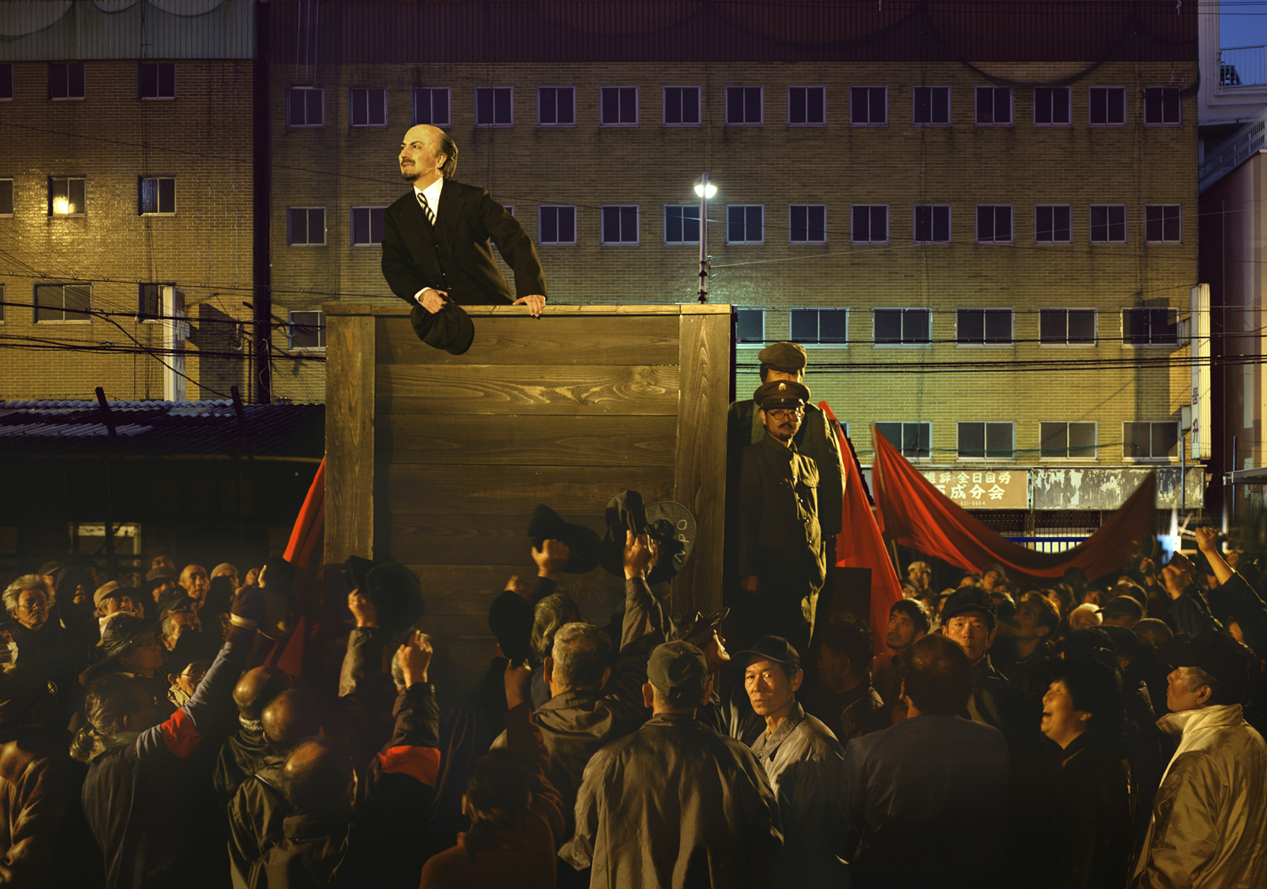
Yasumasa Morimura — A Requiem: Vladimir at Night

Yasumasa Morimura was born in Osaka in 1951, and received his B.A. in 1978 from the Kyoto City University of Art. Since the mid-80s he has pursued his own unique brand of “appropriation” with his simulations of other artists’ paintings where he inserts himself into the work, done with extreme care — and a lot of make-up — to ensure the results have a high level of fidelity. Particularly compelling — and it has to be said, hilarious — are those works of self-portraiture where Morimura becomes the artist “depicted”, from Van Gogh to the more recent Frida Kahlo. He is also well known for his series of Hollywood starlets where he becomes Greta Garbo, Brigitte Bardot, and Marilyn Monroe, among many others.

The above work comes from his latest exhibition, Requiem for Something – Art at the Summit of the Battlefield, which is currently on view at the Tokyo Metropolitan Museum of Photography until May 19. From Lenin to Picasso to Einstein, Morimura’s “self” portraits pay homage to many famous male figures of the 20th century.

Books Exotica — Seventeen by George Hashiguchi

Seventeen, by George Hashiguchi -- Book CoverGeorge Hashiguchi is we suspect not a household name for our overseas readers. But to our mind, even though he’ll never get the love that someone like Hiroh Kikai enjoys, he’s one of the finest portrait photographers in Japan — a modern August Sander of Japan, if we may be so bold.

Seventeen (17æ­³), by George Hashiguchi
Pub. by Kadokawa Shoten, 1998
ISBN: 404851122X
Original Cost: ¥2,800
Japan Exposures Price: ¥1,490 SOLD

Photographer
George Hashiguchi’s portrait collections are so ubiquitous to the point where you may actually be inclined to think he was a hack, churning out book after book like he was a professional cat photographer. It must be said that Hashiguchi hasn’t necessarily helped himself in this regard, since most of his portrait projects — senior citizens, couples, fathers, workers, and 17-year olds like we have here — all follow roughly the same formula: a very specific group of people, full body portraits in black and white, an accompanying page of text featuring the same type of questionairre presentation (eg. the subject’s favorite music, what they ate for breakfast, how much their monthly allowance is) along with a paragraph or two of commentary from each subject. However, like more famous typologists, this standardization goes a long way toward highlighting the individual idiosyncracies of the subjects and countering what could be mistaken for homogeneity.

Seventeen, by George Hashiguchi -- Sample Page Spread 1

Description
Portraits done across Japan of 17-year olds, this is a republished version of Hashiguchi’s “Seventeen’s Map” which was published in 1988 (cue obligatory Parr/Badger reference — Volume 2, p. 300), with all the same portraits and text but different sequencing. Hashiguchi traveled throughout Japan with the very specific intention of taking portraits of people who were 17 years old at the time of shooting. According to Hashiguchi, he didn’t care who his models were, as long as they were 17. He also included in the book every single person he photographed, choosing not to edit out any of the subjects.

Hashiguchi (writing 20 years later) says, “These 17 year olds were all reall very different. These were ordinary high school students, and students whose hearts were engaged in activities outside school. There were 17-year olds who were already working, and those who were devoting themselves to art. All sharing this space of “Japan today,” all breathing the same air, these 17-year olds were yet so different, thinking such various thoughts.”

Condition
No problems at all, some minor sunning of dust cover and page edges is about all one can say bad about this copy. A good, used copy.

Valuation
Well, the original 1988 publication can go anywhere from $200 to $750 depending on condition and whether it’s signed or not, no doubt because it was included in you-know-what.

Seventeen, by George Hashiguchi -- Sample Page Spread 2

Goes well with…
If you’re intrigued by this book, you might be interested in the other Hashiguchi books we have in the bookstore, including a completely new book on 17-year olds, 17: 2001-2006, which has the added benefit of accompanying English text.

If you’re interested in obtaining a reasonably-priced copy of the original 1988 “Seventeen’s Map”, please get in touch and we’ll see what we can do for you.

Details
Hardcover. 22cm x 15cm. 1st edition, 1st printing (1998 version). 200 pages, approx. 95 b/w photos. Available here SOLD.

Tokyo Stories in Stockholm

Rickshaw Driver, Ginza,Tokyo, 1938. Photograph by Hiroshi Hamaya

Review by Lars Epstein for Japan Exposures.

The photographer Hiroshi Hamaya (1915-1999) was only 16 years old when in 1931, with his then-new Leica camera, he took the oldest of the pictures displayed in the photographic exhibition “Tokyo Stories”, which opened at the Kulturhuset (House of Culture) in Stockholm on March 6th. Hiroshi Hamaya was the youngest and perhaps the first Leica owner in Japan (the Leica appeared in 1929), according to Marc Feustel of Studio Equis in Paris, which has produced an exhibition which provides a composite picture of Tokyo’s development from the pre-World War II period to the super-modern society it is today. In addition to images by Hiroshi Hamaya, documentary photographs by Tadahiko Hayashi (1918-1990) and Shigeichi Nagano (born 1925) are also on display.

Curator Marc Feustel with a photograph by Tadahiko Hayashi in the background.

Hiroshi Hamaya (who received the Swedish Hasselblad Foundation International Award in Photography in 1987) strolled around in Tokyo with his camera in the 1930s and took a kind of “westernized” pictures, although he had no contact whatsoever with western photography. He documented a traditional Japan with geishas, rikschaw drivers and fortune-tellers, but also the emerging modernity of the city, and always with nerve and empathy.

Mother and children in a war-devastated area, Tokyo, 1947. Photography by Tadahiko Hayashi.

Shigeichi Nagano’s photographs, also never shown before in Sweden, depict the emergence of modern Tokyo”

Tadahiko Hayashi’s images, never previously exhibited in Sweden, focus on the period just after the Second World War when Tokyo was in ruins and misery and poverty was widespread in the city. They form a deeply moving document of this period in Tokyo’s development. Shigeichi Nagano’s photographs, also never shown before in Sweden, depict the emergence of modern Tokyo, with students protests and the new emerging management philosophy.

Tokyo, 1995. Photography by Shigeichi Nagano.

The famous Swedish photographer Anders Petersen is a great friend of Japanese photography. He inaugurated the exhibition and expressed his delight that we now in Sweden have the opportunity to see some of the rich Japanese photographic tradition that foreshadowed photography giants such as Daido Moriyama and all his followers. You just have to agree with Anders Petersen. Those who miss this exhibition only have themselves to blame. The exhibition continues until May 2.

Anders Petersen inaugurates Tokyo Stories at Kulturhuset.

Lars EpsteinLars Epstein is a Swedish photographer and journalist, now retired. He has worked for 35 years at Sweden’s biggest daily morning paper Dagens Nyheter (Daily News), where he now has a photo blog.

Masahito Agake

Masahito Agake was born in Tokyo in 1969, and works professionally as an architect. In the early 90s Agake began shooting casually while scuba diving, and after coming across the work of Aleksandr Rodchenko and W. Eugene Smith in 1996, he took up photography more seriously. He had his first exhibition at Tokyo’s Place M gallery in 2003, and since then has exhibited his work in different galleries in Tokyo. Most recently he has been exhibiting his work at Third District Gallery in Tokyo’s Shinjuku Ward.

Please also see a gallery of Agake’s recent work shot in Tokyo and Taiwan.

Books Exotica — A Diary by Nobuyoshi Araki

Nobuyoshi Araki, A Diary -- CoverThe shelves here at Japan Exposures are literally crashing to the ground under the weight of all the various books we have. (Note to any budding photo book collectors — IKEA bookshelves will NOT cut it. Budget for quality bookshelving.) Given this situation, the Minister of Storage has started upping the volume on the perennial question (and I quote), “Do you really need all these &%#@-ing photo books?”, and has issued strict orders to clear some space that our books are occupying in the living room, the bedroom, the children’s room, the toilet, well you get the idea.

So, taking a page from Japan Exposures Exotica, where we sell different cameras and such that we pick up here and there, we’re going to start doing something similar with books. On a regular basis we’ll be putting up a book or two in the store. These books will be — as the saying goes — priced to sell. Think of them as “real books for real people at real prices” or something like that.

We’re starting off with one of Nobuyoshi Araki’s 450 (or whatever it’s up to now) photo books, published in 1995 and in very nice condition, the obi intact, etc.

“A” Diary (A日記), by Nobuyoshi Araki
Pub. by Libroport, 1995
ISBN: 484570997X
Original Cost: ¥4,944
Japan Exposures Price: ¥3,990  SOLD

Nobuyoshi Araki, A Nikki -- book spread

Description
A diaristic record of 1995, in chronological order — or so you would think (more on that in a moment). Photos are in panoramic format, and all are taken with date imprinting. Most pages feature two photos on a page, so this book is jam-packed with candid photos from just about every day of the year. All photos are in color, and every page is full bleed. Robert Frank and Nan Goldin put in appearances, as does Araki himself. And many, many models. Many of those models are, surprise, naked, but this is not one of those books. There is a short essay — Japanese only — by someone with the last name of Ito at the back of the book.

The book was published in March of 1995, leading quickly to the WTF? realization that your looking at a record of 1995 that was published at the beginning of 1995. The essay in the back explains that from 1981 to 1995, using a camera that had a date imprinting back, Araki would play with the dial while shooting, so that pictures even on the same roll might have wildly varying dates imprinted on them. (In his first book to feature photos with date imprinting, Pseudo Diary (1980), Araki used dates like April 1 (April Fools Day) and August 6 and 9 (the days the bombs were dropped on Hiroshima and Nagasaki, respectively) to highlight the pseudo-ness of the diary.)

According to the book’s essay, from the massive collection of date-imprinted photos, Araki and his editors assembled a seemingly chronological record of 1995, and that is what A Diary is. To be perfectly honest, it’s a great story but we’re not buying it. It has an apocryphal — or April Fools — ring to it. Was there a panoramic camera with date imprinting in the early 80’s?. We think it’s more likely the book was shot in 1994 — after all, that’s when Goldin was in Japan working on Tokyo Love, Spring Fever 1994 with Araki — with the concept already decided upon.

This is not a much sought after or rare Araki, as far as we know, so no need to rush to the Buy Now button just for collecting’s sake. And if you are more into the not-safe-for-work Araki, you may be disappointed. Nevertheless, we like it because it seems to have the right balance of “take a picture of anything that moves” and Sentimental Journey intimacy. We’re selling it because it’s chunky and stylistically overlaps other Araki books we have.

Condition
Some surface scratches and wear to obi and dust jacket, but very minimal.

Valuation
Haven’t searched this one on the web recently, but when I did I saw one copy for $80, and another for $350 (admittedly that one is signed, but still…).

Details
Hardcover, with obi. 26cm x 19cm. 1st printing, 1st edition. 200 pages, approx. 375 color photos. Available here. SOLD