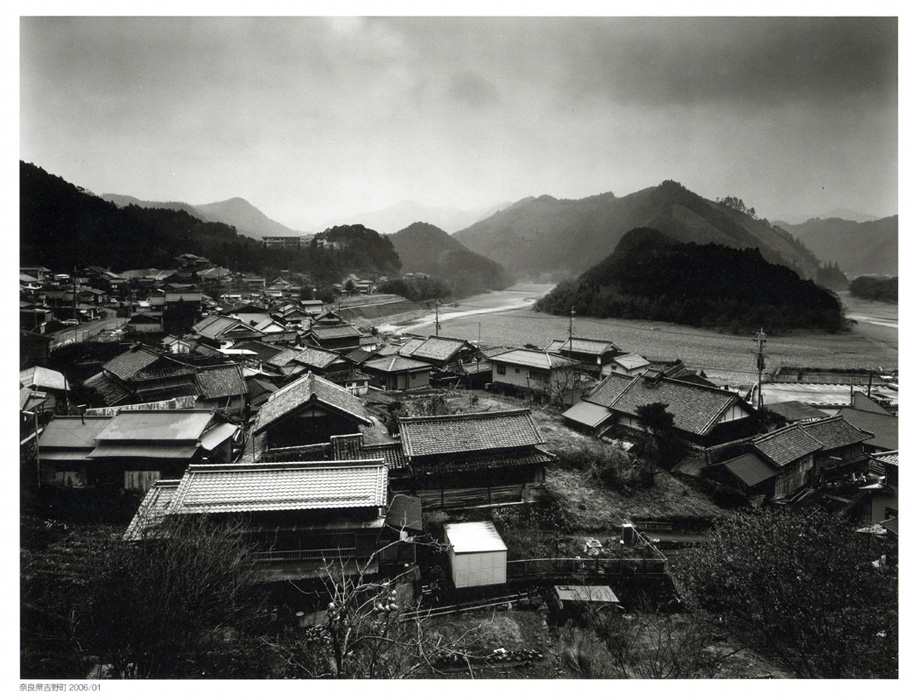
Mitsuru Fujita was born in Tokyo in 1934. He quit a job in advertising to become a freelance photographer in 1961, eventually setting up his own commercial photo agency called Fujitaman in 1966 which he would run for over 40 years. During this time he also taught photography part time at Tokyo College of Photography and at Musashino Art University. Fujita closed Fujitaman in 2007 to concentrate on his personal work.
The above image, taken in 2006 in Nara Prefecture, is from Fujita’s body of 11 x 14 landscape work shot mostly between 2000 and 2009, and collected in Zaisyo, a handsome book published earlier this year.
The collection of scenes that Mitsuru Fujita has assembled into the collection Zaisyo feature not a single discernible human figure. This hardly would seem something worth mentioning, for despite the relatively high population density of Japan, any photographer with a car and a willingness to leave the urban areas could find those vistas devoid of humans yet pregnant with significance that are the well-eaten bread and butter of certain photographers.
But given that Fujita’s subject is the man-made architectural landscape of un-urban Japan — old homes, corrugated tin sheds, light industrial factories, and old kura for storing rice, to take the most representative examples — the absence of people would seem quixotic at best, and willfully obstinate at worst. After all, these are not examples of a rundown and ruined Japan that fill up many the photography section in Japanese bookstores, but living and breathing utilitarian structures. We can only guess at Fujita’s intentions — and allow that Fujita’s chosen process of large format, 11 x 14 photography probably played its part — but ultimately what is impressed upon the viewer of the work is not the red herring of what is lacking, but the warm vernacularity of those quotidian spaces that are not media fantasy-friendly but which still form the backdrop and backbone for a significant part of the population of today’s Japan.
Z aisyo means something like the country or one’s country. The photographer is Mitsuru Fujita, and this is his second photobook. The book tells us that he was born in 1934, became a freelance photographer in 1961, set up a company called Fujitaman in 1966 (man is an alternative reading of the character for Mitsuru), won various advertising awards, taught photography part time at a technical school and a university for 26 years, closed Fujitaman in 2007 to concentrate on the photographs he wanted to take, and has had a number of photo exhibitions.
Zaisyo, published by Tosei-sha in May of this year, presents about 140 monochrome photographs, reproduced 24×17.5 cm, of scenes that are almost all in the Japanese countryside, much of which (I add for readers who haven’t been there) is as densely populated as suburbia elsewhere in the world. Most were taken between 2000 and 2009, although some date back to 1995. Almost always it’s the built-up countryside, and often much of the frame is taken up by buildings less than ten meters away. (There are few distant vistas here.) No people are directly visible, even – so far as I notice – in the background. The complete absence of people might warn that the project is dogmatic and sterile, but this isn’t so: Fujita does sometimes photograph a building head on, but he works to no template: he prefers diagonals and indeed he points his camera in whichever direction he wishes.
Mitsuru Fujita, Toujin, Saga City, January, 2007 — from Zaisyo
Fujita seems to like old-fashioned buildings: those covered with wooden slats, and traditional earthern warehouse kura. But he also clearly likes corrugated iron. What with the rust, dark clouds, puddles and little pick-up trucks, this book is no tourist souvenir. Yet there’s no insistence on age, wear, the vernacular or even the rural: on p.53 is a glass-fronted building in Saga City. (Right next to the building is the entrance to a temple, however.) And there’s also no insistence on architectural quality, oddity, authenticity or a conventionally pleasing ensemble: on p.69 for example is charmless nowheresville, a view redeemed by a dark sky. Yet anonymity is outweighed by quiddity: the one view (p.71) of Tokyo shows what appears to be a suburban fortress, incongruously supporting a prefabricated house of modest size with an imitation exposed timber frame.
“The complete absence of people might warn that the project is dogmatic and sterile, but Fujita works to no template — indeed he points his camera in whichever direction he wishes.â€
I lack the expertise to say whether the printing (by Toppan) is duotone, tritone, quad-tone or something else, but it’s excellent and it’s easily good enough for the non-fetishist. The grey isn’t grey, exactly; instead, it has an hint of gold for an appealingly warm tone to the whole. (Only a hint – there’s no “sepia†for canned nostalgia.) And the resolution is so fine that you’d be able to see any grain visible on prints of the same size.
Mitsuru Fujita, Gojo, Nara Prefecture, January, 2003 — from Zaisyo
Yet there seems to be no grain. Depopulated townscapes are of course the province of view cameras, and indeed there’s sign of lens shifting for perspective correction. The angle of view seems to be wide, sometimes very wide, and I started to wonder what gadgetry had produced it. This isn’t mentioned in the short preface by Fujita, or, it seems, in either of the substantial afterwords by the photographer Osamu Kanemura and a Mr. Hayashi. (Indeed, Kanemura seems not to mention the work or its creator, though he does have a paragraph on Gregor Samsa.) However, googling brought blog commentary that said Fujita had used an 11×14 camera. Fujita’s first book, Ki‑ryo 羈旅 (2000), does show and describe the equipment he used. Sure enough, 11×14: film size 355×280 mm, image size 345×265 mm. For that earlier book he used a 165 mm and a 210 mm lens (divide by ten for the rough equivalent at 36×24mm). The camera weighed 11.8 kg and five film holders added 11.6 kg. If this is what he used for Zaisyo too, then the reproductions in it are about half the size of mere contact prints. With today’s emulsions, it’s not obvious why 5×7, let alone 8×10, isn’t enough for anything other than bragging rights; but anyway this man deserves a floor of the Tokyo Metropolitan Museum of Photography to exhibit thundering great silver gelatines of what we see miniaturized in the book.
Aside from the information it gives us, the earlier book merits a look. Ki‑ryo is B4 format, so the reproductions are bigger than in Zaisyo. But Zaisyo has almost three times as many of them, and is less than half the price. (And the reproductions in Ki‑ryo lack the hint of gold that subtly helps Zaisyo.) Best of all, the work itself in Zaisyo is on average more interesting than that in Ki‑ryo. For Ki‑ryo, Fujita mixed material similar to that in Zaisyo with head-on portrayals of Famous Buildings (and Ancient Trees) that – with apologies to Eiji Ina (Emperor of Japan) – I already get quite enough of in old postcards. So even aside from value for money, Zaisyo is the first choice.
Mitsuru Fujita, Ogi, Niigata Prefecture, September, 2000 — from Zaisyo
And so back to Zaisyo. It provides at least five Y-junctions (pp. 13, 31, 72, 75, 92) for your inner Yokoo. As well as the timber, corrugated iron and asphalt, you get individual private houses, riverfronts, and even the occasional viaduct (p.39) and station platform (p.57). The mood often tends to the melancholy, but it’s rarely if ever bleak: the sun does shine in numerous pages. There’s plenty of detail to draw you back. Every photograph is inconspicuously but clearly captioned on the page, so you don’t have to keep flipping to and from the back; yet in the back there’s also a list of photographs so you can quickly see what’s on offer from, say, Okayama prefecture. Though the book is covered in cardboard rather than cloth, it’s well bound in sewn signatures. As the colophon is in English as well as Japanese it’s odd that nothing else – captions, preface, afterwords – is in anything other than Japanese. If you can put up with this absence and you appreciate black and white views of the stuff of man-made Japan, this book is for you.
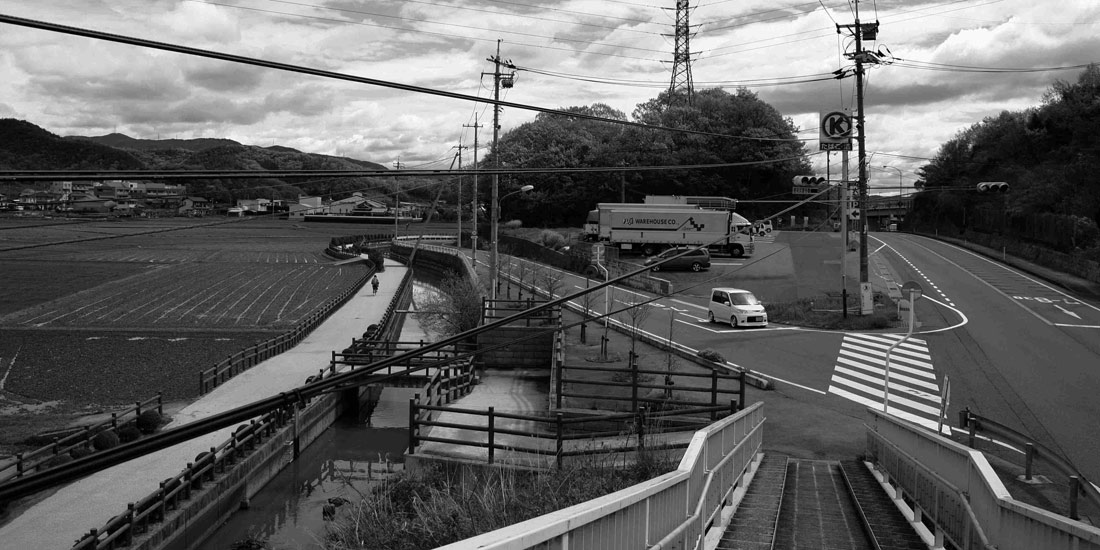
Souichiro Yamaguchi was born in 1959 in Saga Prefecture, located in the northwestern part of Kyushu. After graduating from TÅkyÅ Shashin Senmon GakkÅ (now Tokyo Visual Arts) in 1981, he pursued commercial and editorial photography in Tokyo. In 1993 he published a book of his personal work, City Circuitry.
Eventually, however, Yamaguchi decided to give up photography and return to a place closer to his roots, settling down in Okayama Prefecture, where he now runs a small hotel. It is only in the last few years that he regained his passion for photography, resulting in the book EAST POINT, published by Sokyu-sha in January of this year and from which the above photo was taken, and featuring landscape work from the eastern part of Okayama where he lives. Recently Yamaguchi has issued another book of landscapes from Okayama, front window.
EAST POINT is available in the Japan Exposures Bookshop.
Due in part to the heat, and in part from being extremely busy of late, I haven’t been able to take in as many photo exhibitions as I would like. However, when I received a postcard advertising Hideo Takiura’s latest show, “Tokyo Products”, I knew that this was one show I would make a special effort for. And I’m glad I did.
The show, currently at the Konica Minolta gallery in Tokyo’s Shinjuku ward until August 10th, features work shot by him over a 10 year period. You may remember that back in April Japan Exposures featured work from Takiura entitled “Tokyo Bodies”. Both that series, and the work currently on show, were shot at the same time. However, when he began to shape the work into a series and ultimately his first photo book (also Tokyo Bodies), he focused on the “street photography” aspect where random strangers formed the central subject. However, for this show and a new photo book, Tokyo Products, there are no people present in any of the shots.
I say that there are no people, and on the surface that is very much true, but in reality, the people are everywhere — their presence is unmistakeable. This presence manifests itself in two ways: on the one hand, what often attracts Takiura’s eyes are shapes and scenes that bear a human-like quality (for example, a rubber glove stuck on the end of a pipe on the side of a building conjures up with nary a leap a human arm and hand); and on the other hand, Takiura is constantly providing us with scenes literally man-made, as if he had snapped the scene just after a set designer had finished setting it up (for example, an old washing machine that has now become an impromptu plant holder, or a shot of a door with two wires inexplicably snaking out from the door’s mail slot).
Like most photographers exhibiting their work there was a statement on the wall that Takiura wrote. To be quite honest, I rarely read these, whether they are in English or in Japanese. But this one was so short I was intrigued. Beyond what it said — something to the effect of “when I walk around I often notice that the landscapes and scenes I pass resemble something human, or on the other hand, perhaps they don’t” — what I thought was significant was that this statement was placed in such a way that it could have easily been missed, and in fact I didn’t see it until I had seen the entire show. Not surprisingly, Takiura confirmed to me later that he would rather not write anything and let the photos speak for themselves, but in the end bowed to a feeling that visitors might feel empty without some explanatory text, however oblique (and obliquely displayed) it might be.
I felt fortunate to meet Takiura at the gallery. Previously we had corresponded via e-mail regarding selling his book and featuring his work on Japan Exposures, and it was clear from those interactions that he is very serious not just about the work itself but how that work is positioned, talked about, and put into context. Part of those email discussions revolved around the fact that Takiura would prefer that the work be judged on its own merits, rather than in comparison to other photographers. So, it was with some trepidation that I suggested to him — in response to his genuine query as to whether overseas photography viewers would understand work that didn’t feature any people in it — that his photographs in this current series reminded me of Hiroh Kikai’s two “Tokyo labyrinth” books (here and here). That is to say, beyond the superficial square format that both works share, there is a humor and irony in what both choose to capture, and that to my mind at least these “still lifes” of Takiura’s interact and resonate with his street photography in much the same way that I find Kikai’s people-less Tokyo cityscapes bounce off and inform (or are informed by) his better known “Asakusa Portraits” work. (For his part, Takiura was non-committal to this comparison, as I expected he would be.)
In person I found Takiura to be humble and soft-spoken yet with very clear, well-considered opinions that he no doubt had formed over a long period of taking pictures and thinking about photography. But by the same token, he was very keen to get my opinion on the photographs or on particular aspects of the exhibition. One thing that is very apparent from listening to Takiura is that this — taking photos, and publishing these books — is very much a labor of love. By that I don’t just mean that he doesn’t make money from these endeavors — although clearly he doesn’t — but that rather money or recognition doesn’t seem to interest him in the slightest. He wants to takes pictures, as time and the mundane business of making a living (from photography, but not his own) allow, and he wants to show them to people, both in shows like the current one (although I get the impression these exhibits are fairly “one-off”) and more importantly, in the two books he has so far self-published.
In early June, Takiura’s Tokyo Bodies photo book was featured as one of 60 self-published photobooks at the “Self Publish, Be Happy” 2-day event held at the Photographer’s Gallery in London and organized by Bruno Ceschel. Takiura was candid with me that he could very easily pay one of the handful of small photography publishing houses a tidy sum to publish his work under their imprint (in Japan, the prevailing model is artists pay publishers to publish a book of their work, not the other way around), but has chosen not to. Aside from being cheaper to do it himself, there is the much more important aspect of control — Takiura is a control freak in the best possible sense of the phrase, and for him not only the editing but also the design, and the look and feel of the book, are especially paramount. No surprise then that the new work Tokyo Products is again of the same, considered design as Tokyo Bodies, with Takiura even going so far as to design a slipcase that will house both of them.
Before taking my leave, Takiura pulled out his camera, the one he used to take all these Tokyo “portraits”, the only camera he uses for his personal work — a pre-war Rolleiflex with Tessar lens (sorry, didn’t get the specific model, but this is one of the early Rolleiflexes with the “Rolleiflex” on the nameplate in an old semi-cursive font, not the later boxier font). While it’s true that these tools should hardly make a difference, I can’t deny that seeing this 75-plus year old camera, so obviously lovingly looked after, and seeing the excellent work on the walls that it had a small hand in producing, and meeting the humble but assured Takiura, who had of course the biggest hand in all this, heartened me to no end as I went back out into Tokyo’s sticky summer heat.
It may be different where you are, but here in Japan it is positively sweltering and incredibly difficult to drag oneself outside into the heat unless absolutely necessary. Social life and environmental concerns be damned, here at the Japan Exposures we want to do nothing more than to stay inside, pour ourselves a cool beverage, crank up the air-conditioner, and flip through our photo book library. We suspect it may be the same for you.
To that end we have put a number of books on sale from now until August 31st — although the pessimist in us worries the heat may last longer! While not all titles can claim anything but a slim connection with summer, we did try to cater to vicariousness in our selection, so if you’re looking to experience summer from afar, you might be interested in some of these:
Cell, by Taiji Matsue ï¿¥4,990ï¿¥4590. Truth be told, while there are no doubt shots in this 2008 AKAAKA-published book taken in summer, it’s the book’s cover featuring a swimming pool that gets us in the summer mood. Good thing then that this sampling shows that indeed, there are more pools to dive into.
Hawaii, by Daido Moriyama ï¿¥8,990ï¿¥7,990. What says “summer” more than Hawaii, where it is basically summer all year round? This large tome has plenty of suntan-oiled bodies and floral print wraparounds, not to mention plenty of sand, er, grain. Ample samples here (not all from “Hawaii” though). Bonus points for Moriyama’s high contrast b/w making the surf and sand seem cooler than it probably is.
The Long Vacation, by Mitsugu Onishi ï¿¥3,990ï¿¥3,490. The English title of this work is somewhat misleading. A more accurate translation of the Japanese title might be “The Distant Summer”, and this book has a somewhat “Summer of ’42” feel to it although it is Tokyo in the 1990s, with enough summer festivals, embarrassing hairstyles and stonewashed jeans to have you glad we now live in 2010, although the heat has probably only gotten worse.
There are more deals from where these came from, and while we can’t claim all will cool you down, they might provide some small protection from this summer’s other burning topic, the strengthening yen.
The other day Japan Exposures visited the Fukagawa area of Tokyo to take in a unique photo exhibition organized by the photographer Mitsugu Onishi. The idea is not a single exhibition in a gallery, but rather a series of exhibition spaces — and only one or two of them actual working galleries — spread out over several blocks in an easily walkable exhibition that attempts to weave photography into the fabric of both the local area and the individual exhibition spaces, to varying degrees of success, it must be said.
Two years ago, Onishi — who in addition to his photobooks has penned books about exploring his Tokyo through photography walks and often leads his students on such excursions, organized a similar exhibition in the Urayasu area of Chiba near Tokyo Disneyland. For that event, in locales as diverse as a ramen shop, a hair salon, a five-and-dime candy store, and a community center, among others, Onishi showed work both by himself and others connected with the Urayasu or Chiba area, like Kazuo Kitai, Aya Okabe, and John Sypal. At the time, I remember Onishi as being fidgety because on that sweltering Tokyo summer day there were rather few visitors and he wondered aloud whether everyone was at home watching the first day of the Beijing Olympics in the comfort of their air-conditioned homes.
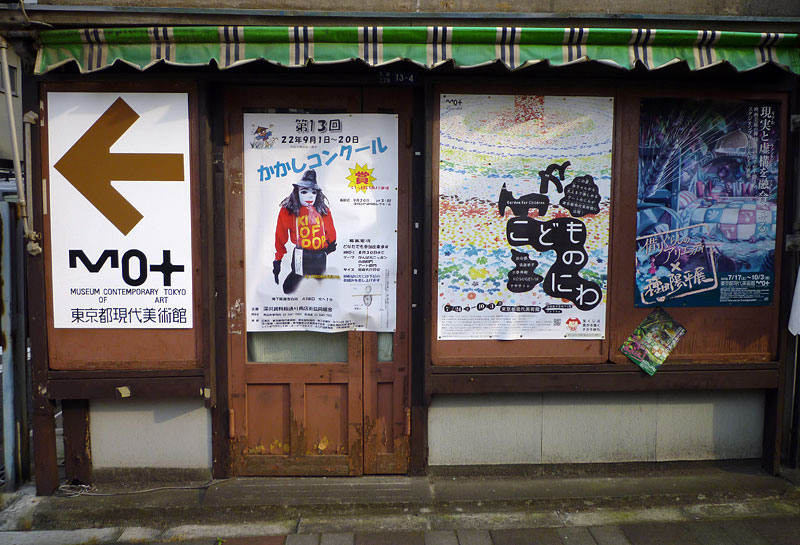
A poster shows the way to the Contemporary Art museum, currently showing work related to Studio Ghibli (far right poster).
We ran into Onishi on the street on the day we went down to see the Fukagawa exhibit, and he was clearly pleased with the comparative success of the current event. Due to the exhibition area’s proximity to the Tokyo Museum of Contemporary Art, which currently is showing a collection of art and posters from the popular movies of Hayao Miyazaki and his Studio Ghibli, and the fact that foot traffic from the closest subway station to the museum passes directly through the main neighborhood exhibition space, attendance was the least of Onishi’s worries, and later we overheard one gallery proprietor claim hundreds of visitors to his small gallery over the 3-day holiday weekend just passed when one suspects it might normally take him two to three weeks to have the same number of visitors.
Here is a takeaway on some of the exhibitions we took in (unfortunately, on the day we visited, some of the shops were closed due to the national holiday of the previous day, so we weren’t able to see all the different exhibitions):
Onishi himself exhibited a series of about 8 photographs in the shop window of a modern home goods store. These photographs were taken with a 4×5 camera set up similarly to a pinhole camera, with 40-minute or so exposures recorded on printing out paper (POP), a process that gives the images a blue tint similar to that at work in blueprint drawings. The photos were of various summer-themed landscapes and were rather different and subdued from the ironic street work Onishi is better known for. We found the combination of long exposure, small format and the blue tone particularly appealing and would have enjoyed a closer and longer look, but with temperatures what they are in a Tokyo summer and the photos only visible from the outside we had to move on sooner than we wanted. Onishi himself laughingly commented on the challenges of spending the time during long exposures outside in summer.
Akihiko Saito - Still Life exhibition hanging from the outer wall of a local temple.
In terms of presentation, Akihito Saito had perhaps the most interesting exhibit with his “Still Life” series of seven photos suspended by twine along the wall of one of the areas temples. The fiber prints had holes punched into them to which the twine was tied. Without frames, curling, exposed to the elements, the exhibition was tactile and tangible existing in the environment of the neighborhood in a way the other exhibitions we saw weren’t. The fact that later we came across the same type of twine being used for a completely different purpose helped to seal the impression of tactility.
On the second floor of the area’s merchants’ association office, which was really a local resident’s house, Yuki Kanehira exhibited about 12 large prints from a much larger body of work documenting the dilapidated and now mostly demolished Dojunkai Kiyosuna-dori apartments that were located just a few blocks from where this exhibition was. This apartment complex was one of 16 ferroconcrete and steel complexes that were built by the Interior Ministry in the aftermath of the Great Kanto Earthquake from 1924 to 1936 (the most famous of which were the now-demolished Dojunkai Aoyama apartments along Omotesando in central Tokyo). Kanehira himself moved into the apartment complex after his early attempts to document the place were met with derision from the residents, and over a seven year period documented the almost exclusively senior citizen residents. His close connection with these apartments, and more importantly with the residents who lived there, was clear to see in the photos. However in our opinion, the work could have been strengthened by including more of the residents and less of the dilapitated buildings, images visible in the supplementary slideshow running on a computer in the room.
We were disappointed to find that Japan Exposures-featured Sachiko Kadoi‘s work was being shown in a reflexology clinic which had customers, so we weren’t able to go in and had to content ourselves with looking through the window. We were excited to see new work from Kadoi-san focusing on the rivers that run through Tokyo, including one very large print that occupied a dominant place in the shop, and hope we will be able to catch up with her on a different occasion so we can see where this new direction is taking her.
The photographer Toshiya Murakoshi runs TAP Gallery, one of the few actual galleries to serve as an exhibition space for the Photo Session. It is a small place, and the lighting was not the best. Another problem was that it was not easy to see a connection between the work and the area, although there was a handwritten statement on the wall that did attempt to explain why these photos were being exhibited. Nevertheless, it seemed something of a missed opportunity, and the work itself was not nearly as strong as the landscape work which was on view in a series of photo books Murakoshi has published over the last few years.
Kiyosumi Shirakawa storefronts - the establishment on the right was part of the Photo Session, but sadly closed on the day we visited.
While the Fukagawa Photo Session Exhibition will be over in a few days, if you do find yourself in Tokyo, a visit to the Kiyosumi Shirakawa area is well worth a visit. The aforementioned Tokyo Museum of Contemporary Art, designed by Japanese architect Takahiko Yanagisawa, is a wonderful museum with a lot of varying exhibits from all genres in very large exhibition spaces (a huge Daido Moriyama exhibition from his Sao Paulo series was held there a couple of years ago). In addition to that, there is also the small but highly recommended Edo Fukagawa Museum which contains 11 full-scale replicas of traditional houses, vegetable and rice shops, a fish store, two inns, a fire watchtower, and tenement homes, arranged to resemble an actual neighborhood. Several blocks away a warehouse is home to some of Tokyo’s most important galleries including Taka Ishii (Moriyama, Naoya Hatakeyama, and Nobuyoshi Araki among others are represented), Shugo Arts (Takuma Nakahira, Shimabuku), and Tomio Koyama Gallery (Yoshitomo Nara). No wonder then that last year, when photo book publisher AKAAKA was looking for a place to set up a combination company office and art gallery, they settled on the Kiyosumi Shirakawa area.




 Cell
Cell Hawaii
 The Long Vacation