All posts by Dirk

Founder

Not a bad picture on show

Report from Camera and Photo Imaging Show 2011, Yokohama

At the risk of stating an utterly obvious and absolutely not new realization: it has become extremely difficult, perhaps impossible, to take a bad photograph with contemporary cameras. At least technically speaking, there is very little that can still go wrong nowadays. Exposure metering is accurate, focus is on target, no excessive lags where you wait for the camera, popping colors, lenses for great image quality, cameras are small enough to not burden even a child and superb looking prints. We are privileged to have all this power available to. Nonetheless, in the context of making photographs, this is meaningless. We, the people behind the camera, are still in charge of picking things from the reality that surrounds us and no camera, sensor or printing paper will help you doing that.

Enough of the philosophizing, since a lot of people will just be interested in the gear, so here you have it.

Fujifilm X100

Everything you heard about it is true. It looks great, the image quality on the display prints is frighteningly good and the EVF overlay is a marvel. The camera is an attractive package and feels good in the hands. Now, I don’t want to be critical on something I have barely seen, let alone used extensively, but I have said that at the end of the day, this camera is just a compact point and shoot with a cool finder. I still think so, even though it is a very good one, perhaps the best one we have ever seen and may see for a while. Is it a game changer? Probably not and a lot of things will depend on how this camera behaves in constant use. The lens is surely brilliant and I doubt that the image quality of the sensor will be disappointing either.

Still, in the few minutes that I handled the camera I noticed some minor niggles: one, there are many controls and buttons, perhaps too many, especially on the back. The camera is not as small like most compacts, but it isn’t large either so the room to put these things is tight. You have a very generously sized screen and on the right several buttons and dial wheel. Only continuous use would tell whether these buttons could be accidentally pressed by handling the camera, large fingers or not, especially with one hand only. Bear it in mind.

The finder — yes, it is a revelation. That EVF overlay in an optical image is absolutely brilliant. A strange thing that I noticed, and I don’t know whether this will disappear in the production version or is something you can set in the options, when you half press the shutter the whole EVF display, lines and parameters, briefly disappear for a split moment (presumably focussing and metering). Personally I would find this a little irritating, because the frame lines are essential for composition and having them disappear or flicker in some way is a distraction, for me anyway. Lastly, and I am sure this can be turned off in the option, you’re composing and shooting while looking at a beautiful optical finder image with the great overlay and, bang, then you are presented with the image you just took displayed full size by means of the electronic finder. That’s an anti-climax.

The camera is slated for release on 5 March 2011 and the price is around Â¥130.000 (almost $1600) and you do know that you can get used Leica M8 camera for little more, don’t you? Want it anyway?

Fujifilm GF670W

This wide angle version of the previously released GF670 will not genuinely surprise you. It has a very solid feel and is well-balanced, so comfortable to hold. In fact, the body is identical to the GF670, except where you previously found the bellows, there is now a lens bolted on which gives it a much more rigid feel. What surprised (and actually bothered) me, is that the lens’ focussing ribs that you are supposed to grab to turn the ring are not applied all the way around the lens barrel, only in two opposite positions as if you are supposed to turn this with two fingers and your hands should travel with the rings movement. That is impossible though and the rest of the ring is smooth and does not offer any grip so your fingers may slip. The booth attendant (funnily enough, the same gent as two years ago) pointed out to me that one is supposed to grab the lens from above with two fingers, but then I saw my own hand in the finder. An odd design decision.

Ricoh GXR Leica M mount module

Yes, you will be able to buy this after all and it should be fun. But then, it won’t turn your Ricoh into a Leica M. Still, great to have it of course and now on a par with the Micro-Four-Thirds and Sony E-Mount systems that let you use Leica M mount lenses via an adapter. You can feel that Ricoh loves photography, despite being a big Japanese conglomerate (that even makes gas meter for homes, as I have seen last week).

Cosina/Voigtländer

Wait a minute, could this whole show by Canon, Nikon and all have just been arranged to accompany a photo exhibition by Tom A?

Two of Tom’s prints are on display, amongst photos by others. Well done, Tom.

Of course, all of Cosina and Zeiss’ wares are out for display but I could not detect anything new or noteworthy. A little quiet there actually and none of the attractive show hostesses ubiquitous at other booths to photograph either.

Kenko C Mount digital camera

Not sure what to make of this, but it looks like a fun niche product: a digital camera with a native C mount (small format cine lenses) so you can use a wide range of legacy lenses without adapters or other fuss. If the image quality is OK and the price is right, I think this will do well and be very enjoyable. Ironically the camera is said not to offer any movie mode.

Pentax

Some fantastic prints on the wall at Pentax. A few years ago I remember feeling slightly underwhelmed with large prints from the 645D, but perhaps it is that printing technology has caught up with bringing out all the information that the images contain. The large panels, some so large that they are made up by a mosaic of four or more. Impressive.

Pentax have established themselves as the individualisable camera manufacturer, there does not seem an end to their ability to make non-standard versions of their cameras. A true logistical and manufacturing feat.

And yes, there will be a K-5 Silver Limited!

Shibakawa LED flash

Shibakawa are a OEM/ODM manufacturer of in- and off-camera flash units for most of the Japanese camera makers. What they are trying to do now is develop an LED light/strobe unit. Only a prototype was presented. What’s interesting is that you can daisy-chain small module units, for example to wrap around a lens or hood with velcro and then build your own ring flash — or a strip light if needed. Any shape is possible. At the moment the modules are still a little “large”, the rep says (not to me), but they should get smaller. A limitation is the low power, only a guide number of four so it is targeted at still life and macro setups where this should not be an issue or low power is even desirable. Also there is no wireless transmitter facility, but again this is not a problem in small setups. What’s very interesting is that you can address any single LED in the array and regulate its output depending on the situation, so you can have less light on one side closer to the subject (an issue in macro where you are very close to the subject, creating lighting imbalances) or create deliberate accents. The LEDs can emit strobe and also continuous light, so you can have a modelling light and use it for video too.

An interesting development to watch. It may come to market either under their own brand or via another maker’s name.

Hey, and I receive my first freebie, a pen, from a very friendly English speaking gentleman. Thank you and good luck to the project!

Canon, On-demand photo books

When I wrote my previous report two years ago, I lamented the lack of choice in domestic (Japanese) options to print on demand photo books and other things like calendars. Well, things have changed and we went from few choices to no choices at all. At least nothing was on display today, not even wedding albums, and this may not be the target audience here. Perhaps it is also that nobody is daring to take on the mighty Blurb, Lulu, MyPublisher etc. who have cornered the market. To compete with them you’d have to do what Japan isn’t generally too good at: create a user-friendly web site which is usable by anyone in the world (read: not cluttered in design and not only in Japanese language). Of course Canon would be the perfect candidate, as they have a powerful printing technology division. That’s not just your office photocopiers, but high-end image processing and on-demand printing lines that should be more than able to do what HP does for the others. However, what we get is a little of something: small-ish, single sized on-demand books for photos and text for 20 to 204 pages, accessible via Canon’s consumer portal Image Gateway, which also offers other post-capture services like image sharing. Of course that’s only in Japanese language, but to their credit not too bad an interface the last time I used it. I know Canon is very keen on expanding printing and trying out many ideas. The book looks decent enough quality, even the images, but it is not really a photo book in size and appearance. It would be ideal to print a diary-like affair, or even one’s blog with photos thrown in. In my opinion it is really more a text format book in terms of size and paper.

Best of the rest

Free lens cleaning at Tamron (thanks)


Large lenses at Sigma put any bazooka or other grenade launcher to shame. Try using those in front of the White House and get a free ride in a military or police vehicle!


Casio think that HDR should be elevated to HDR Art and devotes a large section of their booth to displaying, shall we say, unattractive prints created with the in-camera mode HDR Art.

That’s all folks, thanks for reading and until next time! And in case anyone sees Hans, please send him over to the camera bag section!

The moon is there, even if I am not looking at it

Review by John Sypal for Japan Exposures

The Moon, Following Me is the debut book from Emi Fukuyama, a young photographer living in Tokyo. It is an elegant, nuanced, thoughtful, and beautiful creation, the product of a highly attuned and sophisticated intelligence.

Fukuyama’s mesmerizing and beautifully reproduced photographs settle the viewer into a very distinct and particular point of view. Much fuss is made over the ideal of a “Photographic Vision” that many photographers aspire to but few actually achieve. Fukuyama is in this minority. Rather than attempting political or social commentary she is able to drive her work around a core desire to reveal visual understanding through photography. The fact that she does so without simply trying to illustrate a political concept or visual idea makes time spent with her book that much more rewarding for those interested in an aesthetic based on the delight of straight photography.

A viewer will readily see some visual patterns appear as they look through this book. Thematically her physical point of view allows for plenty of fences laced over and in frames. Various doors sit ajar and monolithic structures loom in the distance, often jutting out of a spot of lush vegetation or neatly rowed houses in the distance. Each image features some form of plant life and nearly all feature a prominent manmade object. But to reduce these images to simply being about man and nature, or even worse a ruddy celebration of the literal visual shapes they make together is to not fully understand them.

Fukuyama’s best pictures are intriguing because of more than simply what’s in the center. It’s not that what is often centered isn’t in itself interesting, but through slightly obscuring what most people may regard as the subject, the entire entity is revealed to be enhanced through her precise framing which creates a heightened awareness of how the world can be organized both in heart and in mind. A picture with a lone chair in an empty lot isn’t simply about that one chair. Three umbrellas hung out to dry is not simply a picture about umbrellas. What I personally find most engaging about this entire affair is that at no point does her technique lower itself to that of a simple gimmick. At the same time the images are never about any one thing directly pictured in them and Fukuyama steers clear of the common misconception that a photo needs to operate as some coherent narrative device. Each image is somewhat mystifying but independently strong. Bound together the effect can be a moving photographic experience.

We are not for want of lunar substitutes.”

The emotional responses they may spark are from her ability to show the viewer the closest thing one might get to looking dead on at what can usually only be hinted at out the corner of an eye.

They say that wherever you go, there you are, and given the title we might expect that wherever Fukuyama is the moon ought to be as well. Interestingly enough, while the actual moon is never actually shown in a single image we are not for want of lunar substitutes. Plenty of glowing and circular shapes appear within the various frames but it may also be that the best analogy to explain an encounter with her photographs would be to liken the feeling to that of looking up at a blue morning sky before eleven to see the white moon above, that odd feeling of familiarity combined with the wonder of seeing something so terrifically beautiful off in the distance.


More work from The Moon, Following Me can be seen in a special extended Japan Exposures gallery. The photobook itself is available in the Japan Exposures bookstore.


“I like to think that the moon is there even if I am not looking at it” — Albert Einstein

Emi Fukuyama Gallery

Introduction by Dan Abbe for Japan Exposures

When you first see Emi Fukuyama’s work, you may ask yourself: “what’s going on here?” Nothing much is ever really happening in the places that Emi photographs, so you could say her work is quiet. But she doesn’t belong with topographic photographers or anything banal. Her photos are vague rather than just simple. As unremarkable as the things she photographs may be, she draws you in by making it difficult for you to see them clearly. This creates a tension running through her work which hints at something more interesting happening here.

Emi’s work is visually slippery. She prints with very low contrast, so nothing jumps out at you, not that there are many eye-catching subjects here to begin with. Still, there is something consistent in the series: your view of the photo’s subject is almost always blocked by something out of focus in the foreground. Someone with an MFA might talk about how this technique is meant to “subvert” conventional “modes” of photographic understanding, but I really don’t think there’s too much to be read here–by now Emi must think no harder about this way of shooting than about her own handwriting. As a viewer, though, it’s strange to be consistently denied a clear view of what you feel you’re supposed to be looking at.

These obstructions provide the tension that holds this work together. It gives me the impression that at a very basic level, she’s not actually trying to show you the thing she’s looking at, but to show you the way that she’s looking at it. If the foreground often becomes a sort of distraction, this might be a kind of honesty on Emi’s part, to show her own unwillingness to look at (and later present) things so simply. In the text accompanying her book, Emi describes a recurring childhood trauma in which she was unable to go to sleep for fear that the world would disappear if she did. So, what is going on here? Maybe Emi’s photographs are an attempt to faithfully trap her own view of things, keeping them from fading away. But I really can’t say, and that’s what keeps me interested.


Please also see our review of Fukuyama’s photobook, The Moon, Following Me.

Emi Fukuyama — from The Moon, Following Me

Emi Fukuyama was born in Saga Prefecture in 1981, and graduated from Tokyo Visual Arts School in 2006. Since 2008 she ha been a member of Totem Pole Photo Gallery in Shinjuku, Tokyo. Fukuyama’s first photobook, The Moon, Following Me, from which the above photo comes, was published in December by Tosei-sha.

More work from The Moon, Following Me can be seen in a special extended Japan Exposures gallery, and we are also publishing concurrently a review of the photobook.

Yu Kusanagi Gallery

Last year marked the 20th annual “New Cosmos of Photography”, a competition started in 1991 by Canon Camera in an effort to identify young, emerging photographic artists deserving of our attention. Judged by a combination of working photographers and critics (Nobuyoshi Araki, Daido Moriyama, and Kotaro Iizawa are among those who have judged the competition in the past), this year saw 25 award winners from among 1,276 entrants in a competition judged by photographers Katsumi Omori, Masafumi Sanai, and Mika Ninagawa, and critics Minoru Shimizu and Noi Sawaragi (each judge chooses one Excellent Award winner and five Honorable Mentions).

The following gallery of images from Yu Kusanagi’s Snow (one of Ninagawa’s Honorable Mention picks) is our second gallery from the 2010 competition.


When we are looking at a photograph we are not looking at reality. We may not even look at a visual representation of reality. What we see is a photograph, an image realistic in appearance. That photograph’s objective is not to show reality to the viewer, but to construct an illusion of reality within the viewer by evocation of emotions by means of shapes, lightness, darkness and color. Even black and white photographs contain color, they are just not visible as such in the photograph.

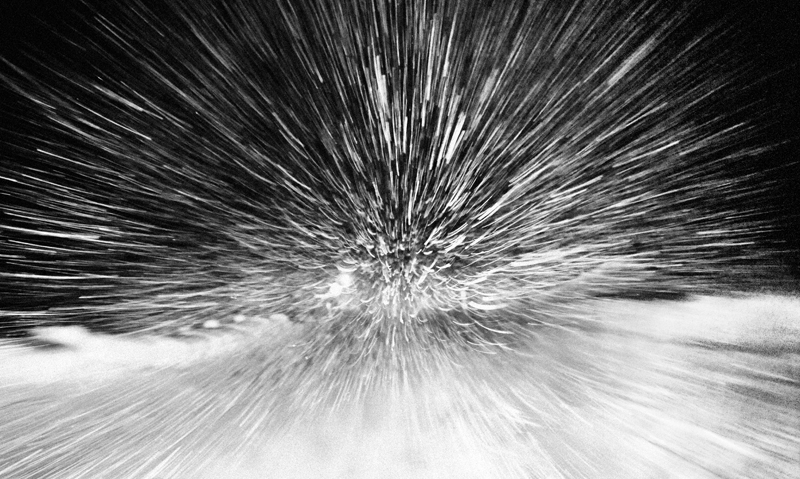
Yu Kusanagi shows us abundantly beautiful snow. Falling from the clouds, freshly settled on houses, cars and electric poles. The visible onslaught of snow, the sheer quantities and somehow even vigor almost seem threatening, and in truth, they probably are. Yet, what is more peaceful in appearance than a world padded with soft, immaculate white?

The photographs do not let us feel the biting cold that the photographer had to bear when producing these images, even though it is clear that when seeing snow falling it has to be a cold night. The viewers perception might even be a warm and romantic sentiment. When we are looking at these photographs we are not even looking at a single common reality.

Nobuto Osakabe Gallery

This year marked the 20th annual “New Cosmos of Photography”, a competition started in 1991 by Canon Camera in an effort to identify young, emerging photographic artists deserving of our attention. Judged by a combination of working photographers and critics (Nobuyoshi Araki, Daido Moriyama, and Kotaro Iizawa are among those who have judged the competition in the past), this year saw 25 award winners from among 1,276 entrants in a competition judged by photographers Katsumi Omori, Masafumi Sanai, and Mika Ninagawa, and critics Minoru Shimizu and Noi Sawaragi (each judge chooses one Excellent Award winner and five Honorable Mentions).

Over the next several weeks, Japan Exposures will present extended galleries of the award-winning series from those of the 25 winners that particularly caught our eye. We kick things off with Holiday Making from Nobuto Osakabe, an Honorable Mention selection of photography critic Shimizu, who wrote in his message to entrants: “Rather than a casual photo, show us photos taken after thinking and looking as much as you can. A square screen is a white cube. Anything can be art, for example. Let’s not make simple imitations. Photos are a lower body kind of thing. So be sure to use your mind to the fullest.”


The images by Nobuto Osakabe show us Japan at play, people taking some time out and enjoying leisure activities. Naturally, the social norms of Japan still apply, and even private lives appear somewhat regulated, at least in public. Leisure activities seem best enjoyed doing the same thing as many others, at the same place as many others and, given the still largely inflexible time-off-work arrangements, at the same time as others. As an aside, Osakabe also indirectly shows us the high population density of the country (without resorting to the unsubtle visual device of crowded commuter trains, I am delighted to add), and those are the ingredients of the photographs you see here. To finish things off Osakabe picked several key locations and captured the unfolding visual theater of Holiday Making.

In Japan (and elsewhere), when we go out to work and play, by ourselves and on our own volition, we tend to think that we are distinct individuals doing something special. Osakabe’s images show us that in situations where many individuals do so, the exact opposite may occur. We are, in fact, at no point ever leaving the collective.

Thousand Happy Moments

When I was travelling in Europe in October I saw the author of a book being interviewed on television. He had accumulated a list of 1000 events or situations that would give you an emotional uplift or generally happy feeling, just to remind ourselves that within all the bad news we see there are also positive occasions, even though they can often be quite small and therefore pass unappreciated. The man is certainly an optimist!

Last week I was reminded of that book when experiencing two personal happy moments. Firstly, after a long struggle my son finally managed to ride a bicycle without any help or aids. There he was, wobbly but riding all on his own. A superb moment. Secondly, it was time for the annual JRP group photo show and I decided to go into my archives an edited a series of 12 photographs on the theme of “night” together, taken over a period of 5-6 years on film and digital. After struggling with editing, sequencing and printing (my first all-inkjet show) I was like the years before very happy to see the results hanging on the wall and being looked at by visitors.

The two moments are not as unrelated as one may think. I often think of my photos as almost child-like. When good work is strong enough, I feel that it can stand on its own and no longer needs me to explain or otherwise attend or foster it. The images take on a life and meaning on their own, independent from me, their creator. It’s almost as if they’re not made by me at all.

I was also reminded once more of how important the process of showing your work in public is. The thoughts that one needs to put into editing, sequencing and printing alone, which I mentioned above, will force you to reflect on your work in a way you normally wouldn’t. When putting your work in a finished, presentable format in front of people and perhaps being asked to comment on it is really a test for yourself whether you feel that you have done all you could to produce work to the best of your abilities. And before you think, “well, I regularly put galleries on my photo blog and Flickr sets to receive feedback”, it just isn’t the same, not even remote. I would not even count putting photos on the web as “publishing” nowadays, because it requires so little effort and, what’s more and that’s the key here, you will not be held accountable for what you have produced by anyone. It’s so easy to just say “well, that was just a small thing, I could do much better if I really wanted to”. Really? With electronic publishing, there will be no face to face discussions with your viewers, no “I wish had done this differently” thoughts when you cannot change anymore what’s hanging on the wall. This is where the true learning process lies, in feeling the excitement and also pains of creation. That’s not to say that electronic publishing has no merits, but there are certain ways to sneak out of your need to take responsibility for what you have done.

Invitation post card for the exhibition featuring one of my photos.

I used to be skeptical about the prevalent mode of operation of Tokyo’s photo galleries, where you essentially pay to rent the space for a week. There is no major hurdle to enter the game except the budget to pull it off. The same goes for photo book publishing. I have changed my mind. If anything, you do the exhibition for yourself, to progress and learn. You don’t need a workshop, just spend the money on the gallery space. During the preparations you will be running around seeking advice, and learn. Who wants to deliver something not their best when spending over $/€1000?

Put simply, everyone should be doing a gallery show or exhibition at least once a year. The venue almost does not matter, remember, this is mostly for yourself. Only a fraction of people interested in photography will ever do so. Those who do, I see as photographers, the rest are camera enthusiasts and people ‘interested in photography’, frequenting photo web sites and giving advice to others on how to “impove” their photography. Nothing wrong with that, just be aware of your own ambitions and where you stand right now.