Tag Archives: Germany

From Germany #1

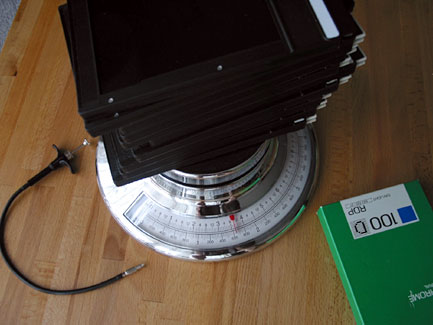
JOBO Duo Set 2502

Merry Christmas!

As you can see I am already preparing for the new year with a slightly changed site. I grew a little tired of Movable Type, never bothered upgrading to version 3, so I thought I should try switching altogether. So far so good, it was very easy to switch it over, just need to work on the looks of it now.

Meanwhile, it is time and there is time for some film processing at Christmas. As I have mentioned before, I bought a Jobo 2500 series drum for processing sheet film a while back. When I got it, they included two Duo Set 2502 reels for 35mm and 120 size film. The whole drum takes five reels in 35mm setting, but in Japan these reels are prohibitively expensive (about Â¥6000 ea.). So while in Germany I managed to buy three more of them and I will try for the first time processing with this setup. I have never tried processing 35mm in a rotary processor, so let’s see how it goes. With five at a time, I may be able to clear my backlog soon – if it all works out.

Some Germany

When I went to Germany on my own this time, I expected and intended to try a lot more of Euro street photography. It has been said, by a in this respect and others completely unreliable German source, that taking photos of people in public is much more difficult than in Japan. This comment makes sense to some degree. Apart from receiving a, shall we say, veiled threat from what I can only think of as a Russian yakuza in Japan, there is little or nobody bothering to challenge the street photographer in Japan.

Since we know that Germans like to challenge things and people, I expected a lot more suspicion and resistance. And while for family reasons I did not find as much time for taking pictures as I would have liked to, I did some just to get a feel for shooting in a “foreign” environment.

Rather unsurprisingly, it is pretty similar to shooting in Japan. Naturally, the subject matter is different, and in my personal opinion far less exciting than in Japan, but that’s a different issue. I felt surprised being able to speak freely to people, in the case they joked about me photographing them, or in one case asking me what I am doing this for (I replied I am visiting from far away).

This little series was taken more or less haphazardly when I accompanied my mother to a doctor’s appointment at 8 or so in the morning. The location is a shopping centre area in what in Japan would be called new town, or housing development elsewhere, built in the 1960s. This area has never been of much interest to me, and this hasn’t changed. As youths we tried to avoid it because the social structure of the area was rather different from our backgrounds in the traditional town. We spent little time there, or with others from that area.

Unfortunately I had only the roll of film available, that was in the camera at the time, but it was enough to get into the groove and be able to compare. Don’t know what to make of the photos. I wish I would have had more film, and the market itself was not of such a great interest to me, but the only thing that was going on there at that time of day.

As for the girl in the wheelchair, I had no hesitation taking a photo of her, as she is part of the scene there like the others. We had a brief conversation, and it turned out that she was visiting from Heidelberg and had difficulties getting around in this unknown city. I replied that I have the same problem, which seemed to surprise her for some reason.

No preconceptions

The title of this post is a quasi-quote from the artist and legendary street photographer Garry Winogrand. It has become my main mantra of late, not only about photographic matters, but about life in general. It is a very difficult objective to keep an open mind, especially since I think that the interpretation of experiences and resulting conceptions are very closely bound to human nature, a natural way to make us feel emotionally safer. Brands and advertising, for example, exploit this longing for familiarity and make us reach out for packaging and colours we have seen before.

In itself, there is nothing wrong with this. However, there are certain times, if not most of the time, where we should be self-aware of our preconceptions, if only to prevent us to become easy prey for stereotypes and prejudices, positive and negative. Maybe we have heard something similar several times from from different sources. Or we have heard fractions of facts and our creative mind tries filling in the gaps. The purpose of this is to help making sense of the world in one way or the other, if only temporary. Would we feel the full effect of knowing that we know nothing, we would probably go crazy.

It is in this period of thought, where an email from a friend reaches me, and I am surprised that it discusses a very similar thought that I have been having and have recently articulated in an article for the German-Japanese Society of my hometown. Many people think of Japan by imagining sushi, temples, geishas and other “typical” things. While of course these things exist here, they by no means represent Japanese culture. In fact, I think they are rather offensive as they simplify and distort reality.

In my photos I am trying to show aspects of daily Japanese life, any and all aspects I personally come across. And even though I am not trying to exclude sushi, temples and geishas, unlike others I am also not looking for them. I capture what presents itself to me, and those obvious Japanese things are just several of many, many other things that make up the puzzle of this country. I can’t say I have succeeded, but just like they say in British news when they don’t know for sure: “The Police are keeping an open mind.”

I am quoting – with permission from the author – an article written for Tibetan Review:

Shattering the Shangri-La Stereotype: Tibetans re-branded
Continue reading No preconceptions