Category Archives: Feature

Reviews, critiques and essays on selected topics

Tales of Glass and Ceramics, Pt. 1

When the E. Leitz Company introduced the first practical 35mm camera in 1925, it was an instant world-wide sensation. The Leitz Camera — Leica –, paved the way for a completely new way of creating photographs. At that time the Carl Zeiss Foundation of Jena, Germany, was already a well-established company with almost 50 years of optical history behind it. It had begun producing camera lenses in 1890, but was not able to respond to the success of the Leica by offering a comparable product. To do so, Zeiss acquired four small camera manufacturers and merged them into the Zeiss Ikon AG, based in Dresden and Stuttgart. Even so, it took several more years to develop and produce a match for the meanwhile dominant Leica camera. This was the Contax, Zeiss Ikon’s top of the line rangefinder camera, presented in 1932.

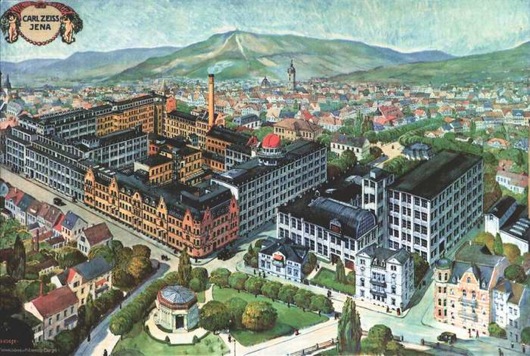
Postcard of Carl Zeiss in Jena around 1910
Carl Zeiss in Jena around 1910

The first Contax did not manage to fully live up to its ambitions. It was a very sophisticated and also complex little device and soon became known to suffer from a lack of reliability, especially due to its complicated shutter. Hubert Nerwin, Zeiss Ikon’s camera designer par-extraordinaire, picked up the pieces from the first unreliable Contax designs, and re-designed it to one of most famous and desirable 35mm cameras ever to have been produced; the Contax II. In 1936 it was brought to market with many revolutionary improvements, such as a combined viewfinder and rangefinder. In terms of features, it beat the comparatively primitive Leica hands down. Not resting on its success, Zeiss immediately started working on the next generation, the Contax III. But another ambitious project was already lined up beyond it — the Contaflex twin-lens reflex camera (TLR).

Zeiss Ikon Contax I, image courtesy of Tomei Collection

The second world war saw the cities of Jena and Dresden become the Soviet sector of occupied Germany. The production facilities were damaged and everything salvageable was relocated to Kiev in the Ukranian province, to provide the Soviet Arsenal conglomerate with the means to construct a world class camera called the Kiev, initially entirely from leftover parts from Germany. Prior to the handover to the Soviets, the withdrawing US Army had recognised the significance of Zeiss and facilitated the relocation of over 100 key personnel, management and engineers to West sectors. This chapter alone is a fascinating period of Contax history and many papers and books have been published trying to establish on what exactly happened under the Russians’ control and what cameras where built at what location.

Like Germany itself, Carl Zeiss was now divided into East and West. In the West, Zeiss continued working on improving the classic II and III series rangefinder cameras, whereas in the Soviet sector work concentrated on developing the single-lens reflex. In 1949, at the Leipzig Spring Fair, an industrial showcase, Zeiss Dresden (East) released the Contax S (for Spiegelreflex [reflex mirror]. Due to increasing disputes around the Zeiss trademarks, which occupied German courts for 15 years, Zeiss Dresden renamed their cameras to Pentacon, derived from the combined words PENTAprism CONtax). It was the one of first 35mm SLR film cameras featuring a pentaprism allowing direct viewing from behind without a reversed image.

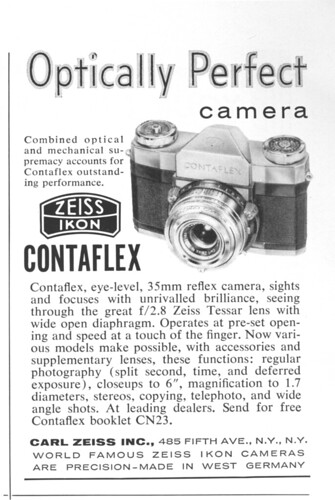
Contaflex ad in National Geographic, January 1958

The era of the rangefinder camera started drawing to a close and the SLR’s rise began. Carl Zeiss (West) released their first SLR in 1953, the Contaflex. Unlike its pre-war TLR namesake, it was a single-lens reflex camera (SLR) it featured a leaf shutter and but unlike the TLR only at a later stage was it equipped with a built-in (selenium) exposure meter. The follow-on model was called the Contarex and showed German engineering at its best: the world’s first exposure meter-coupled, focal plane shutter camera; it even sported interchangeable film backs. Despite its sophistication, the Contarex and its follow-on models were not commercially successful. While it was superbly crafted and packed with innovation, it was an engineer’s camera, which is to say ugly and heavy. Its selenium metering cell in front of the pentaprism gave it the name Cyclops or Bullseye. Production of the renowned Contax rangefinders IIa and IIIa (the a distinguishing them from the pre-war models) was ceased in 1961.

Meanwhile Japan had risen from its own ashes and started the onslaught that would leave the German camera industry practically wiped out (except for, ironically, the more and more archaic seeming Leica M). The Japanese practical design and not least pricing of cameras like the Nikon F simply could not be matched. Nonetheless, Zeiss continued to deliver in its cameras many world firsts that are taken for granted in today’s cameras: electronic auto-exposure, attachable motor drive and the technical feat of an electronically driven and vertically travelling shutter (a shorter travel distance means that shorter shutter speeds became possible). Undoubtedly SLR cameras would not be the same today if it wasn’t for the continuous innovation by Zeiss in their Contax cameras. The economic perspective was different, however. Zeiss simply could not continue to produce cameras in Germany alone, facing the fierce Japanese competition.

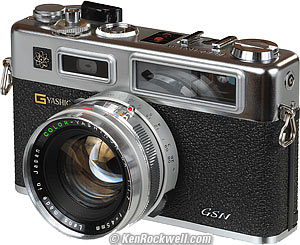
Yashica Electro 35 GSN, image courtesy kenrockwell.com
The key strategy was to find a strategic partner in Japan. Initially talks were held with Pentax, but efforts abandoned. The Pentax K is one remaining legacy of this attempted co-operation. In 1973 the alliance between Zeiss and Yashica commenced, a partnership that would hold for over 30 years. Yashica was founded in 1949 in Nagano prefecture and made a name for itself by producing high-quality 35mm and TLR cameras. The Yashica Electro 35 was a very popular rangefinder, said to have sold over 5 million units, and the Yashicamat a very reputable TLR. Yashica’s expertise in building electronic cameras paired with Zeiss’ excellence in producing optics seemed a promising formula for success.

Perhaps it was the experience of the cyclops that prompted the addition of another ally: the F. Alexander Porsche Group. Industrial design was still in its infancy as a concept or product development consideration, yet Zeiss and Yashica must have recognised its importance and potential. Porsche Design were a pioneer in ergonomics and consulted on appearance and human interface design. The fruits of this collaboration were introduced at Photokina 1974 — the Contax RTS SLR.

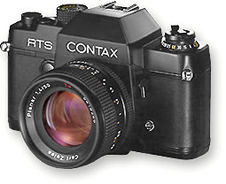
Contax RTS
Contax RTS
The RTS (Real Time System) once more introduced a fireworks of innovation: a wholly electronic camera with aperture priority and manual exposure modes, optional five frame per second motor drive with intervolometer (selectable frame per second rate), 5-flash-per-second electronic flash capability and two frame per second winder. The totally stepless electronic shutter had a maximum speed of 1/2000s. Exposure compensation was found for the first time on any camera. The traditional maze of mechanical levers, rods, cams and gears, common to most shutter release systems had now completely given way to electronics and electro-magnetics. All timings in the body were now governed electronically; the follow-on RTS II had adopted quartz to ensure precision timing. A slew of other models targeted at different types of photographers followed and Yashica also continued to manufacture cameras under their own brand, which shared the Contax mount (C/Y mount) so that lenses were interchangeable between them. Zeiss concentrated on producing their fine SLR lenses.

Read in Part 2 about how ceramic kitches knives from Kyoto helped Contax to remain on the cutting edge, tackling the challenges of auto-focus and the looming age of digital…

Yutaka Takanashi’s Field Notes

Yutaka Takanashi’s current retrospective at The National Museum of Modern Art in Tokyo, — it runs until March 8 — is a great opportunity not only to view the trajectory of a career that has spanned close to 50 years, but also to trace the city of Tokyo from its pre-1964 Olympics days up to the present day. Over 11 different series, we can follow Takanashi’s varied takes on the loose theme of “The City”.

Figures of commuters solitarily ensconced in the bubbles of private space on a packed train.”

Early on we have Takanashi as “economic miracle” chronicler in the mold of Shomei Tomatsu with the series “Tokyoites”, a series of 15 photos all taken in the year 1965. The photos are not all about boom and prosperity, to be sure, but the mood is generally upbeat. The images for the most part are intimate, a single figure captured in his or her world — a boy peering into a doll house, a woman nursing a baby in a speeding Mazda, or the figures of commuters solitarily ensconced in the bubbles of private space on a packed train.

Yutaka Takanashi: from "Towards the City" series
Yutaka Takanashi: from “Towards the City” series

But on the other side of the wall, literally and figuratively, we have the series “Towards the City” of photos from the 60’s and 70’s. It is one of the few series where the capture details — when the photos were taken, the locales, etc. — are not provided, an aberration for the inveterate note taker Takanashi (the exhibition does after all bear the subtitle, “Field Notes of Light”). Takanashi was one of the founding members of the short-lived avant-garde group Provoke, known for their grainy, blurry black and white aesthetic, and these pictures, like that of the other “Provoke” artists of the time, are grainy in the extreme, poised between carefree and careless, and without any focus (both types). In contrast to the “Tokyoites” photos, the images here are generally long distant scenes, landscapes in a way. The angles are skewed, sharpness definitely a bourgeois concept. You get the feeling these were taken out in the country, from speeding cars, no doubt traveling “towards the city”.

Takanashi settled down after that heady time, and we don’t see again the same level of angst in his later work — but the restlessness is there in the ways Takanashi has taken on various projects and adapted various modes of working to accomplish them. Some more successful than others, it has to be said, in part I think because some of this work was driven by series published in the camera monthlies of the time, and carries with it vestiges of Takanashi’s commercial photographic work.

Along a long wall of the exhibit is the series “Hastukuni: pre-landscape” shot from the mid-80s to the early-90s, across the whole of Japan from Okinawa to Hokkaido, often taking as its focus various shrines and temples, as well as festivals. It’s a difficult series to grasp, in part because many of the photos for me are not compelling in their own right. You get the feeling it is a project that comes better across in book form, though personally I’m not familiar with Takanashi’s 1993 book of the same name.

Empty, people-less spaces, yet stolid, girded for the coming decades.”

Yutaka Takanashi: From the series "Visages of the Metropolis"
Yutaka Takanashi: From the series “Visages of the Metropolis”

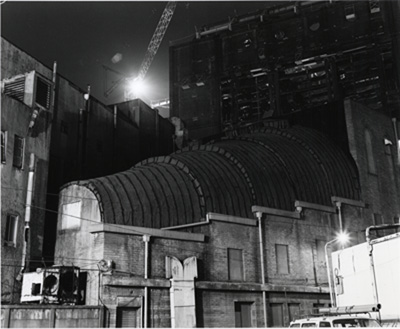
The series Visages of a Metropolis, from the late 80’s (published in book form in 1989), are photos Takanashi shot at night with a 6×7 camera, focusing on Tokyo buildings and structures that date from the 20s and 30s. They have a film noir feel to them — empty, people-less spaces, yet stolid, girded for the coming decades we know in retrospect they have survived. Though in earlier series on view — Machi (Town, 1977) and Text of the City: Shinjuku (1982-83) — Takanashi explored space as a type of city-dweller in and of itself, both series (one of storefronts and store interiors, the other of bar interiors) seem a bit cold and inaccessible, the various tightly framed, claustrophobic spaces more typological than individual. In the “Metropolis” photos, we get something in between the ephemeral gobs of grain of Towards the City and the specificity of these two series.

In the current decade, Takanashi has continued to explore the spaces of the city, alternating between a static, formal mode of exposition, and a decidedly more fluid one. In Nostalghia (2004) and Kakoi-machi (2007), he uses color film to explore the modern urban landscape of Tokyo and its environs. These two series are presented together, and unlike any of the series on view at the exhibition, here the photos are printed large and hung mosaic-like along three walls, so that walking through this semi-enclosed space indeed does feel like walking through a city where city planning has been thrown out the window, a city moving forward by accumulation rather than regeneration.

Yutaka Takanashi: From the series "Kakoi-machi"
Yutaka Takanashi: From the series “Kakoi-machi”

In both series, but in Kakoi-machi in particular, many photos use as a visual motif those blue billowing tarps that are used to enclose buildings as they are being constructed, or the solid fences that enclose — and cut off — construction sites from the rest of the city. (We can translate the title as “enclosed city”). Takanashi uses these veils, as it were, to explore the fact that while the intention is to keep these places from view until their unveiling, we as dwellers of this place can’t avoid what is in effect the proverbial elephant in the room.

Takanashi has taken the idea of enclosed space in a completely different direction in the two other series that close this retrospective, WINDSCAPE (2004) and silver passin’ (2008), both a return to black and white and a more hand-held aesthetic. In the former series, which was included in book form as a supplement to Nostalghia, Takanashi shoots the landscape, both urban and rural, from local trains throughout Japan. (The series was shot between 2001-2003). There is no attempt to hide the fact that Takanashi is behind the glass of a train car, often incorporating the reflections and glare into the photographs.

Yutaka Takanashi: From the series "silver passin'"
Yutaka Takanashi: From the series “silver passin'”

Likewise, Takanashi’s most recent work has been a series of photographs taken while riding Tokyo’s city bus system. Taking advantage of his age to qualify for a “silver pass” — a reduced-fee bus pass for senior citizens — Takanashi haunts the city in an entirely different way. Unlike the train journeys, here he is in the midst of the city, only a meter or two from the sidewalk, and while there are one or two photos that give away he’s on a bus, the overall effect is a disconcerting one where Takanashi is both on the street and above it.


We have the catalog for this exhibition in the bookstore. While not outstanding by any means, it does reproduce every photograph in the exhibition and therefore serves as a good overview of Takanashi’s career. We also carry Takanashi’s 2007 book Kakoi-machi.

Takanashi’s early books like Towards the City (1974, self-published) and Tokyoites, 1978-1983 (1983, Shoshi-Yamada) are works of art in their own right that would cost you dearly if you can find them (expect to pay upwards of $2000 for the former, Takanashi’s first book). If you ever have the opportunity to see these books in person — the library at the Tokyo Metropolitan Museum of Photography is one such place — I recommend you seize it.

Ginza Classics

Text and images by Barry Kawa for Japan Exposures

At most train stations in Tokyo, there are still film stores that can develop a roll of film in 45 minutes or less, so you can stop back and pick up your pictures on the way through, and enjoy looking at them on your train ride home. In the Japanese photography magazines, many articles are still devoted to film cameras each issue, although digital camera coverage is starting to pull way ahead. (There are even some dedicated magazines catering only to digital shooters.) Nonetheless most of the camera store ads in the front or back pages still list a huge selection of used film cameras and lenses for sale. These are now referred to as “classic” cameras.

Used camera shops like Sankyo Camera Co. [ map ], in the heart of the Ginza, Tokyo’s prestigious shopping district, located just off the famed 4-chome intersection, still offer shelves of Canon and Nikon rangefinder cameras and lenses for sale to film camera junkies like myself. In a store that is a throwback 20 years into the past, there aren’t any digital cameras for sale here.

At lunchtime, I have just enough time to walk up to Sankyo to see what’s new on their shelves since my last visit. Since I’m there, I can’t pass up the chance to stop by three other adjacent camera stores in this four-corner area of the Ginza that is a landmark for film camera buffs. My weekly “fix”.

There are actually two Sankyo camera stores within a half block, one specializing in Nikon and Canon rangefinders as well as other Japanese camera models, and another shop specializing in Leica cameras, although the window has a nice eye candy collection of Rollei 35mm, Rolleiflexes and Rolleicords for sale.

Across the busy street, there’s a Miyama Shokai Nikon branch store [ map ] that sells new and used cameras, mostly Nikon, but also enough used medium-format, rangefinder and other gear to take a look at. And just a few doors down is Katsumido [ map ], the ultimate store for Leica collectors who want everything in mint condition — and have the credit line to pay for it. This store also has a changing collection of highly priced and highly desirable cameras and lenses of all types in the window, with everything in near-mint condition.

I’m also not going to be able to afford any of those line of Leica M3s or M2s on display. They know it, and I know it.”

But the stop I enjoy the most is at the Sankyo Camera store with all the Nikon and Canon rangefinder gear, managed by Hiroatsu “Hero” Akizawa (call him Hero-san). At most Tokyo camera stores, the language barrier is difficult. There’s also the snobbery factor, as in stores like Katsumido, where the staff is aloof, and I’m too self-conscious to even ask a question, knowing that they are going to have to find somebody to talk to me in English, if there is anyone.

I’m also not going to be able to afford any of those line of Leica M3s or M2s on display, starting from 200,000 yen (about $2,200) and up. They know it, and I know it. So, I nonchalantly make my way over to the display case where cheap Nikon, Canon and Sigma auto-focus lenses are for sale, kept apart from the Leicas.

When I stop by Sankyo Camera, however, I’m greeted by Hero-san with a smile and in English. It’s the same relationship I first had with the now-closed Ohba Camera, which was located about a 10-minute walk from the Ginza near Shimbashi Station [Now a standing sushi bar — Ed.].

Sankyo Camera
The rangefinder section at Sankyo Camera

The store manager at Ohba was friendly, spoke English, and since I was a good customer, always gave me a discount. If I brought back something I had bought there, he would always give me at least 80 percent in trade. That kind of service instills customer loyalty, since in most of the Tokyo used camera shops I’ve visited, I’ve been offered pennies on the dollar on my trade-in gear.

When Ohba was closing last April, one of the clerks asked me, “What are you going to do now?” They would see me stop by at lunch and sometimes after work, on my way to the station, to see what they had got in. When they closed, I went through withdrawal pains. Sankyo has stepped in to help ease the pain. The store has treated me well, offering me good trade-in prices, and usually knocking a little off the price of anything I’m interested in buying as well.

My first time there, I brought in some Nikon binoculars I wasn’t using, an old Nikon P camera and some Canon lenses to trade, Hero-san looked, and then grabbed a calculator to show me what he was offering. The price was very, very fair. Since that time, I’ve been a regular customer, wandering in off the street each week to see what’s in the display cases.

Prices are not cheap, and bargain hunters in the States still can get better buys on eBay or through their local Craigslist site, although the condition can be a craps shoot. But at Sankyo, there are good buys to be had on cameras and lenses that are impossible to find in the States, and usually in excellent condition.

One glorious day, there was an Olympus XA4 macro model, no strap, but I turned it over, and there was the extremely rare quartz date back on it. The price? 8,000 yen, or about $70. “I’ll take it,” I said. Hero-san smiled and nodded. I also traded in a Canon rangefinder cameras and some lenses one time for a Canon 7SZ with a 50mm 0.95mm lens, in fair condition, but a steal at under 90,000 yen (about $800).

Happiness is finding a mint black Canon lens case for your 35mm F2 for a 100-yen coin.”

Other days, there have been cameras like a rare, heavily used black Canon P (gone the next day, when I couldn’t get it out of my mind and went back for a second look), and lenses like the Avenon 21mm and 28mm models don’t stay on the shelves very long. Sometimes, in front of the store, there are boxes filled with old lens cases and camera cases, selling for 100 yen (about a buck). Although I feel like a homeless person foraging through a garbage can, I still can’t resist jumping in.

Sankyo Camera
“Most Japanese like the Nikon”

Happiness is finding a mint black Canon lens case for your 35mm F2 for a 100-yen coin, which I embarrassingly hand over to Hero-san, my “purchase” for the day. But these days, business is slow at Sankyo, Hero-san says. On this Saturday, there’s a steady stream of customers looking, but few are buying. “Now, it is very slow, slow, slow,” Hero-san says. The reason? Of course, it’s digital cameras. Hero-san says it’s understandable, with how easy it is to use a digital camera. In the future, is there hope for stores like Sankyo to survive? A resurgence in film cameras?

“Sometimes, the person wants to do the shutter timing, aperture… maybe, I hope,” he laughs. Looking around at all the shelves of Canon and Nikon rangefinder cameras, I marvel at the selection, and ask Hero-san where they are from. Surprisingly, Hero-san has attended many camera shows in the United States, buying cameras and returning them to the country where they were made, to sell to collectors. He said the Pasadena show in particular, is a good place for them to buy rangefinder cameras and lenses in great condition.

“The weather is good, dry, the condition is better than in Japan,” Hero-san says. “In Japan the weather is very wet – sometimes the lens gets mold, the shutter time gets very long – not so good.” So, Japanese collectors are drawn to stores like Sankyo Camera, to buy the cameras that were exported to the U.S. back when the exchange rate was at 360 yen to a dollar.

Hero-san said Nikon cameras and lenses, particularly Nikon Tokyo Olympic models, are his store’s best sellers. Although the store has a display case full of Canon rangefinder cameras and lenses, the Nikons outsell the Canons. “Canon (prices) are going a little down,” he says.

Hero-san points to all the Nikon collectible books, and says this interest has helped fuel the collector market. “Most Japanese like the Nikon, I think,” he says. “Then, also, the Nikon mechanical system is better than the Canon – Canon changes their mount, very quickly – and the old ones are very hard to use.” Himself, he still likes the Nikon F camera. He was born in 1946, (“after the Second World War,” he laughs) so he always wanted the Nikon F when he was in high school, but it was too expensive. So, he started off with a Pentax camera, then later got his Nikon F. I compliment Hero-san on his store’s friendly customer service, and generous trade-in offers. “Ah, so,” Hero-san laughs. “If it is quick to sell, I buy.”

In this digital world, leave it to the nostalgic Japanese to keep a flickering candle lit for the world of film cameras.


Barry KawaBarry Kawa was born in Atlanta, Georgia, and grew up in Clearfield, Utah. He has worked as a reporter, bureau chief and editor at the Ogden Standard-Examiner, Times of Gainesville (Ga.), Charlotte Observer, Cleveland Plain Dealer and Dallas Morning News before moving to Japan in 2001 with his wife, Yumiko. He now works at a Japanese newspaper, and has become an avid camera enthusiast and collector.    

The multi-dimensional Tokihiro Sato

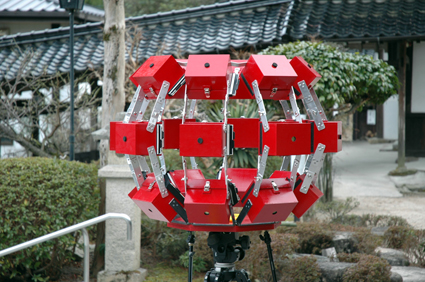
Tokihiro Sato was born in 1957 in Yamagata Prefecture. He graduated in 1983 with a MFA in sculpture from Tokyo National University of the Arts. He is well known in Japan and in the rest of the world for his exploration of making photographs of landscapes or common spaces using very long exposures. He proceeded to the construction of various kinds of cameras, including a multiple pinhole camera, and their installation in public or generally “vacant” spaces.
Sato Multi-Pinhole camera

Since 1999 he has been an associate professor in the Department of Inter Media Art at the Tokyo National University of the Arts (known also as “Geidai”).

Tokihiro Sato’s work has been exhibited extensively internationally, for example as part of the 1997 6th Havanna Art Biennale and the 9th Asian Art Biennale, Bangladesh (2-person show) in 1999. He is represented by Gallery GAN (Tokyo), Leslie Tonkonow (New York) and Haines Gallery (San Francisco). Solo exhibitions of his work have been held in various locations in Japan and abroad, such as the Sakata City Museum of Art and the Art Institute of Chicago.

Most recently he has been working on a project on the theme of relationships with others as well as since 2000 the Sightseeing Bus Camera Project, where lenses are mounted onto the side of a public sightseeing bus to project the passing scenery onto a screen mounted in the middle of the bus.

In 2005 a book entitled Photo-Respiration was published in English by the Art Institute of Chicago. However, a book with the same title containing a very similar spectrum of work was already published in Japan in 1997 by the Nikkor Club*.

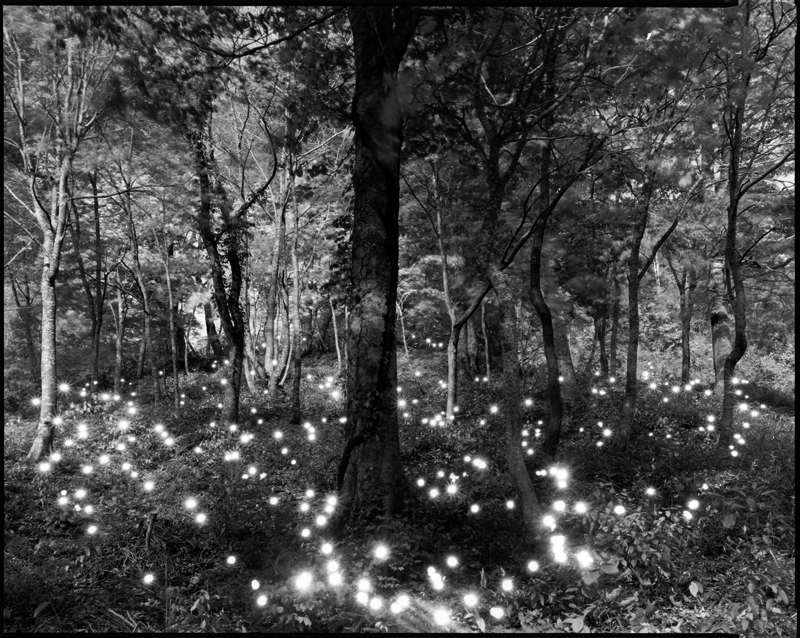
Tokihiro Sato - Shirakami #10, 2008

The Photo-Respiration series is Sato’s most well known work. When we approached him with our request for a cover photo, we were delighted to learn that he has been continuing to work on the series up until now, as the above 2008 image Shirakami #1 illustrates. Photo-respiration consists of two sub-streams, Breathing Light and Breathing Shadows. To make these photographs, Sato opens up the lens on his 8 x 10 camera for an extended exposure, sometimes up to three hours, and subsequently physically enters the scene in front of the frame. In Breathing Shadows a flashlight is pointed at the camera at nighttime or in a darkened space. In Breathing Light he uses a mirror to reflect light back toward the lens by day. In both cases he then moves around in the scene adding streaks or spots of light to the image. Ironically a long exposure of a person becomes a photo without anyone in it, but the viewer infers the person’s presence from the resulting image.

The title Photo-Respiration was chosen, according to Sato, because in the photographs he makes “a direct connection between my breath and the act of tracing out the light.” In his view this has the same significance as in monotonous activities such as long distance running or swimming, when one’s focus is only on breathing. The fact that Sato accommodates the three-dimensional real world by tracing it through his person into the image is often attributed to his training as a sculptor, although naturally the concept of dimensional collapse is part of the medium and a consideration for every photographer.

The resulting photographs have a very timeless and lyrical feel about them and this impression persists even after learning about the technique that was used to create them. In fact, knowing the method of creation adds to the enjoyment of the work. As always, it is the viewer who makes the image once more when facing it and doing so is a delightful moment. Interpretation is tempting, but one should be careful not to jump to quick associations. In an Q&A session, Sato was once asked what the reflections of light “represented” to him: perhaps fireflies, or marching pieces of string? His response was that representation is not his intention. All they represent is where he stood shining the light into the camera.

Tokihiro Sato Triangle-Square-Pentagon The Camera in UbeEven though we refer to Tokihiro Sato here as a photographer, it might be more accurate to speak of a visual artist who is appropriating the medium of photography. The Wandering Camera, for example, demonstrates a strong resemblance to an art installation or a performance which even includes an immediate feedback loop to the audience. Lastly, his award-winning contribution to the 20th Exhibition of Contemporary Japanese Sculpture 2003 is a camera-esque steel sculpture that reflects the outside world on the inside, showing that this artist is more than comfortable to move between the media he chooses to work in.


Please also see Sato’s Cover Photo of the Brooklyn Bridge taken with a multi-pinhole camera, as well as a feature by Stacy Oborn on Sato.


*We have used copies of Sato’s 1997 book, Photo-Respiration, for sale in the bookstore.

Camera of generations

Text and images by Barry Kawa for Japan Exposures

Recently, a young Japanese woman brought in an old shiny camera to my office, a curious look on her face. It was her grandfather’s 1950s Konica IIA, a rangefinder. She said her grandmother had wanted her to have it, an old antique that her grandfather, who had passed away recently, had loved using.

The young woman told me that she had taken the Konica to a camera shop, where they had charged her 30,000 yen (about $270) to do a CLA on it. But the young employee at the counter who returned it to her told her he didn’t know how to load film into the camera or use it. I told her that the camera was not worth that much, being an obscure Japanese brand, and she paid more than what it was worth. I admired the 1950s styling, always a sucker for an old chrome rangefinder camera. I asked her if she wanted to sell it. ‘’Oh, no, it was my grandfather’s camera. I will never sell it,” she said. So, I looked up the camera instructions on the Internet, put some film in, and showed her how to set the aperture and shutter speed. Without a meter in it, I printed her out the “sunny F16” rule, and told her to go have fun with the camera. It’s what her grandfather would have wanted.

It was his father’s camera, and he had too many good memories of family pictures being taken with it.”

Then, another co-worker, a Japanese gentlemen who collects antique tin toys, brought in a Pentax S2 with the standard 55mm F2 lens, sold in the Japanese market, to show me. He asked me if I knew how it worked. When I looked at the viewfinder, I couldn’t see anything, even after checking to make sure all the lens caps were off. When I took off the lens, I noticed there was no prism! I took the camera to Ohba Camera, and they estimated it would cost about 10,000 yen to repair it. I told my friend at the office he should just toss the camera, that it had no value, and I knew he would never use it, even if he got it repaired. But he said he couldn’t do that, it was his father’s camera, and he had too many good memories of family pictures being taken with it.

Even though space is very limited in Japanese homes and apartments, most Japanese seem to pass their cameras down to the next generation. In the United States, looking at various local classifieds sites, Craigslist, Internet camera ads, eBay ads, I’m always struck by how many sellers say the camera was their father’s or grandfather’s camera. Since moving to Japan, I’ve myself benefited by my wife’s family passing down their cameras to me. We moved to Tokyo in 2001, and I became interested in photography. I had worked at many newspapers in the United States as a reporter, and then a bureau chief and editor. I had worked alongside many of the finest newspaper photographers, so I had never had the need to pick up a camera myself. In Japan, however, most journalists have to take their own photos, so it was a skill I needed to acquire.

My wife’s grandfather, a retired architect, had spent his lifetime shooting photos, mostly landscapes around Japan, and family photos. Now in his 90s, shakier of both hand and feet, he can only shoot with a Pentax Espio 115, a point-and-shoot film camera. He lamented the loss of control over his photos, but the convenience of that lightweight plastic body and zoom lens was more important. One night, my wife told me, ‘’Ojii-san (grandfather) wants to give you his camera.’’ She didn’t know what kind, so I was hopeful. Would it be a Leica, or maybe an old Nikon F? Camera Generation In the moment when he handed me the funny box-looking camera, I smiled. It was an early 1950s Rolleiflex, with a Tessar 75mm F 3.5 lens. Never having used a medium-format camera, I had to look up the manual on the Internet. My wife said he had bought it in the mid-1950s when his friend needed to sell it. Ojii-san asked his wife if he could buy it, since even at that time, the purchase of a used Rolleiflex with the leather case and all accessories cost them almost half their savings. It turned out to be a wise investment, back in the days when a good camera was a finely made instrument that would last a lifetime and — as we now see — even longer. In all his photo albums, I see that old Rolleiflex around his neck at family gatherings and visits to hot springs spas. At their small apartment in Tokyo, one storage room is completely filled with albums on the shelves. He still keeps a photo album year by year, his best photos enlarged and cut to fit spaces.

Now it was me who said that, of course, I would never part with it; it holds too many sentimental memories for my wife’s family.”

Then, another night, my wife told me again, ‘’Ojii-san wants to give you another camera.’’ This time, it turned out to be a Minolta X-600, a model I had never heard of. From doing some searching it turned out this model was a rare one, only made for one year, 1983, and sold only in Japan. My wife’s grandfather had bought it to use in his architectural work. Later, he would travel with his wife on the group tours the Japanese are famous for, with that camera and a Minolta 35-105mm F 3.5-4.5 lens, to take some of the most beautiful landscape photos in Japan and around the world imaginable.

I posted on one Internet site asking about the value of an X-600, out of curiosity and the possibility of finding another one in Japan, and someone immediately sent me an e-mail wanting to buy that old camera. Now it was me that told the requester that I, of course, would never part with it; it holds too many sentimental memories for my wife’s family. I tried the Minolta X-600, even getting a 45mm F2 Minolta Rokkor for portability. It’s a fun camera to use, focus is manual, but there are confirmation dots that light up to tell you the subject is in focus. I mulled just outfitting that Minolta X-600 with the best lenses and making it my sole camera, but my friend at Ohba Camera in Tokyo laughed, and told me that only old men still use and collect Minolta cameras.

In brand conscious Japan, I knew that I would end up eventually carrying a Leica. So, the X-600 went into permanent “retirement.” Since then, my wife’s father also gave me his old camera: a Minolta 7000 and two Sigma zoom lenses. I thanked him, and took the camera, which he seemed pleased was going to someone who would use it and take care of it. I also found the old Minolta 7000 enjoyable to use, fast and responsive. Like the X-600 and Rolleiflex, they are all going into my dry cabinet. Since my wife and I have no children, I’ll pass them down to my nieces some day, with all my wife’s grandfather’s photo albums. Hopefully, they’ll gain that same love of film photography and appreciation for their ancestors and family that these old cameras have given me. For in Japan, there is a reason why family treasures such as these are never sold.


Barry KawaBarry Kawa was born in Atlanta, Georgia, and grew up in Clearfield, Utah. He has worked as a reporter, bureau chief and editor at the Ogden Standard-Examiner, Times of Gainesville (Ga.), Charlotte Observer, Cleveland Plain Dealer and Dallas Morning News before moving to Japan in 2001 with his wife, Yumiko. He now works at a Japanese newspaper, and has become an avid camera enthusiast and collector.  


Interview with Sachiko Kadoi

Sachiko Kadoi was born in 1963 in Tokyo, and studied graphic design at Tama University of Art (Tokyo) from 1982-1986. She has been actively pursuing photography since 2003, and her first book Kadoi Sachiko: Photographs 2003-2008 was published in the Fall of 2008 by Sokyusha.

Here she talks to Japan Exposures about how she came to adopt photography as her means of expression, the importance of photographers as different as Michael Kenna and Koji Onaka in setting her on her creative path, and her thoughts about the man-made landscapes that comprise the dominant theme of her work.

The interview was conducted during the last week of December, 2008. In addition to the photographs that accompany this interview, please see our special Sachiko Kadoi gallery.

日本語


Japan Exposures: When did you first become interested in photography, in taking pictures?

Sachiko Kadoi: When I was 11, my father bought for me and my sister an easy-to-use half-frame compact camera for me to take with me on a school trip. This was the first time I took photos. Bringing a camera along on school trips is quite a common thing to do in Japan, but I was happy to handle the camera, and remember that it was interesting to take my own photos. It was when I was in college and bought myself a camera that I began to be more seriously interested in photography and in taking photos.

JE: You attended Tama University of Art in Tokyo, is that right?

SK: Yes, that’s right. I was interested in art from a young age. There were art books and catalogs of various exhibitions that my grandfather, who was a painter, bought into the house. I often looked at these and I also used to go to museums in my junior high school and high school days, and thought that I wanted to be a painter in the future.

But we lived in a small house, my parents, my older sister and I, and my grandparents, and I didn’t even have my own room, and so to go to art college was not easy. It was like the movie “Billy Elliot” [laughs]. I felt I needed to be independent from my parents after graduating from college, but it seemed impossible to be able to survive as a painter. So I entered the Graphic Design department at Tama University of Art. However, I came to feel that the advertising world was not a place I could be comfortable in, and ultimately, I felt that I wouldn’t be able to be happy doing that kind of work.
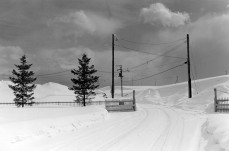
Sachiko Kadoi: Airport, Asahikawa, Hokkaido 2004

Thankfully, there was a photography class offered in the design department. I was interested in working in the darkroom, so it was a lot of fun. At that time, I bought a Canon 35mm camera. I still have it, and have used it without trouble for 20 years. I learned how to print black and white, as well as various other techniques little by little, such as toning prints, making photograms, solarization, etc. At any rate, I liked taking photographs. I preferred to take pictures more than looking at another photographers’ work. I didn’t look at photo books or go to photo galleries that much, compared to now. After graduating I liked to travel on my own, both within Japan and overseas, taking pictures as a way of enjoying myself.

JE: What did you do to support yourself after graduating?

SK: Rather than entering a design company after graduation, I did freelance work in the book publishing field. Mainly book design, but other various things related to books as well, such as editing, making objects for craft-making books for children, illustration, and so on. The books were mostly about natural science and geared towards children from kindergarten to primary school age, or books about practical skills and child-care counseling for child-care professionals. The work was really hard, there was a year I couldn’t have any holidays at all. During this time, I continued to hold on to the desire to do my own artwork, not photography but drawing or painting, but it just wasn’t possible because of my work load.


I looked at Kenna’s photos again after that talk, thinking that there were eight hours captured on this paper, and I began to look at photography in a new way.”

JE: When did you begin to consider photography as a creative outlet?

SK: Well, I often worked with commercial photographers in the studio and on location, and I learned about book editing work in an editorial agency that had a stock agency attached to it, where we would get stock photographs mainly related to natural science for the books. So photography was always a part of my freelance work, but I began to consider photography as a creative outlet after I went to Koji Onaka’s workshop in 2003.

JE: How did your participation in that workshop come about?

SK: There were actually a lot of things that happened in 2003 to make that year a turning point for me.

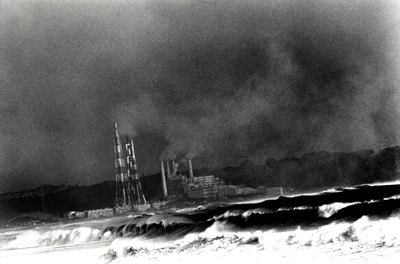
There was a retrospective exhibition of Michael Kenna’s work in Tokyo, and I attended a slide show and talk that he gave. He talked about exposing one of his photos from his Ratcliffe Power Station series for eight hours. [Kadoi remembers it being Kenna’s “Study 31” from this series. – ed] Of course I knew that he used long exposures to make those photographs, but I was very surprised to hear it was eight hours! I looked at those photos again after that talk, thinking about a camera that looked at a power station in the quiet of the night and that there were eight hours captured on this paper, and I began to look at photography in a new way. I had the feeling that a photograph was not the flow of time and space passing before my eyes that the camera captured, as a mere tool, but rather that a photograph was the flow of time and space passing before the camera, as if it was like a living thing, with its own personality, and that I captured what it was looking at. At that moment, I had the strong desire to take photographs. Although this urge was a bit strange, seeing as I had been taking photographs for 20 years.

Sachiko Kadoi: Rut, Matusdo, Chiba 2005

And then that summer I participated in Koji Onaka’s photography workshop held at the Yokohama Museum of Art. About 10 years ago a friend of mine who was into looking at photographs, knowing that I liked to travel by myself to various places, taking photos, asked me to go along with him to an exhibition of Onaka’s. He probably thought Onaka-san’s work would be good for me to study. I still remember seeing works of his shown in Ebisu that had been printed large onto rolls of paper.

I guess that in doing nothing but the opposite of what Onaka-san talked about, I was not a good student.”

JE: Could you tell us more about Onaka’s workshop, and what you learned from him?

SK: I think the most important thing that I got from the workshop was that it gave me the intention to exhibit my photos as a photographer. It was not only about my strong feelings towards art, but also that up until this time, because of my freelance work, I had had the idea that a person called “photographer” was someone who did commercial photography. So I hadn’t yet hit upon the idea that I could exhibit my own work.

Onaka-san talked to us about photography’s “時代性” (jidaisei) by which he meant a photograph’s ability to record the time period in which it was taken. According to Onaka-san, it is because of this ability that photographs derive their power. He also talked about “interestingness” captured in photographs. At this time, he was negative about even taking pictures in foreign countries because we didn’t know its jidaisei. He talked about the importance of being genuine when taking photos of subject matter with a strong character. That is his methodology for taking photos, and that is why his photos are good. However, if I followed his way, it was only occasionally that I could produce work with a similar feel.

His workshop was a good opportunity for me to think about my own photos, question what it was I wanted to do, what I had been doing up to that point, and what I should be doing going forward, and so on. As a result, I ended up ignoring Onaka-san’s words to “take more pictures of towns”. [laughs] More and more I came to take photographs of simple scenes and places. So, I guess that in doing nothing but the opposite of what he talked about, I was not a good student. [laughs] The series of photographs of the gravel mountains in the latter half of my book [Kadoi Sachiko: Photographs 2003-2008] came from such a background.

Anyway, I was still working very hard to support myself, but I was also becoming crazy about photography. Even when I finished my work at 2 o’clock in the morning, I would then look at my contact sheets for over an hour.

JE: Speaking of your book from Sokyusha, it carries the subtitle “Photographs, 2003-2008”. That makes me think this book is a “collection” of your work from the last 5 years, rather than a single project that took 5 years to photograph. How do you think of this book?

SK: Actually, I want my next book to be a single project. But I wanted to make this book first. However, rather than a collection of individual images taken over the last five years, I think the photographs have been selected and edited together to become something with a unified feel. I feel that Ota Michitaka-san has done a great job taking a number of my projects and shuffling them around. At first I showed him the postscript I had written and conveyed to him my thought process behind the taking of the photos.

[Ota runs the publishing company Sokyusha and has edited and published many important photo books, including the original Ravens by Masahisa Fukase, as well as books by Daido Moriyama, Miyako Ishiguchi, and Onaka. – ed.]

JE: The book does seem to me to be very well edited. What was the working process with Ota?

SK: At first I handed him the photos which I had selected, and about a week later he presented the first draft, and then I gave him my opinion. Every time Ota-san shifted the photos around, I would make a mock-up and he would check the sequencing again. He would suggest what photographs he thought would work the best in the sequencing, and then I would look at the contact sheets again, and print more photos as well. The inclusion in the book of photos from the “gravel mountain” series was a result of this process. We worked on this from the middle of July until October (2008). It was very tough work because of the short time span.

I don’t think that man and nature are opposing concepts, and therefore I don’t want to take photographs from such a point of view.”

JE: There are only a few photographs in the book that have any people in them, but on the other hand, it seems that almost everything we seen in the photographs comes from man, is man-made. Can you tell us more about your approach to landscapes and what attracts you to a scene?

SK: Although I am walking around places where I rarely encounter people, I’m thinking that I want to take pictures of people. But this thought to take photos of “man” doesn’t mean that I want to take pictures of, say, the elderly that I sometimes pass by on my walks. Japan is a small country, and because of this we can see a direct relationship between people and nature or the land everywhere we go. Sachiko Kadoi: From "Sank in the time and space", Hamaoka, Shizuoka, 2007I’m not particularly thinking in a conscious way that “this object has a relationship with man”, but it seems that the scenes in front of me that I want to take are essentially always those kind of scenes. I don’t think that man and nature are opposing concepts, and therefore I don’t want to take photographs from such a point of view. While there is a clamor against environmental destruction nowadays, when I look at the landscapes on islands or sand dunes, etc., I find that man’s existence is small and that I am overwhelmed by the immense power of this other thing, that is nature or what some people might call “God”. The important thing for me is that, as opposed to ruins which are of “the past”, the subjects I want to take photographs of most of all show man’s existence, and are things still in operation.

JE: These are not what many people would consider beautiful places.

SK: Daniel Stifler, who translated the postscript of my book into English, told me that the subjects of my photographs are perhaps not beautiful in a traditional sense, but that he felt I was able to find beauty in them, and that there is both space and silence. I was told similar things by some Japanese people, such as “I like your work because there is a space I can participate in”. I was very happy to hear that.

JE: How often do you photograph? Are you a photographer who is always shooting pictures, or are you a person who works more on a project by project basis?

SK: I think a bit of both, but I don’t have the feeling that I am always taking pictures. But that doesn’t mean that I take pictures by seeking out beforehand potential locations to shoot in, according to some theme or another. I think encountering the landscapes just by walking and walking is important for me. When I’m out shooting, I don’t take photos or not take photos to fit some theme.

JE: Can I ask you about the camera(s) you use and whether or not equipment is important to you?

SK: I shoot in 35mm and sometimes use a Mamiya 645 camera. I think the camera – or rather, the lens – is important, but I am not a camera otaku. My camera is not so bad, but I am thinking I want another one. I received a 6 x 9 format camera last year, so I am looking forward to taking photos with that. It is often said about me that I like to take photos unhurriedly, but I take photos as if I’m taking snapshots, and shoot quickly. I don’t vacillate about composition, and those times when I look through the viewfinder and can’t decide on a composition, I don’t take the photograph. I don’t use a tripod except in dark situations – it seems to change the photograph if I use one. As for film, I used to like XP2, but I use Tmax 400 developed in XTOL now. I process and print my own work at home.

JE: What are you working on now?
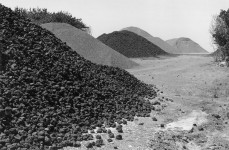
Sachiko Kadoi: From "In the beginning" Oshima, Tokyo, 2004
SK: The photographs that are in my new book are several projects that continues now. The series of gravel mountain in particular I want to spend more time continuing to photograph, and would like to publish it sometime in the future. There are lots of different photos I have taken from this series, so I am thinking about what kind of things I can do with those photos for a photo book.

I started taking photographs in parks when I was in Onaka-san’s workshop, and some of these are in the book, but I stopped taking them after that. I would like to pick that back up again. Additionally, as a new experiment, I’m making small prints of photos taken in Tokyo’s old town, which I have at an arts and crafts store called “Fukugawa Ippuku” near the Museum of Contemporary Art Tokyo, and which I add to each month. These will be snapshots taken in the older districts in the eastern part of Tokyo, what we call “shitamachi”, around my hometown.

And lastly, it is not landscapes, but I have a project that I have been wanting to do since I began to have exhibitions of my work held. This is still at a trial stage, so I cannot talk a lot about it, but it involves photographing the movement of the body. I don’t know if I can succeed in that project or not. Anyway, I need a lot of time for all these projects!

JE: 最初に写真に興味をもったのはいつですか?

SK: 11才のとき、日光林間学校に合わせて父親が子どものためにハーフサイズのコンパクトカメラを買ってくれて、初めて自分で撮りました。修学旅行や林間学校にカメラを持っていくのは日本では一般的なことですが、自分で撮るのはおもしろく、カメラを手にしてうれしかったのを覚えています。本格的に写真を始めたのは、大学時代にカメラを買ってからです。

JE: 多摩美術大学に通われたのですよね?

SK: そうです。もともと私は美術に興味がありました。画家だった祖父が買った美人画の画集やいろいろな展覧会の図録が家にありましたので、それらを見たり、また中学高校時代は美術館に通ったりして、将来は画家になりたいなと思っていました。でも私の家族は小さな家に両親と姉と私と祖父母とで住んでいて自分の部屋もなかったし、美術大学に進むのも大変でした。映画『リトルダンサー』みたいで(笑)。それで卒業後はとにかく親から独立したいと考えていて、そんな自分にはファンアートの世界は生計を立てる上で難しく思いました。それでデザイン科に進んだのですが、入ってみたものの広告デザインの世界には馴染めませんでした。

ただ幸せだったことは、美術大学のデザイン科やデザインスクールには必ず写真の授業がありました。暗室作業には興味がありましたのでとても楽しみでした。そのときに自分でキヤノンの一眼レフを買いました。今でも使っているカメラです。20年故障なく使っています。

Sachiko Kadoi: Airport, Asahikawa, Hokkaido 2004

学校では、モノクロのプリント技術や調色の他に、フォトグラム、ソラリゼーションなどいろいろなことを少しずつ学習しました。写真は他の作家の作品をみることより、とにかく撮るということが好きで、今と比べると、写真ギャラリーを回ったり写真集を見たりというのは少なかったです。旅が好きだったので卒業後は国内外一人で行っては自分の楽しみのために撮っていました。

JE: 卒業後はどうされていたのですか?

SK: 卒業後はデザイン事務所には勤めずにフリーランスで書籍の仕事をしました。ブックデザインの仕事ですが、構成、編集、造形物の制作や、イラストレーションなど、本に関するいろいろなことをやりました。主に幼児から小学生の読む自然科学の本や、保育士向けの実技書や保育カウンセリングについての本です。仕事は本当に忙しく一年休みなく働いた年もありました。その間も、作品を作りたい、これは写真ではなくドローイングやペインティングですが、その気持ちはずっと変わらず持ち続けていたのですが、忙しい毎日でなかなかできませんでした。

JE: 写真を表現手段として考え始めたのはいつですか。

SK: スタジオ撮影や野外の撮影の仕事もありましたし、主に自然科学の本に使われる写真のストックをしている編集事務所で編集の勉強をさせていただいたので、いつも写真と隣り合わせの仕事ではありました。でも表現手段として考え始めたのは2003年に尾仲さんのワークショップに通ってからです。

JE: ワークショップに通われたのはどういうきっかけですか?

SK: 2003年は私にとって、ターニングポイントとなるできごとがたくさんありました。マイケル・ケンナさんの個展があり、ご本人のスライドトークがありました。そのなかで、ケンナさんが “Ratcliffe Power Station”の写真のひとつに8時間露光したと聞き、もちろん長時間露光の写真とはわかってはいましたが8時間というのに大変驚きました。(そのシリーズの中で門井さんは「Study 31」を記憶している。- 編集者談) スライドトークが終わったあと再びその写真を、そこに8時間の時間が写っているのだと、夜の静寂に発電所に向かっているカメラを思い浮かべながら見ているうちに、こんな思いが浮かびました。
写真は、私が見ている時間、私の前に流れている時空をカメラが切り取るのではなくて、カメラが見つめている、カメラの前に流れている時空を私が切り取るものなのではないのか、ということです。その瞬間、ああ写真が撮りたい、と強く思いました。20年撮り続けていたのになぜかそう思ったのです。

Sachiko Kadoi: Rut, Matusdo, Chiba 2005

またその夏に尾仲浩二さんのワークショップが横浜であり参加しました。尾仲さんについては、10年程前、写真の好きな友人が尾仲さんの個展に誘ってくれました。私が旅好きで、一人でいろいろなところへ行って写真を撮ってくるのを知っていて、参考になるだろうと思ったのかもしれません。まだロール紙で大きくプリントしていた尾仲さんの作品を恵比寿で見たのを覚えています。

JE: 尾仲さんのワークショップについてもう少し教えてください。

SK: 尾仲さんのワークショップで得たものの1番は、作品を発表していこうという意思をもてたということだと思います。美術に対する思いが強かっただけでなく、仕事を通じて、写真家と呼ばれる人はコマーシャルの仕事をしていると思っていたので、自分の写真を作品として発表するという考えを思いつきませんでした。
尾仲さんは、写真の時代性や写真に写り込むものの面白さということを話されました。時代性こそが写真の力であると。だから外国に行って写真を撮ることには当時は否定的でした。

また、キャラクター性の強い(おもしろいもの)を撮るということに対して、「おもろいもの」を素直におもしろいと思って撮ることの大切さも話されていました。ただそれには尾仲さんの方法論があり、またそれが尾仲さんの写真の良さであり、それ通りにしていればいつしか似たような作品になってしまう。
尾仲さんのワークショップに行くことで、自分の写真のこと、やりたいこと、今していること、これからするべきこと、などを深く考ることになったのがよかったと思います。結果的には私は「街を撮りなさい」という言葉も無視して(笑)ますます時代性のでない状況や、写り込むもののおもしろさを極力避けたような写真を撮って行くようになりました。反抗ばかりしていてきっとよい生徒ではなかったと思います(笑)。写真集の後半に入っている砂利山のシリーズはこうした背景からでてきたものです。仕事は相変わらず忙しかったけれど、写真に夢中でした。夜中の二時に仕事を終えたときでも、それから一時間コンタクトを見たりしました。

JE: 蒼穹舎から出された本について、”Photographs, 2003-2008″と副題に、ひとつのプロジェクトによる写真集というより、5年間の作品集と印象を受けましたが、そのへんについて聞かせて下さい。

SK: この次はひとつのプロジェクトで本を作りたいと考えていて、その前にこれを作っておきたかったというのがありました。ただそれぞれが独立したイメージの作品集ではなく、本として統一されたものになるように写真は絞られて編集されていると思います。編集の大田通貴さんは、いくつもの私のプロジェクトをシャッフルしながら、うまくまとめてくださったと感じています。大田さんには、後付けの文章を先に渡して、どういう思いで撮っているのかを伝えました。

JE: とてもよい編集がされていると思います。大田さんとの編集プロセスを聞かせてください。

SK: まずは大田さんにセレクトした写真を渡し、一週間後にいただいた案に今度は私が意見を出しました。写真が入れ替わるたびに私が小さい完成見本を作り、大田さんが再度流れをチェックしました。流れのなかでそこにどんな写真くるとより良いのかを聞き、コンタクトから見直しプリントを繰り返したところもありました。砂利山のあたりがそうです。2008年の7月の中旬から10月までの作業でした。期間としては短かったので大変きつい作業でもありました。

JE:人の写っている写真はほとんどありませんが、一方で、「人により作られた風景」であると感じられます。風景に対するアプローチや、引きつけられる風景いについて教えてください。

SK: もともと歩いていてもめったに人に会わない場所なのですが、「人を撮りたい」と思っているのです。でもその「人を撮りたい」と思う私の思いは、例えばたまにすれ違うお年寄りを撮るというのとは違うものであると考えています。日本は国土が狭いので、どこへ行っても人と自然(土地)との関わりが見られます。Sachiko Kadoi: From "Sank in the time and space", Hamaoka, Shizuoka, 2007特に意識して「こういうものは人との関わりだ」と考えて撮ることはありませんが、撮りたいなと思う目の前の風景がそもそもどれもそんな感じに私には思えます。人と自然は相対立するものでではないと考えていますので、そういう視点で撮りたくはありません。環境破壊が叫ばれている昨今ですが、むしろ島や砂丘などで見る風景には、人は本当小さくそれ以外の力、自然というかそれ以上の、「神」と呼ぶ人もいるでしょうが、その大きさに圧倒されることがあります。重要なことは、人の存在といっても、廃墟のように”かつて”ものではなく、現在稼働しているものを撮りたいのです。

JE: 多くの人々があまりきれいな場所と思わないでしょう。

SK: 翻訳してくれたダニエル・スティフラーさんには、私は伝統的な意味で美しいものは撮ってはいないが、どんなものにも美を見いだしていると言われました。それから私の写真には空間と静寂があるとも。似たようなことを私の写真を好きだといってくださる日本の方にも言われたことがあります。「見る私の居場所がある」と。それらを聞いたときとてもうれしく思いました。

JE: どのくらいの頻度で撮るのですか?いつも撮っているタイプの写真家でしょうか?それともプロジェクトを基本にして撮っている方でしょうか?

SK: どちらもと思いますが…、あまりいつもいつも撮っているという感じではありません。でもテーマに沿って、被写体のあるようなところをあらかじめ調べ、撮りに行くということではなく、あくまで歩いて歩いて風景に出合うことを大切に考えています。撮るときに、テーマに沿って撮ったり撮らなかったりもないです。

JE: お使いのカメラや設備について聞かせてください。

SK: 35ミリと、その他にはマミヤの645のカメラを持っていて、時々はそれで撮ります。カメラ(というかレンズ)は大切だと思いますが、”カメラオタク”ではありません。私のカメラは悪くはありませんが、また違うカメラも欲しいなとは思っています。昨年69のカメラをもらいました。今はそれで撮るのを楽しみにしています。よく人から「ゆっくり構えて撮っているようだ」と言われますが、スナップショットのような感覚で撮っていて、撮るのは速いです。構図に迷うこともなく、ファインダーをのぞきながら構図を迷うときは撮るのをやめてしまいます。暗い時間以外は三脚も使いません。三脚を使うと写真が変わってしまうように思います。フィルムについてはXP2が気に入っていたのですが、今はTmax 400を使いエクストールで現像しています。自分の家で現像もプリントもしています。

JE: これからの予定について聞かせてください。
Sachiko Kadoi: From "In the beginning" Oshima, Tokyo, 2004
SK: 写真集に収められた写真はほとんどがいくつかの継続しているプロジェクトです。特に砂利山はまだまだ時間をかけて撮り続け、近い将来まとめたいと考えています。いろんな写真がありますので、写真集でどんなことができるのか考えて進めていきたいと考えています。

また尾仲さんのワークショップのときに撮り始めた公園の写真ですが、いくつかは写真集に収められていますが、その後しばらく撮ってなかったもので、また続けたいと考えています。

あとこれは新しい試みで、東京のスナップを小さいプリントにします。”深川い
っぷく”という東京現代美術館の近くにあるショップに置かれるものです。毎月
新しい写真を置く予定です。下町と呼ばれる東京東部地区でのスナップで、私の
生まれたところでもあります。

また風景ではありませんが、ひとつ写真を発表し始めたころからやりたいと思っていることがあります。これはまだ試作段階なのであまりお話できないのですが、体の動きを撮るというようなもので、うまくいくか未知数です。いずれにしても時間が必要だと思います。

Hiroshi Sugimoto Visions in my Mind

My first encounter with Hiroshi Sugimoto’s work was in a 1980s compilation of Japanese modern art featuring his movie theatre and seascape works. Not surprisingly, it took me quite a while to wrap my own mind around his visions.

What is fascinating about Sugimoto’s photographs is that even when looking at work from 20 or 30 years ago, it still seems very much contemporary and recent. The reasons for this are surely manifold, but not least because of the use of black and white, the often archetypal subject matter and ultimately the work’s examination of timelessness itself (which would make an interesting nested double conundrum). This short documentary is an attempt to get a better impression about the man behind the pictures.

I have hundreds of different ideas always in my mind, secretly.”

The film opens with Sugimoto experimenting with a Van de Graaff static electricity generator throwing sparks between the machine’s and the handheld spherical devices. The sparks are to be recorded on sheets of 8×10 film and later to be enlarged to prints resembling giant fireworks of lightnings, x-rays or even aerial reconnaissance images. He states that he had the idea to explore this when removing or inserting dark slides into the film holders during dry winters, which generated sparks, ruining the film in them.

His statement “I have hundreds of different ideas always in my mind, secretly” is the thread that appears to lead us from one project to another. Sugimoto is a quiet and persevering explorer of fascinating small details in the world which most of us would not care to look at for extended periods of time. While this may be valid for any noteworthy photographer, Sugimoto’s approach is unique in that it appears to completely isolate the subject matter, place it under the microscope (or rather the camera) and then records it in a quasi-scientific manner, often in a variety of subtle variations. While watching the film it occurs to me that a comparison to Edward Muybridge is not too far fetched.

The film continues to follow Sugimoto around during the preparations of his major retrospective. We join — presumably invited — visitors being shown around and explained selected works by the artist himself. Technically inclined viewers will certainly appreciate a glimpse at the working practices of a master, including his darkroom or the explanation of the “double-infinity” technique used in the Architecture series. Large format or film photographers in general will be assured that dust on film and prints will treat everyone equally, master or novice.

This documentary film by German art historian, curator and independent documentary filmmaker Maria Anna Tappeiner provides some valuable views on Sugimoto and his works. However, overall its approach appears rather detached, even restrained, showing little desire to dig its teeth into such rich subject material. Mostly for this reason I feel it ultimately falls short of giving the viewer the deeper thoughts behind the works, the influences, motivations and intentions. We see a lot of the well-known art works, results of brilliant craftsmanship, the Sugimoto studio with staff working on computers or work-in-progress images lined up against the walls – but even though these things catch the film viewers attention we are not enlightened about them, which is a shame. We are left with the impression of having scratched only the surface of a universe, about what makes the man tick. While this film is a must for all Sugimoto fans, to me at least it at no time seems to get near enough to reveal the title theme of visions in the mind.

The Visions in my Mind DVD is available in the Japan Exposures bookstore. We also have a couple of recent special magazine editions devoted to Sugimoto.


Ufer! Art Documentary, Germany, 2007, DIGIBETA, Colour, 43 min, English with Japanese subtitles

Film official site and trailer

Official Hiroshi Sugimoto home page