All posts by Kurt

A Singular Full Of Plurals — Ken Kitano

Profile by Yu Hidaka for Japan Exposures. Please also see our extended gallery of Kitano’s work.

Note: click on images to see large

The photographs of Ken Kitano are both extremely concrete and highly philosophical at the same time. Kitano, whom the critic and curator Vince Aletti picked as one of current five photographers in the world to watch in the April, 2009 issue of Modern Painters, recently published his second book, Flow and Fusion this winter. This book attracted attention this past Fall at Paris Photo, an international art fair held every November in Paris, where Kitano has continually been a big hit. This warm reception follows upon Kitano’s 2008 appearance at the same fair, where “Flow and Fusion” was short-listed for the Paris Photo BMW Prize. His “one day” series was similarly nominated and showed during the 2009 fair.

In the series “Flow and Fusion,” Kitano captured the cityscape of Tokyo by means of a slow shutter speed during the 1990’s, which was a kind of apocalyptic period of such events such as the bursting of the bubble economy, the Great Hanshin Earthquake, and the terrorist actions of the Aum religious cult . We can read Kitano’s photographs as a trajectory of his deep meditation on our existence as human beings and the world we live in.

Kitano’s way of fusing such plural existences together into one trace of light is his consistent and unique style.”

In that sense, “Flow and Fusion” should perhaps be looked at in detail first in order to understand Kitano’s whole photographic vision. In “Flow and Fusion”, the use of long exposures causes people as plural existences on the street to melt into one flow of light. Kitano’s way of fusing such plural existences together into one trace of light is his consistent and unique style, and can be seen through all three series of his photography, “Flow and Fusion”, “our face”, and “one day”.

In responding to the chaotic conditions of society at the young age of 20, “Flow and Fusion” undoubtedly became the starting point for Kitano’s search for who he is, and what the border or contour of a person is, and what divides him or her from others — that is, how a photographer can grasp the identity of each person. He resorted to the seemingly contradictory idea where people’s rigid contours, which as depicted in photographs can be seen as something endorsing identity, are put in danger of disappearing by melding them into one trace of light. In this time of people swinging and living in an unstable social environment, how can a person exist as a solid being with actual feelings for his existence? — that seems to have been a crucial question for Kitano at that time.

Even after the chaotic upheaval period of the 1990’s had apparently passed, Kitano continued to explore the difficulty of seeing our contemporary life clearly with actual feelings. The series “our face” shows the next stage of his search for human conditions in this contemporary world.

Ken Kitano, from our face, 24 guards in Tiananmen Square, Beijing, China, 2009

Kitano widens the field of his photographic investigation from the cityscape to the globalized world in this portrait series. He superimposed finely detailed portraits of each subject located in a specific region and situation in the world into one collective portrait photograph, and named it “our face.” The choice of “our face” for the series title represents the conflicting union of the plural idea of “our” and the singular form of “face.” He seems to be waiting for the emergence of a new form of our identity in his photographs that is beyond contradiction. Although such qualities as the fine-grained of his photographs reveals his desire to see things in atomic level as a cold realist, “one day” also presents a hot visionary artist keen to envision the image of our identity in a difficult time, and one eager to believe in the solidity and graveness of our identity.

Kitano has continued to pursue this portrait project as he attempts to superimpose people in different parts of the world, a sort of endless and perhaps impossible journey to capture all of us. This epic idea of photographic research might remind us of that of the great photographer August Sander, who tried to represent the “Citizens of the Twentieth Century”.

Ken Kitano, from one day, Classroom, Kanagawa Kenritsu Soubudai High School

Kitano’s newest series, “one day,” is a landscape series and a work-in-progress that he has been pursuing off-and-on throughout the last decade. In this series he captures, in a single long exposure photograph, a full day in various places, both common, everyday sites like a high school classroom, as well as historical sites in Japan. Here Kitano expands his study of the human condition and further moves us from that territory which we can grasp consciously into a place beyond our consciousness.

Furthermore, he investigates the identity of photography in this process. He transforms the concept of photographic moment to a prolonged and continuing time. He accumulates moments of time and weaves them into a singular landscape. “One day” invites us to read something overlooked and underlying as a vision of our world. The landscapes of “one day” and the people in “our face,” the origins of which can both be traced to “Flow and Fusion,” might be read as a coupled mirror with which to see our life in this world.


Yu HidakaYu Hidaka is an Assistant Professor at Gunma Prefectural Women’s University, where she teaches on visual culture. Her book, Reading Contemporary Photography: Toward Democratic Vistas, was published by Seikyu-sha in June, 2009. She has written on photography and other forms of visual media for various Japanese publications, including “Studio Voice” and “Asahi Camera”. She received her MA in the Course of Culture and Representation from Tokyo University.
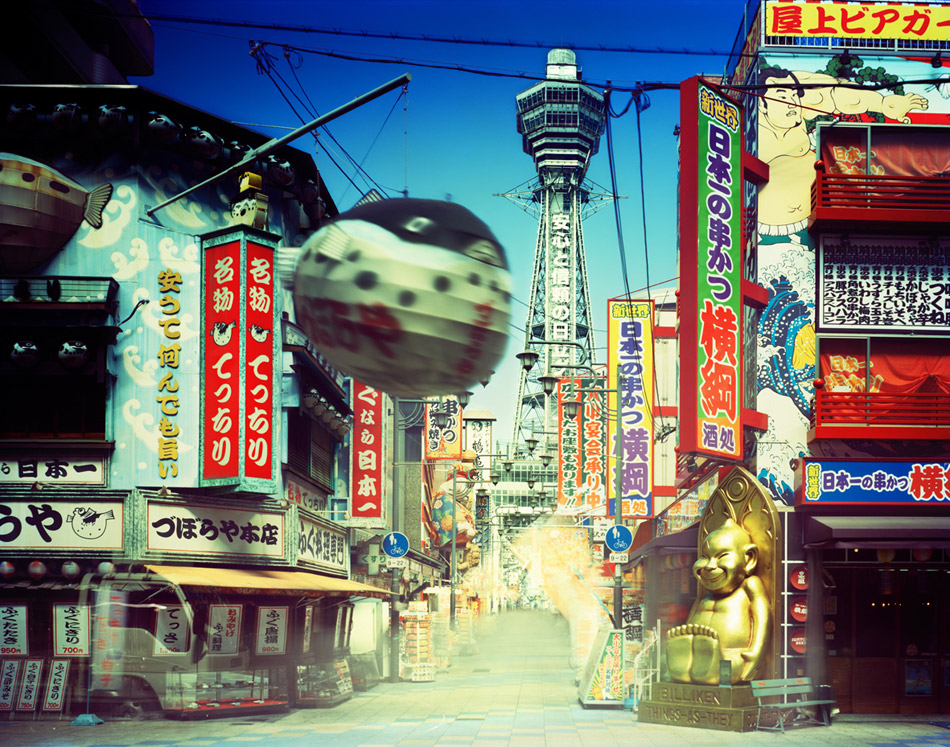
Ken Kitano — from One Day

Ken Kitano was born in Tokyo in 1968, and graduated from Nihon University’s College of Industrial Technology in 1991. Since 1993 he has been a freelance photographer. Kitano came to prominence with the release in 2005 of his “Our Face” series of group portraits made by combining many individual portraits into a single work, and won the Newcomer’s Award from the Photographic Society of Japan in 2007. For the last three years Kitano has been one of the major hits of the prestigious Paris Photo art fair, and in both 2008 and 2009 was among the short-listed candidates for the BMW Paris Photo Prize. The critic Vince Aletti last year picked Kitano and one of five photographers “to watch”, saying “Kitano…isn’t working with ideas, he’s working with people, and his faces are mesmerizing — strong enough to draw me in from across a very crowded room.”

This coming May, Kitano will be an artist-in-residence for three months at the Three Shadows Photography Art Centre in Beijing, where he will continue work on his “Our Face” project.

The above photograph comes from Kitano’s most recent series “One Day” begun in 2007, a series of landscape works which attempt to capture a given location from sunrise to sunset in one long exposure. You can see more from this series, as well as Kitano’s two other major series “Our Face” and “Flow and Fusion” in a special gallery we have prepared. Please also see our profile of Kitano.

Hiroshi Watanabe’s Love Point

Hiroshi Watanabe is a photographer who was born and raised in Japan but is now a naturalized American citizen. Love Point is his most recent work, a lovingly printed edition published by Tosei-sha earlier this month, and available for sale now in the Japan Exposures bookstore.

Much of Watanabe’s work in the past has focused on an intersection of the real with artifice, as explored through such photo subjects as Noh masks, Bunraku puppets, and traditional Japanese performing monkeys. Even Watanabe’s book Ideology in Paradise, shot in North Korea, can be seen in a similar way.

Here Watanabe turns his attention to the silicone “love dolls” that seem to have enjoyed a “boom” in popularity over the last few years — or is that boom more of Westerners fascination with yet another entry into the “weird Japan” sweepstakes?

Be that as it may, Love Point is not meant to be about the phenomenona itself but rather is a measured, considered book of portraits of models and dolls (created by the Japanese company 4woods) where it becomes very difficult to tell who is who — or what is who, perhaps I should say. The pictures become an authentic look at the lack of authenticity.

The book includes an original short story by novelist and screenwriter Richard Curtis Hauschild (in English and Japanese translation), as well as afterword by Watanabe (in both English and Japanese).

You can see images from the book at the artist’s website.

Hardcover with dust jacket, 27cm x 26cm, 40 pages, 21 b/w photos.

Nipporini from Nippori Guidebook

Nipporini is a persona created by Takahiro Wada, who was born in Tokyo in 1963, and for nearly 30 years has enjoyed a career as a professional commercial photographer. Through his commercial work he is known as something of an expert with digital cameras, publishing articles and how-tos in Japanese camera magazines. Since the early 90s, he has also been exhibiting more conceptual, personal work, including photo-sculptures and photographs made from a customized toy camera.

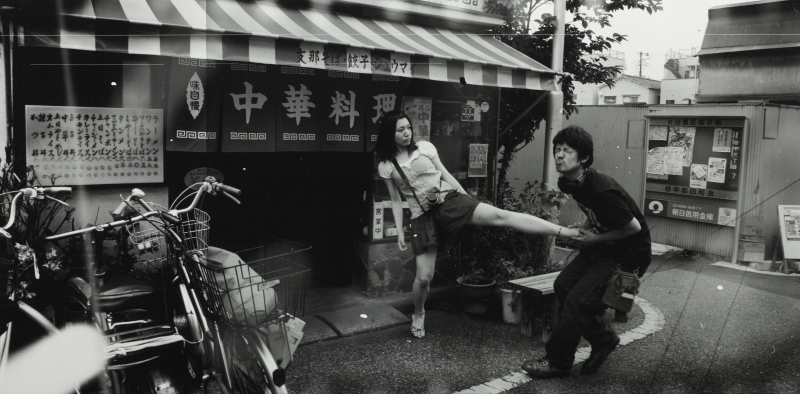
“Nippori Guidebook”, from which the above photo is taken, is a series of photographs made with both of digital and analog techniques, and is Nipporini’s attempt to explore the town of his birth and it undergoes many modernizing changes. Please also see our gallery of work from Wada’s Nipporini Guidebook.

Nipporini Gallery

Nipporini is the pseudonym of the well-known commercial photographer Takahiro Wada, and a mash-up of the photographer’s hometown of Nippori in Tokyo, and the famed film director Federico Fellini. Wada’s “Nippori Guidebook” project and “Nipporini” persona as it were are a homage to his hometown, even as it also seems to be a calling into question of the slick and smooth world of advertising photography. Says Nipporini:

The democracy of Japan had the defeat and arose. How my parents adopted themselves to the conversion of ideology? The technique of prints that I had learnt at the photography school easily became unnecessary because of the appearance of the digital camera. I think I tasted the same circumstances as my parents a little. The world was made by 0 and 1 when I slipped out of my air-raid shelter of darkroom. If I had Fellini’s eye of love and freedom, could I find pleasure in the society of the lie?

Please also see our current Cover Photo featuring Wada’s Nipporini.

Shinji Abe – From Tokyo

Shinji Abe is a young, 26-year old photographer who was born in Saitama Prefecture, and who graduated from Tokyo Visual Arts professional school in 2008. He has no online presence, nor a home PC for that matter, but I was fortunate to meet him at the Third District Gallery in Tokyo’s Shinjuku Ward last December on the occasion of his exhibition there entitled Tokyo. It is perhaps a cliché to say that Abe is nothing like the person we’d expect to meet based on his photography, but nevertheless that was the impression I had when I discovered that the unassuming, reserved man sitting in the gallery was Abe himself.

When I asked Abe if he was a fan of Michio Yamauchi it was no surprise to hear a resounding yes, even as he was clearly embarrassed to be mentioned in the same breath as one of the masters of the street photography genre — and another modest, humble person with a demeanor quite at odds with the photography he produces. Abe acknowledged that he has a long way to go before he can get out from under that shadow, but he remains firmly committed to continuing to ply his trade on the streets, even as he noted ruefully that it is getting harder and harder to do so in a world increasingly suspicious of strangers taking pictures of other strangers.

Please also see our special gallery of Shinji Abe’s work.

UPDATE: a slide show with more photos from the exhibition is available on the Third District Gallery web site. [Click on the top postcard image; thanks to Aya Takada]

My Favorite Japanese Photobooks of 2009

Photo-eye recently posted their annual “Best Books” feature, with a whole host of photographers and photo people submitting their top 10 books of 2009. Naturally I was interested to see what Japanese books made the grade, but was rather disappointed that on the whole so few Japanese books were chosen. This is I’m sure due in large part to a lack of access to books published here (but hey, Japan Exposures is here to help!), but I do wonder if the paucity of Japanese choices means the general feeling is that 2009 was a poor year for photography books from Japan.

Ivan Vartanian‘s survey Japanese Photobooks of the 1960s and 1970s shows up twice (Ed Templeton, Richard Gordon), which was both heartening and worrying — let’s hope that it’s not an indication that we need to harken back to those halcyon days to get our photobook fixes.

The other Japanese photography books that made the various lists:

  • The Joy of Portraits, by Keizo Kitajima (John Gossage, Lesley A. Martin) — If you’re interested in acquiring this 13-pound, 2-volume set for a reasonable price, please get in touch; or you could content yourself with the catalog from Kitajima’s Tokyo retrospective from last Fall.
  • Portraits of Silence, by Hisashi Shimizu (Daniel Espeset) — Glad to see this moving book recognized.
  • Cui Cui, by Rinka Kawauchi (Tricia Gabriel) — Mind you this book was published in 2005, but who’s counting 😉
  • Kamaitachi, by Eikoh Hosoe (Sara Terry) — a 1969 book, but since this was republished in a trade edition in 2009 we won’t complain.
  • Binran, by Masato Seto (Michael Wolf) — technically from 2008.

Like I said, not much love as far as Japanese photography books goes.

Here are my very subjective choices for favorite books published in Japan last year:

Citizens, by Jun AbeCitizens, by Jun Abe (published January 11, 2009) If it weren’t for the “1979 – 1983” subtitle that very subtly accompanies this work from Jun Abe, there would be very little to belie the fact that these photos are 25 – 30 years old. And aside from that information, there is nothing else by way of context — but who needs it? You only need this book, and the hope that the maligned genre of street photography doesn’t get trampled by privacy pushers and the “right to my own likeness” brigade.

“Magazine Work” set, by Daido Moriyama (September, 2009) Many Daido Moriyama publications in 2009 (by my count there were at least 10 new Moriyama books relased in 2009, which is getting into prolific Araki territory). Of them all, I think that the two volumes of magazine work from the sixties and seventies, Nippon Gekijo and Nani ka e no tabi are particularly worthy additions to the Moriyama canon and essential to understanding his development as an artist. Honorable Moriyama mention for Northern, in some ways the most un-Moriyama book since the 2005 Takuno.

Tokyo Zenritsusengan, by Nobuyoshi Araki (October, 2009) 2009 was a very lean book year by Nobuyoshi Araki’s normal assembly line standards, and this book published toward the end of 2009 told us why — Araki was diagnosed with prostrate cancer in 2008, which understandably limited his creative output. Maybe it’s the backstory working its magic, but this book for me feels more heartfelt and intimate than an Araki book has felt in some time. Bonus points for the slightly unconventional binding.

Yasuhiro Ishimoto “Multi-Exposure” (exhibition catalog, May, 2009) Nothing better than to visit a small, out of the way exhibition at some outlying university campus of one of your favorite photographers and find that they have accompanied said exhibition with a lovingly produced catalog that presents the work in a unique way and features contextual essays about said favorite photographer and said exhibition in English. This catalog of Yasuhiro Ishimoto’s multiple exposure collages produced by Musashino was such a catalog.

Tokyo Y-Junctions, by Tadanori Yokoo (published October, 2009) When I came across famed graphic designer Tadanori Yokoo’s book of paintings Y-Junction (2006), which take as their subject the Y-shaped intersections of Tokyo, I found myself fascinated by the serial nature of the work, and how photographic the project felt — helped in part by Yokoo’s desision to pair each intersection painting with a collage of photo studies he had made of the same intersection. So it was curious to see that Yokoo decided to make a separate project of these intersections, but this time consisting only of photographs — surely overkill, no?. But the resulting mix of part “Tokyo Nobody” Masataka Nakano, Becher-like typology, and ephemera-collecting Kyoichi Tsusuki is really a quite wonderful portrait of vernacular Tokyo.

Shomei Tomatsu: Hues and Textures of Nagasaki (exhibition catalog, October, 2009) Unfortunately it seems a very long time since we were treated to a new Shomei Tomatsu book, and so one must content oneself with the Skin of the Nation book of a few years ago, or the omnibus-like catalogs that have accompanied various Tomatsu retrospectives in Japan over the past few years. This catalog from the Nagasaki Prefectural Art Museum is everything you’d expect from a museum catalog — which basically means it does the job. But no matter. Any chance to catch up with what Japan’s greatest living photographer (IMHO, of course) has been doing in the “noughties” is one worth grabbing, and with over 309 color photos collected, it’s impossible to be disappointed, not the least because it proves that the near 80-year old Tomatsu is still at the top of his game.

Blue Period 1973-1979, by Akiyoshi Taniguchi (April, 2009) There seem to have been a lot of books published last year of work done in the past, but of those I’m not sure there were any that featured photographs taken by an artist when they were in their teens, besides this one. Akiyoshi Taniguchi — who later studied photography under Leo Rubinfien before becoming a Buddhist priest — shows that while he may have been a teenager, the photos he took evidenced a mature outlook and calm reflectiveness that no doubt have served him well in his current career.

Hana Dorobou, by Eikoh Hosoe (November, 2009) This lovely book by one of Japanese photography’s undisputed masters resurrected a project from the mid-60s that even Eikoh Hosoe himself had forgotten about. Hosoe took some dolls hand made by a famous lingerie designer, put them in decidedly un-doll-like situations, creating a book that can be enjoyed by parents and children alike — if the parent is not averse to dealing with the frank questions that surely will result. Beautifully printed too.

Honorable mentions to the following: Gyahtei, by Manabu Yamanaka; Faraway Eyes, by Jiro Nomura; Hong Kong Reminiscence 1958, by Shigeichi Nagano; and Banta, by Osamu James Nakagawa.

What were some of the 2009 books from Japan that Japan Exposures readers enjoyed?