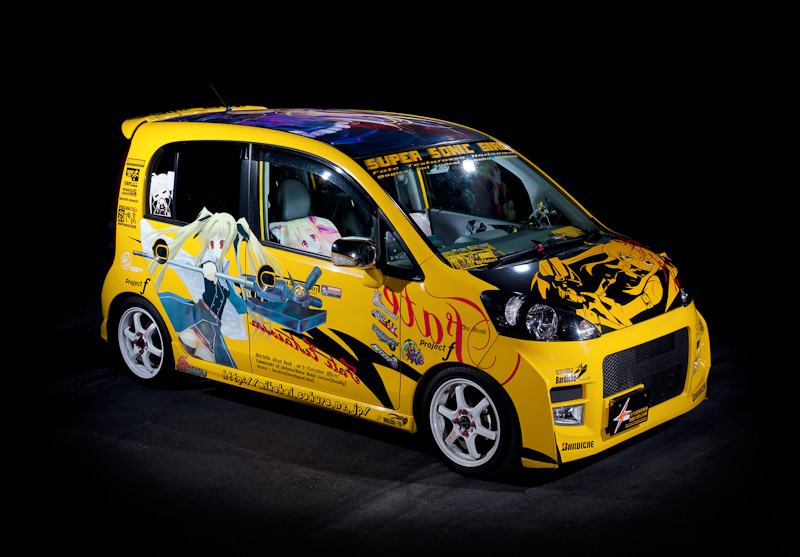
Tomoyuku Sakaguchi was born in Kagawa, Japan in 1969, and currently lives and works in Tokyo. In 1995 Sakaguchi received a Masters of Science from the University of Tokyo before eventually deciding to pursue photography. At the beginning of the decade Sakaguchi attended classes at the Nippon Photography Institute, as well as a workshop run by Masato Seto (Picnic, Binran). Sakaguchi has been exhibiting his work in since 2000, and in 2007 he was a runner-up for the Aperture Portfolio Award. Sakaguchi’s first book Home, from which this photo is taken, was published in 2007 by Sokyu-sha, and garnered him the annual award from the Society of Photography (Japan) in 2008.
Please also see our special gallery of Tomoyuki Sakaguchi’s work.
I first saw Tomoyuki Sakaguchi‘s images of suburban Tokyo when I was in my third year of a photography BA and something of a transparency film snob. Everything had to be film, and the only purpose of digital was quick and dirty snapshots. Sakaguchi’s work was the catalyst that suddenly pointed out that fine art photography is not strictly the reserve of film. The appeal of Sakaguchi’s series Home is, for me, how effectively it marries the ‘look’ of digital photography to the content of the series. The strange quality of light and the unnatural saturation and tonality of the greenery have a uniquely digital aesthetic.
This glossy plasticity is at odds with an American photographer whose work provides an interesting counterpoint. Todd Hido’s large format series Homes at Night embodies everything Sakaguchi’s work eschews. Where Homes at Night is dark, subdued and atmospheric, Home is vibrant and saturated. Hido’s images are stuck in the past, whereas Sakaguchi’s are unashamedly modern. We need only look at the cars in Sakaguchi’s images to confirm this. They are brightly coloured, compact, utilitarian. They are also, in a very real sense, the main characters in this odd little nocturnal drama. They occupy each image with surprising presence and vitality, providing a link to the sleeping residents of each home.
[In addition to Silas’ selection of images from Sakaguchi’s Home, we’re also pleased to present a small gallery of work from Sakaguchi from his earliest series “Mado” (2002) and his most recent work, “Ita☆Sha” (2009). — ed.]
Please also see our current Cover Photo by Sakaguchi.
Silas Dominey recently graduated from Leeds College of Art’s BA Photography Programme and currently works as a freelance photo assistant. His work can be seen at www.silasdominey.com.
Takashi Homma’s extended photographic survey of Tokyo remains, to my mind, the most complete and persuasive body of work completed on the city. (With one caveat, that is: Nobuyoshi Araki’s fictive, sexualised playground, which actually says more about the photographer himself than than the real city of Tokyo.) Over a period of nearly 15 years, Homma has created a cohesive photographic study of the city and its inhabitants, taking in disaffected youth, suburban space and the plasticity of modern life. His work is, above all, always concerned with and reflective of the changing attitudes of a post-Bubble Japan.
“
Homma’s work is always concerned with and reflective of the changing attitudes of a post-Bubble Japan. â€
Homma’s career in the visual arts began at the Light Publicity advertising agency, where he stayed from 1985 to 1991. From there he moved to London to become involved with the fashion magazine I-D. These early, formative years are important to mention, if only to establish that Homma has a deep and complex understanding of the power of visual imagery, underpinned by extensive experience in the advertising and fashion industries. There is no ‘accidental genius’ to his photography. It is as deliberate and considered as an advertisement, and no less effective.
Homma returned to Tokyo in 1993. An early work, Baby Land, failed to make a serious impression on the Japanese art community. That didn’t happen until the publication of Homma’s ‘telephone directory sized’ book Tokyo Suburbia in 1998. The book contains sixty-four images of the newly constructed suburban areas of Tokyo, known as Kogai, or Newtown. Homma’s photographic approach, which has remained largely consistent throughtout his Tokyo survey, involves muted, neutral colour and a remarkably formal, almost architectural viewpoint.
Fireworks, Urayasu Marina East 21 2, 1995, by Takashi Homma
In a series of images from 1995, Homma uses a long exposure to show a fireworks display hanging over Urayasu Marina East, one of the city’s Kogai developments. Viewed from a vantage point some way away from the display, the fireworks appear as a childlike white scrawl on the sky. There is nothing celebratory about the image. The barely visible, unlit tower-blocks in the foreground suggest an emptiness and gloom at odds with the notion of fireworks and festivities. If any image can confirm the suggestion that Homma’s early work is ominous and ironic, it is this one.
While remaining visually cohesive, Homma’s work has gone through a very subtle shift in tone and subject in reaction to the newfound optimism in Japan following both the end of the ‘Lost Decade’ and Takashi Murakami’s Superflat art movement, which has engendered a new-found nationalistic pride in Japanese art and culture.
To explain, Superflat is both a post-modern art movement and a visual style. It represents the ‘leveling’ of high and low culture (for example ukiyo-e and anime). It is both a celebration of the uniqueness of Japanese culture and an acceptance of the imperial influences that have shaped it. In this way it has cracked open the discourse about what it means, culturally, to be Japanese, and it is this debate that Homma engages with in his photography.
Omotesando 1, 2007, by Takashi Homma
Somewhere around the turn of the new century, a barely perceptible shift occurs in Homma’s work. He begins to title his images with the name of the architect, if a building is present. This simple act implies ownership and pride in the base material of the city. Secondly, Homma’s visual treatment of glass and metal ‘takes on a quality of beauty, not of sanitisation’ (Ivan Vartanian, in his essay accompanying Tokyo, published by Aperture in 2008) providing a corrollary to this newfound pride implicit in Homma’s image titles. The image “Omotesando 1” could, in itself, be a metaphor for the ideals of Superflat. Layers of glass, metal, concrete, reflections, light and space are condensed into the abstract graphic surface that makes up the photograph.
Homma himself makes obscure reference to the ideals of Superflat in his essay in Vartanian’s 2006 essay collection Setting Sun: Writings by Japanese Photographers. The essay begins, ‘I am standing once again on the burned field…’ simultaneously an allusion to the scoured, levelled surface of Superflat and the WW2 bombings in Hiroshima and Nagasaki. Homma implies a parallel between the end of the war and the rise of Superflat. A new start for Japanese society, this time with the imperial ideals of America subverted and transformed into a cultural export the nation can take pride in. He further compounds this sense of hope in the following statement, which somehow manages to encompass both the failure of the bubble generation and the optimism of the ‘newly enfranchised’, post-Superflat Tokyo:
As a generation, we have missed the boat. Fine! So let’s start from here.
Silas Dominey recently graduated from Leeds College of Art’s BA Photography Programme and currently works as a freelance photo assistant. His work can be seen at www.silasdominey.com.
Manabu Yamanaka’s Gyahtei, published earlier this Fall, brings together Yamanaka’s six major series focusing on societal outcasts, including street children, homeless, the physically deformed, and the elderly. Working in a similar vein for over 25 years, each series might take up to four to five years to complete. Yamanaka doesn’t just bring his subjects into a studio but chooses to immerse himself in the milieu of his subjects and their living conditions before ever setting up his camera.
Yamanaka’s working methods, as well as the consistency of purpose and style he approaches his subjects with, clearly show that he doesn’t take his project lightly, nor is he interested in a quick hit of shock. In a 2005 interview, Yamanaka talked about his working process:
First of all, I decide on a subject for a project and then study and research the subject. And the next step is planning out picture composition [while] at the same time scouting, casting, and thinking about the other details. Finally, I start the new project if I convince myself that all of the above is in place. Usually it is not so easy, so I’m constantly making changes. I always find the appropriate way of shooting after I start. I believe that there is always a way through a difficult project.
The title Gyahtei as well as other series’ titles all originate from Buddhism. Even though Yamanaka has said he is not a practicing Buddhist, he does “always hope that I gain more understanding of Buddhism every time I finish a project. In other words, I show my work as a consequence of my understanding on the theme of the project.”
Manabu Yamanaka’s photographs are often referred to as disturbing, or unnerving, but perhaps that faint praise says more about the viewer than it comments on the actual work, the subjects of the photos, or the photographer’s intentions. In the way that some people peek through their fingers at horror films, labeling Yamanaka’s work as disturbing seems a defense mechanism, a way of distancing oneself from the visceral realization that what separates the viewers’ reality from that of Yamanaka’s subjects is what the Japanese call ç´™ä¸€é‡ (kami hitoe) — a fine line. That Yamanaka can bring us so uncomfortably close to confronting that which we take for granted, and our corporeality and mortality, in the reserved and respectful manner that he does, might be one reason why the photographer Kyoichi Tsuzuki called Yamanaka the most “hardcore” of all Japanese photographers working today.
Japan Exposures is honored to have the opportunity to present to our readers the following introduction to Manabu Yamanaka’s work. Please also see our current Cover Photo featuring Yamanaka.
Manabu Yamanaka: Wu Kong #19
Manabu Yamanaka: Wu-Kong-#01
Manabu Yamanaka: Jyoudo #03
Manabu Yamanaka: Jyoudo #13
Manabu Yamanaka: Dohshi #03
Manabu Yamanaka: Dohshi #09
Manabu Yamanaka: Gyahtei #14
Manabu Yamanaka: Gyahtei-#09
Manabu Yamanaka: Arakan #01
Manabu Yamanaka: Arakan #13
More of Yamanaka’s work can be seen at his website, including some brief writings about each series. A report on him in Japanese can be found here.
Manabu Yamanaka was born in Hyogo Prefecture in 1959, and moved to Tokyo when he was 23 to pursue a career in commercial photography. Amidst the dizzying frenzy of the “bubble” years, in 1989 Yamanaka released Arakan, portraits of Tokyo homeless, which would mark the first of a career-spanning, 25-plus year body of portraits and still lives focusing on subjects outside the margins of society, including the physically deformed, street children, and the very elderly. It is from this last series of nude portraits of women in their 90s that our Cover Photo comes.
Though relatively unknown in his native Japan, Yamanaka has been exhibited widely in America and Europe, and is represented by Stefan Stux Gallery in New York.
Earlier this year, a friend mentioned to me that he’d recently seen an award-winning show at the Konica Minolta gallery. It had apparently made a real impression on him, so when I next found myself in Shinjuku I decided to stop by. As it turned out, the show was “Asadake” by Masashi Asada, who won the 31st career-making Kimura Ihei Award. (Hiromix and Rinko Kawauchi are two recent winners whose names may be familiar to readers.)
Having only recalled a bit of my friend’s description — something about family — I didn’t really know what to expect. Walking in to the room I saw about 15 or 20 large color prints, with no clear visual order. I remember thinking to myself: “what am I looking at?” Even looking at the first print, I couldn’t process the image properly. Why was it so big? Who were those people? Why were they in a ramen shop? Who takes a large format camera to a ramen shop anyway? And why was the woman in the corner giving the camera such a strange, knowing smile?
“I couldn’t process the image properly. Who were those people? Why were they in a ramen shop? Who takes a large format camera to a ramen shop anyway?â€
Soon I remembered the concept behind the show: Asada takes portraits of his family (in Japanese, the “Asadake”) in highly staged situations, often engaged in activities that would have some resonance for a Japanese audience: working at a ramen shop, gathering at a school assembly, campaigning for votes in a white van, and so on. (It’s worth noting that others are less specifically Japanese, like playing in a rock band, reporting a news story on TV, or fixing up a car.)
It seems to me that the intent of using these activities is not to comment on contemporary Japanese culture, as they’re never scrutinized in any serious way. Rather, they are a medium through which Asada can heighten the feeling of his portraits. Using these artificial situations brings out the personalities of the members of his family, and also creates a relationship between the work and its audience.
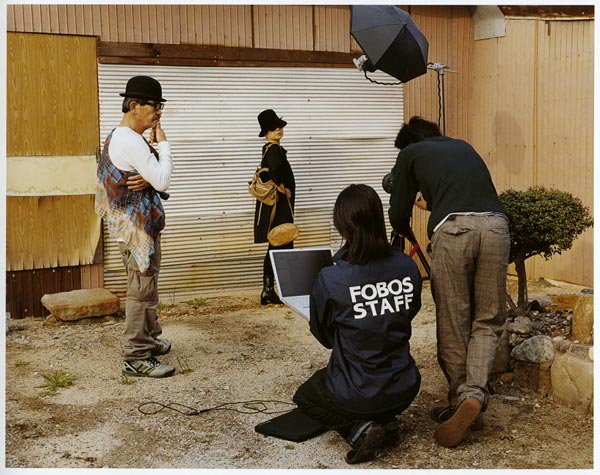
Masashi Asada, from Asadake (2008)To create these portraits, Asada had to put his family into some fairly strange situations. For example, how often do you pretend to be on the set of a fashion shoot with your family? The obvious relish with which Asada’s parents (an older couple) tear into their roles in this image is what makes it work. As a model being photographed, the mother wears a glamorous all black outfit, and two gaudy purses more likely to be found on a woman at least half her age. She affects an almost contemptous look, while the father, an art director, sports a bowler hat, a ludicrous shawl of some sort, and a posture that suggests, “I’m thinking very deeply about what’s going on here.†Throughout the work, the audience finds the family wearing silly outfits, or pretending to be something they’re obviously not. This reveals the person to the audience—the mother’s come-hither pose communicates something tangible about her ability to take herself seriously. Depending on the situation, there can be genuine feelings of humor, warmth, or seriousness in the way that the subject approaches their role. This feeling breaks through the artificial conceit of the scene.
Masashi Asada, from Asadake (2008)Asada’s work makes it easy for the audience to establish a relationship with his family. Although the scenes are obviously staged—and there can only be an initial, fleeting doubt about this—they play a small but useful trick on the audience. In an uncanny way, it’s as if the audience already knows them from the beginning: here are the farmers you see when you visit your grandma in the countryside, here are the drunk office workers you see around midnight, here is the staff at your local ramen shop. Taking an American audience, for example, scenes at a drive-through fast food restaurant, a high school football game, or the parking lot of a big box retailer could produce the same effect. Even if you don’t love those things, they would be immediately recognizable in the way that a white political campaign van will be recognizable to anyone who lives in Japan. Asada effectively removes a barrier to identification with his subjects by placing them in these situations.
Masashi Asada, from Asadake (2008)The charm of “Asadake” is that it seems as though everyone could be about to break into laughter. This is actually the case in the ramen shop photo, where the mother gives the camera a sly grin, but it’s even more pronounced in the political campaign van photo, where everyone is cracking up. Each person shows the role they are playing, but they show themselves as well. It’s not a surprise that this image got quite a lot of attention at the gallery, where people would come up to it and share in the absurdly joyous moment.
Masashi Asada, from Asadake (2008)The audience at the Konica Minolta exhibition was certainly in tune with the humor running through Asadake. Almost without fail, people walking into the gallery would stop for a few seconds, figure out what was going on, and then laugh all the way through the series. The feeling of walking through an exhibition where most people were laughing, gesturing at a photo, or calling a friend over to see something outrageous was certainly much different than most photography exhibits I’ve seen. In such an atmosphere, it was hard to not feel close to the subjects of the work. I haven’t ever heard of such a thing, but the exhibit felt like a getting-to-know-you party for the Asadas.
You can purchase a copy of Asadake (The Asadas) in the Japan Exposures Bookstore.
Dan Abbe lives in Tokyo and writes a blog about photography called Street Level Japan.
Eiji Ina was born in Nagoya in 1957, and graduated from the Tokyo College of Photography in 1984. Since 1981 Ina has been exhibiting and publishing his work, starting with large format cityscapes of Tokyo (In Tokyo), but since then Ina has explored such topics as the American military in Japan (Base and Zone), the omnipresence of security cameras (Watch), and environmental issues (Waste). In 1988, he won the Higashikawa New Photographer Prize, and in 1998 he was the recipient of the Leopold Godowsky, Jr. Color Photography Award.
The above photo comes from Ina’s Emperor of Japan series, which was published in book form by Nazraeli Press in 2008. The book contains images Ina shot of the misasagi (burial mounds) of 124 of Japan’s emperors, dating back to the Kofun period some 1600 years ago. As is clear from the above photograph, Ina’s photographs of these often humble, understated tombs and mausoleums are as much about the setting as they are about the tombs themselves. The tombs provide a uniform thread, an orderly, sculpted center, while the surroundings reveal that no matter how much order and sublimity one tries to instill, chaos reigns supreme.
More examples from this series, as well as Ina’s other work, can be seen at Ina’s web site.