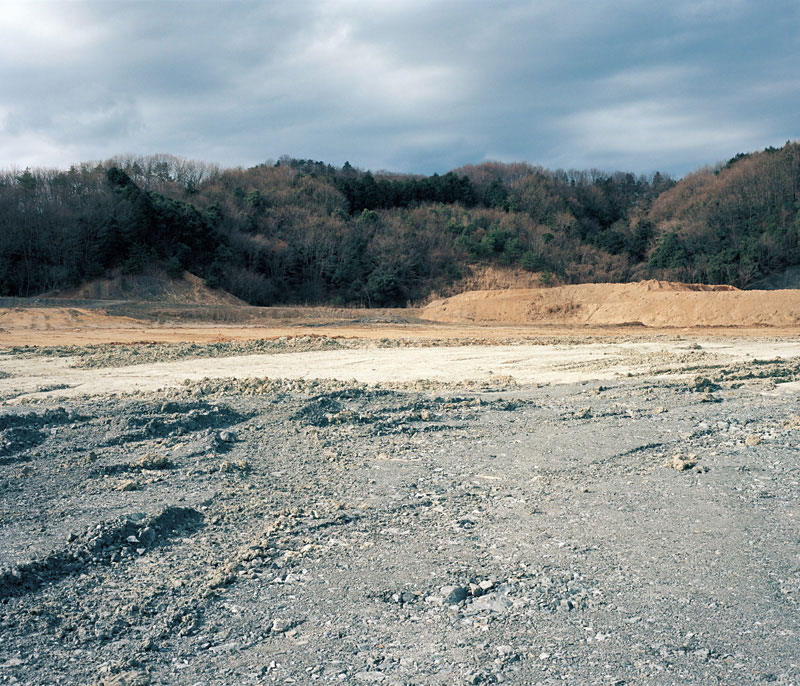
There was a forest near the house where I lived when I was a child. When the forest existed, I felt the connection with a deep part in the world there. However, the forest has since been destroyed, and only the process of the loss and its memory were kept in my mind.
I am living in a place which is a little distant from there at the present day. When I look at the scenery in periphery of the city where I live, I can see a new contemporary scenery which overlaps with the past scenery. I keep walking and roaming around the place until it leads me to my destination. And the subdued light is shining on the space which illuminates my memory in the past.
At that time, I realize that I can regain the connection with the world.
K Nishiyama, 2010
While evidence of the man-made landscape, which very often would be more aptly titled the man-altered landscape, is visible all over the world, I have always believed that for some reason it seems more obvious and noticeable in Japan. Is it the widely acknowledged density of the place, or simply the breathtaking pace at which it takes place? Or the for Western eyes and minds incomprehensible reasoning of the decision-making process to replace areas of nature in cities that already seem short of them with more housing, roads or shopping complexes?
Observers of photographic culture in Japan are also only too familiar with the dominating style of nature and landscape photography. Images of immaculate and perfect flowers, waterways, mountains, images of nature that almost violently belie the presence of nearby powerlines and places of industry.
Koichi Nishiyama’s photographs provide a quiet view onto an environment at a crossroads in time. His introductory statement aside, we do not know what has disappeared from the scenes in front of us, neither do we know what will be there in the future. In some sense, the subject matter of these images touches on the pure essence of photography — a moment without a past and without a future. What we do know is that a decision has been made and hands were laid onto this grounds.
In my view the most powerful articulation of observing this changing landscape is not the explicit and accusing imagery that seems to shout loudly “stop doing thisâ€, rather than pictures that calmly, yet very emotionally, seem to affirm: “this is the world, that we chose to create for ourselvesâ€.
What we hope for from the artist is help in discovering the significance of a place. In this sense we would choose in most respects for thirty minutes with Edward Hopper’s painting Sunday Morning to thirty minutes on the street that was his subject; with Hopper’s vision we see more. – Robert Adams – p.16, Beauty in Photography.
Koichi Nishiyama was born in 1968 in Yokohama, Japan. He studied contemporary art at B Seminar School in Yokohama. After graduation, he undertook performance art, Installation art, and organized exhibitions. He took up photography in 2007 by studying “Workshop Calotype†by Jun Shiraoka in Tokyo.
He comments on his own work as follows: “The landscapes in my work convey both a feeling of emptiness and vacancy, as well as a certain sense of intimacy that can yet be found in the middle of that desolation. My works represent an attempt to retrieve a connection to the world that has been lost by confronting the spectacle of absence and disappearance.”
Shiyo Takahashi, Manager at Leica Ginza Shop (Taken with Leica Noctilux-M 50/f1.0)
The Leica and Japan — an association of which many legends are made of, but perhaps also a relationship that is often misunderstood or misinterpreted. Many people see the Japanese camera market solely populated by wealthy individuals that will put the precious machine only on the shelf, longing to be used to what is was made for, taking photos.
Together with John Sypal of Tokyo Camera Style we visited the Leica Ginza Shop in central Tokyo to find out what Leica in Japan is all about.
Shiyo Takahashi has been managing the flagship outlet in Tokyo since its opening in 2006. The store, more resembling a fashion boutique than a camera shop, was the first of its kind for Leica worldwide and follow-on locations like recently London Mayfair are modelled after it. Takahashi was also involved in developing the Leica M7 Limited Edition Hermès, a total of 200 silver chrome Leica M7 cameras with exquisite leather finishes applied by Hermès (a French high fashion house specializing in leather, ready-to-wear, lifestyle accessories, perfumery, and luxury goods — Ed.). Takahashi’s professional background is in the fashion and luxury brand industry, however he has been an active photographer since his high school days.
Japan Exposures: In Japan one can still encounter a great number of photographers using film cameras. Are you selling a lot of the classic Leica M cameras?
Shiyo Takahashi:: I don’t have the exact numbers on hand right now, but a high proportion of Leica MP and M7 cameras are sold in Japan, and the majority of those here through the Leica Ginza Shop. That means this store is selling a substantial number of film cameras that Leica produces.
JE: Is this also the reason why we see many special editions sold here?
ST: Indeed — I was involved in developing the Hermès edition and before that we had the 50th Anniversary Leica MP Titanium, another film camera. Suffice to say that Japan is the principal place to still sell such kind of film cameras.
JE: Are these cameras well received then?
ST: Absolutely, people are still actively looking for 50th Anniversary Titanium M7 and MP. In fact, it is not just Japan, we have a lot of interest from Leica users in Korea, Hong Kong and China. Japan, and as you know Ginza in particular, is a very special place when it comes to cameras. Dr Kaufmann (Andreas Kaufmann, Deputy Chairman of the Supervisory Board of Leica Camera AG since June 19, 2009 — Ed), who incidentally will visit us tomorrow and hold a lecture at the JCII Camera Museum on Sunday, used to come to Ginza to browse for used cameras even before his involvement at Leica.
“If people want to buy a camera, they will buy a Sony, Panasonic or Nikon. People come here to buy a Leica.â€
JE: So are you happy with how you are doing in Japan from a business standpoint?
ST: Oh yes, even though we are also feeling the effect of the current economic situation. Nonetheless, the digital range — M8, M9 and X1 — are all doing very well at the moment. The time around 2006 was an important period for us, when we entered the digital age with the Leica M series. The opening of this shop at that time was also a turning point on who we would address as our target market. When before it was camera and photo enthusiasts, we are now engaging a much wider customer base. I am referring to people interested in high-quality consumer and luxury goods. Audio systems, cars, watches, that sort of things.
JE: People who like expensive things?
ST: It’s not that simple, even though these people definitely exist, especially in Asian boom economies. And even they don’t just want things for the sake of being costly. They know what quality is and they know what a quality brand is. I mean a brand with quality products with tangible value, not just a popular luxury brand. Just like these people would buy a very good wine, they may buy a Leica, because it is the best product of its kind. That’s one way to see things, but to be fair the majority of Leica buyers are more interested in the philosophy behind the product. The technology, the design and how it is made, plus of course the history and heritage. Many of our customers are creative professionals, for example musicians or designers. They appreciate the beauty of the object as much as its functionality and performance, similar to a musical instrument like a well-crafted guitar. Another group of customers are doctors, people in healthcare. Again, not just because they may have the means, but because they are scientists and have a natural appreciation of technical expertise and precision instruments, for example MRI (medical imaging), microscopes and other precision optical devices. So it is not just people who like the Leica name or brand, it is individuals who seek a high level of quality and performance in the equipment they use.
Shiyo Takahashi holding the best selling Leica a la Carte configuration: Leica M7 Black Paint with lizard skin and silver MP controls
JE: On Tokyo Camera Style we lately encounter a lot of younger people who carry and photograph with a Leica M camera, I would even say more than, say, five years ago. Do you see the same or have an explanation for this?
ST: Yes, I am aware of this trend. In my view there are several reasons for these people to move towards a Leica. Bear in mind that some younger people may not even know film-based photography, they grew up with digital cameras. So this way of how a photo can be made is new to them. Using a toy camera or the old Olympus Pen is very popular in Japan. Then there is the handling of a rangefinder camera, which is different and perhaps they will try a Voigtländer camera and like it. Yet another reason is the image quality produced by a rangefinder lens. Eventually people will discover the Leica, its history and all that, and will be attracted to join that culture.
JE: What is it like to sell a German-made product, and a niche product at that, in the home market of the big manufacturers like Nikon and Canon, who probably account for 99% of camera sales?
ST: I don’t think it is a direct comparison. If people want to buy a camera, they will buy a Sony, Panasonic or Nikon. People come here to buy a Leica.
JE: Do you think that in Japan the attitudes towards cameras and photography are different from elsewhere?
ST: As far as collectors or enthusiasts are concerned, I don’t think so. Yes, they are very much into their pursuit, but that’s not too different from other places or other areas like collecting wines, fashion or stamps. They are obsessed with the subject.
JE: Does your clientele mainly consist of such people?
ST: For film cameras, yes, but M8, M9 buyers acquire the camera with a strong intention to use it. They want to take photos. Take us as Leica staff, we all own a Leica MP, but the camera we use on a regular basis is the digital M or a compact. A digital camera is almost like a household appliance, it’s bought to be used.
JE: The people desiring a classic film camera seem often to originate from the post-war baby boom generation, a group that is getting older and has been supporting a lot of the camera shops that we now see slowly disappearing…
ST: Yes, the demand for film cameras is comparatively low. One thing that recently is very popular is the Leica a la carte programme. Due to an adjustment for the exchange rate to Euro, their prices have dropped by 20-30%. We have several customers purchasing their third or fourth a la carte Leica.
JE: In terms of products, is Leica treating the Japanese market differently from other places in the world?
ST: If you mean limited edition cameras for Japan only, we would like to, but it is difficult to make one item really exclusive to one location. When we opened in Ginza four years ago, we released the M3J, later we had the titanium MP, but eventually they will become available elsewhere. For example, now that the Leica Shop in London has opened, they would also like to have their own edition, but it is difficult to make it really limited. What we would like to do is special editions on digital, but it is a little early for that. I don’t think there is anything wrong with doing special editions targeted at special markets, be it Japan, the US or for example the Middle East. Tastes are different and people like having a choice different from what’s available normally.
JE: With the change to digital, what is your outlook into the future?
ST: Film will get rarer and more expensive, almost like a luxury product. However, there will always be things that digital cannot do and that film can do very well. When you make prints, you can see an obvious difference between the two. However, digital is just so easy in terms of technique and the rewards are instant. Imagine going on a holiday trip, you can see the results quickly, edit them etc. That is very attractive to people. It enhances the learning process by getting feedback and seeing the results of their technique immediately. It’s a great way to learn photography, to learn to take photos. Then, once you have the skills, you should go and shoot with a film Leica again.
Repair and Service Counter at Leica Ginza ShopA case displaying every component of a Leica M7
JE: What will happen to the Leica-manias, the serious enthusiasts that know every camera ever produced and such things?
ST: Oh, they are still around. We get quite a few people that come in and take a display camera to listen to the shutter firing in excitement, over and over. They already own these cameras themselves, so they visit the shop for servicing or to buy accessories. They have gone digital as well, following the times.
But there is another important change with digital: before, photography was really an individual’s hobby, you did it on your own. But now with the M8 and M9, it has become a family hobby, for everyone. It is so easy to shoot and share results, even the normally not interested spouse can do it, very accessible. In fact, some people don’t really care about what the equipment is as long as it lets them take great pictures. Of course, there are also the artistically minded people, but the camera is capable of serving all of them well. Before, only particular people were into photography seriously, but now this has entered into the mainstream.
JE: Surely, that is a good thing for Leica..?
ST: Of course, it’s good for everyone. The playing field is now level. Everyone can do it, shoot like a pro if they want to, or just family pictures.
JE: Are there any Leica Japan-only versions or editions of products in the pipeline?
ST: I don’t think so. We still have a lot of people waiting for their M9 and X1, so that needs to be taken care of first. Actually I don’t think that many people buy these specials because they are in some way special or limited. It’s more that they find the designs or colors attractive and that is then the driver to purchase, not that it is in some way a scarce or limited product.
Leica M8 Safari Edition
JE: How about a Leica M9 a la carte instead?
ST: Of course, that would be nice, but mind you there are not so many elements of the camera that can be varied, unlike with the film Leicas. We made a very small run of Leica M8 with silver elements and purple leather coverings, they were very popular. Another even more popular special was the Leica M8 Safari, which was sold out even before launch. The White lasted a little longer, even though white is a very popular color in Japan.
JE: Are Leica in Germany aware enough about how things work, perhaps differently, in other parts of the world, or do you have to nudge things into the right direction from time to time?
ST: Oh, they know about Japan. They work with Panasonic and of course are aware what the other players in the camera industry are doing. They know that Japan is a different market, even when compared to the rest of Asia, quality-wise, culturally and how people take photographs here.
JE: So what challenges remain for you?
ST: To maintain and keep up the level of service and quality. We are catering to a market that will always be able to make a purchase, if they want to. So service and quality are key. Of course anyone can come in here, have look at the cameras and lenses, we take the money and put it in a shopping bag. You don’t need to come to a Leica shop to have that experience. We have many customers, ladies and gentlemen alike, who appreciate our special service. On the occasion when they wish to buy something, they book in advance and when they come to the shop we will take care of them at the level and quality of service that such clients would expect. It does not stop with Japanese buyers, in fact we have customers from Europe or USA, and of course from places like China, who, despite the price differential, choose to buy here instead of their home country. They enjoy their time here, the whole process and location of buying their Leica. It is not just the purchase or the item, it makes a memorable experience to come here. Not unlike a child would enjoy a trip to a theme park.
Leica Ginza Shop and Salon
6-4-1 Ginza, Chuo-ku, Tokyo
Tel: +81 (0) 3 6215 7070
Fax: +81 (0) 3 6215 7071
Opening hours:
Tuesday – Sunday 11.00 am – 7.00 pm
Mikiko Hara was born in Toyama Prefecture in 1967. She graduated from Keio University in Literature in 1990 and Tokyo College of Photography in 1994, where she was also a research student until 1996. Hara has had numerous solo exhibitions and exhibited internationally in Europe and in Asia. “Hysteric Thirteen,†a photo-book of her work, was published in 2005 by Hysteric Glamour, Tokyo, and her work has been included in the international collection of the Bibliotheque Nationale de France. She is represented by Third District Gallery.
The work of Mikiko Hara is hardly a new discovery as she has been working prolifically and exhibited extensively since the late nineties. That period also happened to coincide with the rise of Japanese female photographers labelled “onna no ko shashinka,” usually translated into English as “girlie photographers.” However, to mention her name in that context is a misplaced generalization of her work, and like all generalizations an inaccurate typecasting of other Japanese photographers that happen to be female.
Her photographs, taken in color in the square 6×6 roll film format, are subtle snapshot observations of people in public. The viewpoint taken by Hara represents an open invitation to connect with those pictured individuals. We, the viewers, can almost read the thoughts on their minds.
The new Sony E-Mount is an exciting addition to the growing variety of small mirrorless SLR cameras allowing flexible use of contemporary and classic lenses. While there are a wide variety of adapters on the market, Rayqual adapters are MADE IN JAPAN to the highest quality standards allowing photographers and cinematographers to reliably and precisely mount alternative lenses on their cameras.
A customer in the video/motion picture industry who tried their luck with the cheaper alternatives comments: “We already have adaptors for all our Nikon lenses and they work, it’s just that the tolerances are no good resulting in the lenses rotating which is a problem when trying use a follow focus shooting video.” The issues were resolved after switching to the equivalent Rayqual products.
Essay by Marc Hohmann for Japan Exposures. Photos courtesy Shingo Wakagi for Famous Aspect.
For me as a Creative Director and Editor, visual creation is always about the formation of a new world. A “Gesamtkunstwerkâ€. Old harmony. New combination. What form should go with this image? Which sound should surround this product? What word is an extension of this shape? And so on. When I am working with a photograph it is about working with or against a context. It exists as personal art before type (a word or a price) is on it. Afterwards it is an art product and its success is measured by its universal rather than personal or regional appeal. As a designer, photography is one of the graphic ingredients at my disposal and I frequently utilise the work of Japanese photographers.
Japanese photography (and I believe a lot of Japanese 20th century art, architecture and music) has always been strongest when in a most direct reaction to a cultural, most often Western, current: The 60’s psychedelic era, the 70’s punk movement, 80’s post-modernism, the 90’s individual & technology changes, the 2000’s and still current authenticity vs. imitation trends and so on. All of these created peak examples of photographic brilliance everywhere in the world. However, the decades’ highlights in Japanese art photography (both personal and commercial) survived this better than most Western images because, a) emotionally their creators were never as invested in these Western currents as the ones in the originating countries; and, b) the Japanese are by nature more society-conscious and therefore more careful in execution; and finally, c) their creator’s tendency to replace emotional and fashionable advances with overly methodical, technical skills. Curiously from a modernist perspective, these ingredients (or, in minimalist terms “positive restrictionsâ€) are major in creating a universal appeal.
“Emotions are mostly expressed through contrast, focus or composition, rather than direct expressive attitude or subjective gestures. â€
Something specific that comes to mind here is the intentional, pragmatic and architectural use of space in Japanese photography and Japanese film since the 1920’s. Their use of negative space – mostly composed, controlled and open – is not as intimidating and less filled with expression than their Western counterparts. Emotions such as anger, for example, are mostly expressed through contrast, focus or composition, rather than direct expressive attitude or subjective gestures. To me, quintessential Japanese photography is strong because of its open, compositional distance and its emotional constraint and not because of its Western, in-your-face, “aggressive†spontaneity or directness.
I find these qualities very attractive and it is important as a (Western) designer to understand their artistic dimension as they can be treated as design statements in themselves. Personally for some time now, my work has been about a refined “more with less†approach which is rather about framing space than occupying it. This means finding the most elegant, non-forced position for a design element or message with the intention to elevate the total experience. When I’m working with great Japanese images I am attempting to create a strong field that supports the photo’s structural distance and openness which I find so modern. Instead of pushing a dominant message against the image to create tension, I am trying to work off of its inherent qualities. From the depth of a title, or the size of the type to the precision of the crop, it’s all about keeping nuances while creating a new context. A reference would be a Toru Takemitsu score (a Japanese composer and writer on aesthetics and music theory — Ed.) where the composer is carefully balancing his intention to support a scene with the goal of creating a totally new dimension whenever the film’s open, sparse architecture allows it.
The great NY architect Richard Gluckman once told me that in his work he is always considering the importance of space in relation to the object: It is both the object that defines the space and the space that defines the object. According to him, a space isn’t finished until it is occupied by an intention. My advice is the same when I’m reviewing young photographer’s portfolios or speaking to my design assistants: Before photographing or designing space try to remove yourself from it and look at it from a distance or from the outside. Gather information about its purpose and its inherent qualities. This will bring it closer to the attributes I admire in great Japanese photographic works.
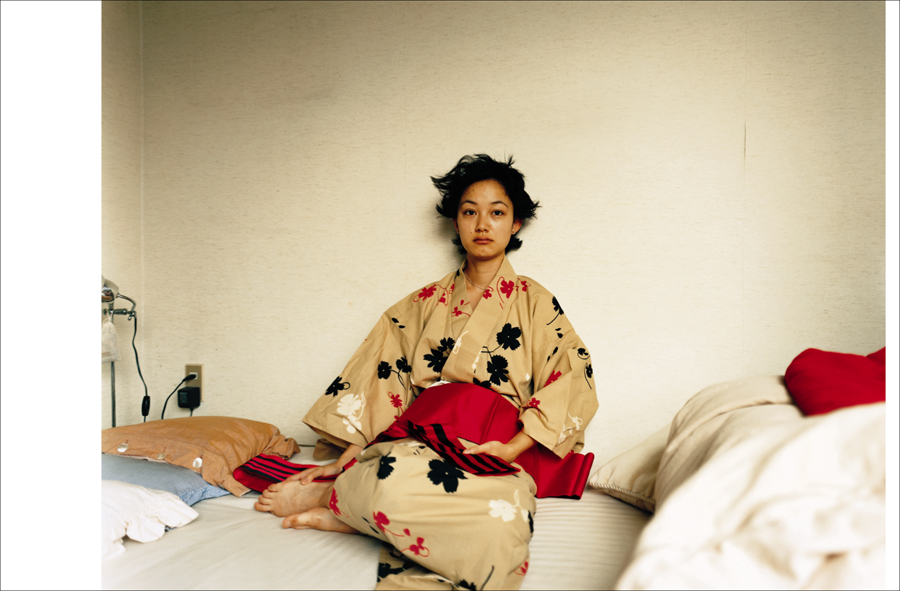
An image that I like very much is a diptych story by Shingo Wakagi that was shot for my magazine Famous Aspect. The series is titled Tokyo Modern. One image shows a still life of beautiful weathered flowers, the other a girl in a kimono sitting on a bed in an apartment. There is an air of intimacy and distance that I really like and it reflects some of the ambiguities expressed above. Looking at it you have no sense of time. It is a fashion image yet there is no fashion there. It is sad yet beautiful. Close but unreachable.
Don’t let his personal selection for this Japan Exposures gallery mislead you: Arimoto doesn’t only do street portraits. Visit his thoughtfully designed home page and you will find a good variety of photographs taken on the streets in Japan or other locations such as Tibet (recommended series “Why Now Tibet?”).
What shines through all his images is the gentle approach to his subjects, respectful and yet with a powerful, and at times uncomfortable, quiet undercurrent. Street photography is no longer a niche pursuit, however finding interesting angles of approach is a challenge. I believe that in this genre the photographer’s own personality makes a visible difference in the resulting photographs. I enjoyed looking at Arimoto’s street portraits because you can sense a that these were not images taken by a passing snapper, but someone who bothered to engage on the way. The photos date back over several years, with series named systematically as ariphoto vol. x and no other titles or captions that would shed some light on a context for the viewer. We can see a spectrum of subjects ranging from attractive women to what appear to be homeless people. The reasons for making this photograph is not clear to the viewer and those seeking such clarity might find Arimoto’s photographs a suitable exercise to tolerate a greater element of the unsaid when looking at images.
Shinya Arimoto was born in Osaka in 1971. He graduated from Osaka School of Visual Arts (whose faculty includes Daido Moriyama) in 1994. Since his graduation he held numerous exhibitions and since 2006 is a represented member of Totem Pole Photo Gallery. A solo exhibition titled 「ariphoto selection vol.1ã€is held at the gallery from 6-11 July 2010.